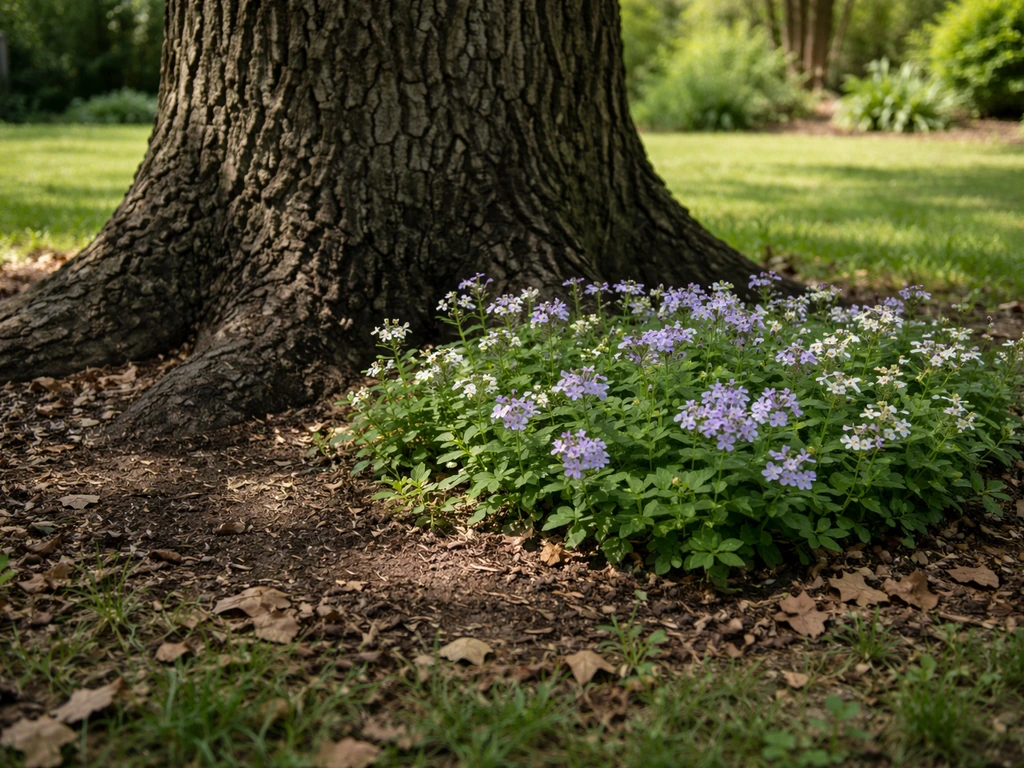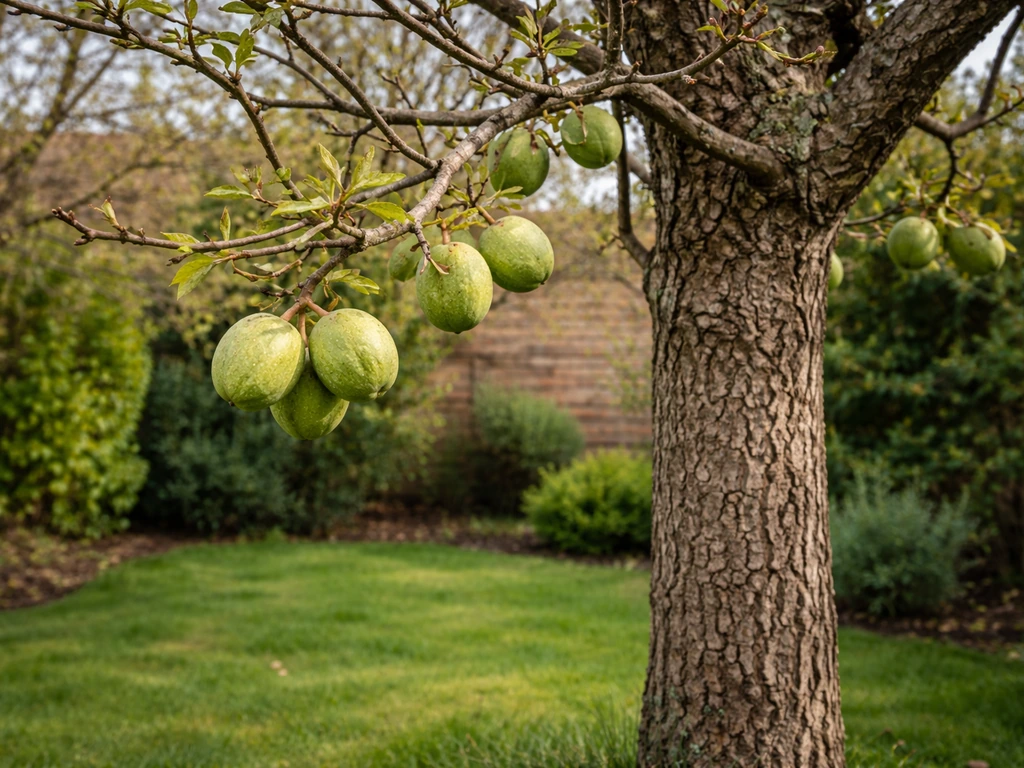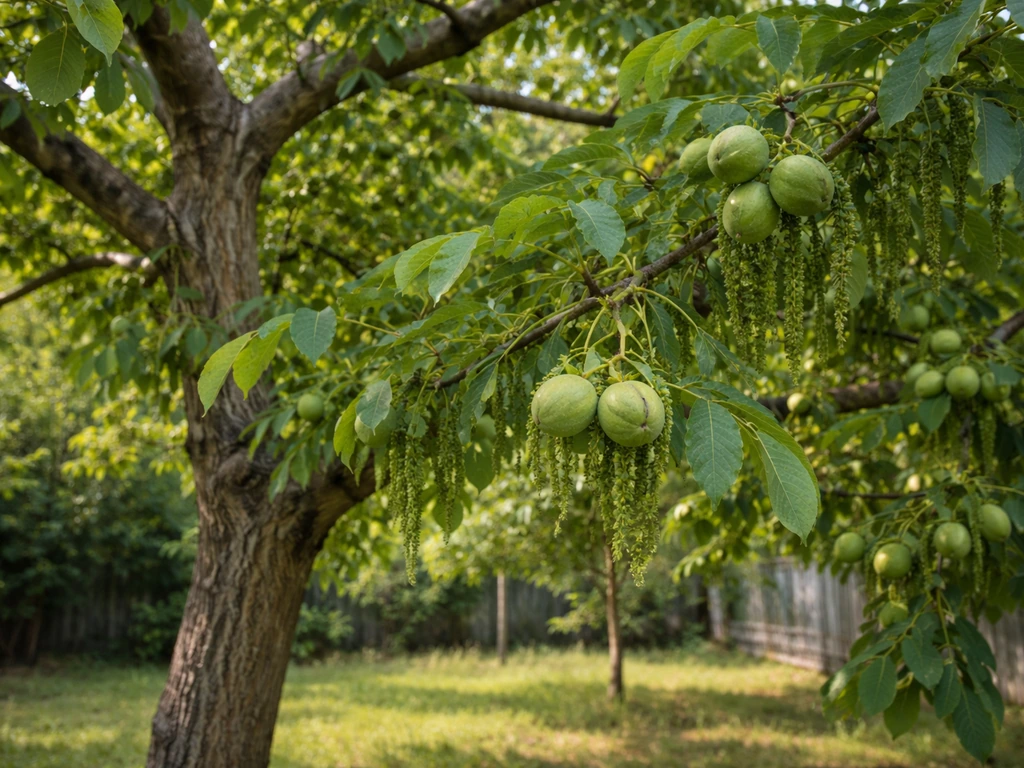
A mature walnut tree in active growth needs roughly 1. 5 to 2. 5 inches of water per week during peak summer, which translates to somewhere between 200 and 500+ gallons per week depending on tree size, climate, and soil. If you're also planning companion plants, it helps to consider what can grow near walnut trees since their roots and leaf litter can affect nearby soil moisture and chemistry.
How Much Water Does It Take to Grow a Walnut
Marcus Hendricks
16 May 2026
A young tree in its first season needs far less in volume but needs it more consistently: around 3 to 5 gallons per week to keep the root zone moist while the tree establishes. Those numbers are a starting point, not a fixed schedule. The real work is figuring out what your specific tree, soil, and climate actually demand, and then verifying that your irrigation is delivering water where and how deep it needs to go.
Walnut water needs from seedling to mature tree
Walnut water needs shift dramatically as the tree ages, and treating every stage the same is one of the most common mistakes new growers make.
Year 1 and 2: establishment is everything
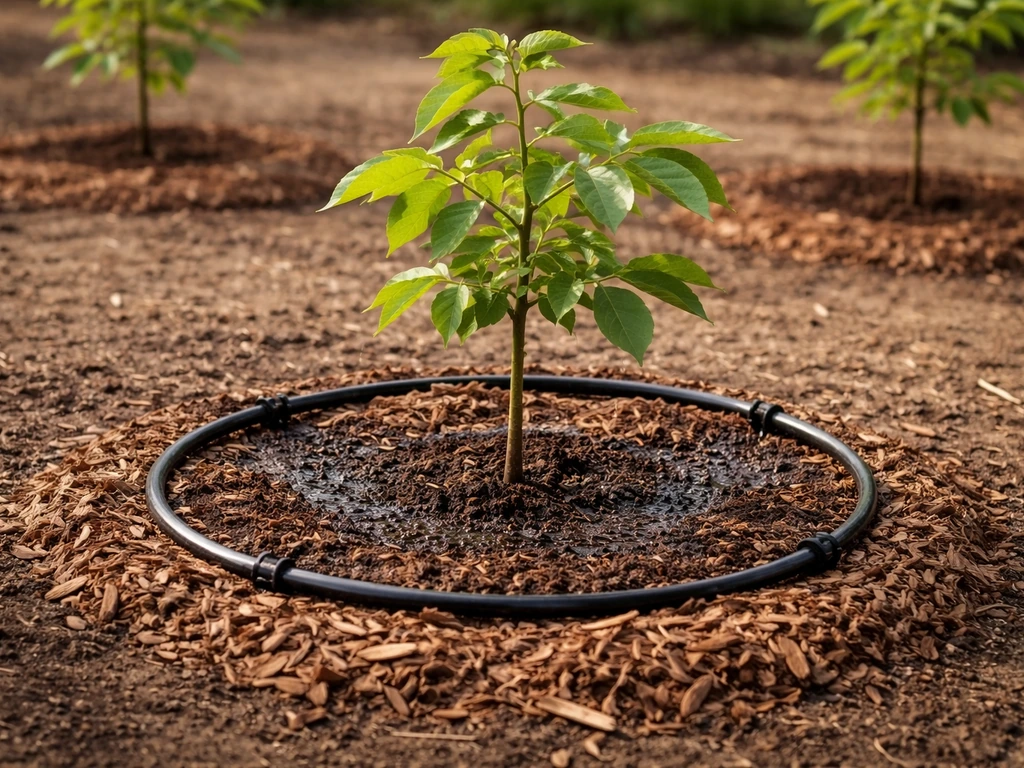
Newly planted walnut trees, whether started from a nut or transplanted as a sapling, need supplemental irrigation for at least two full years after going in the ground. During this phase, the goal isn't maximum growth, it's root establishment. The root system is small and can't yet pull moisture from a wide area, so you're watering a fairly tight zone around the trunk. About 3 to 5 gallons per week is a reasonable starting point for a young tree in a temperate climate, applied slowly so it soaks in rather than running off. Sandy soils will need more frequent applications; heavier clay soils hold moisture longer and need less frequent watering but benefit from slower delivery to avoid waterlogging.
Years 3 through 6: the juvenile growth phase
Once the tree is established, water demand increases alongside the expanding canopy and root zone. Shoot growth is vigorous during this phase, and consistent moisture during spring and early summer directly affects how much structural growth you get each year. Irrigation strategy during this period starts to shift toward tracking plant water status rather than just following a calendar. Pressure chamber readings and soil moisture sensors become genuinely useful here, especially in drier climates, because the consequences of stress during active growth can show up as reduced shoot extension that you can't recover later in the season.
Mature bearing trees: water demand peaks and shifts seasonally
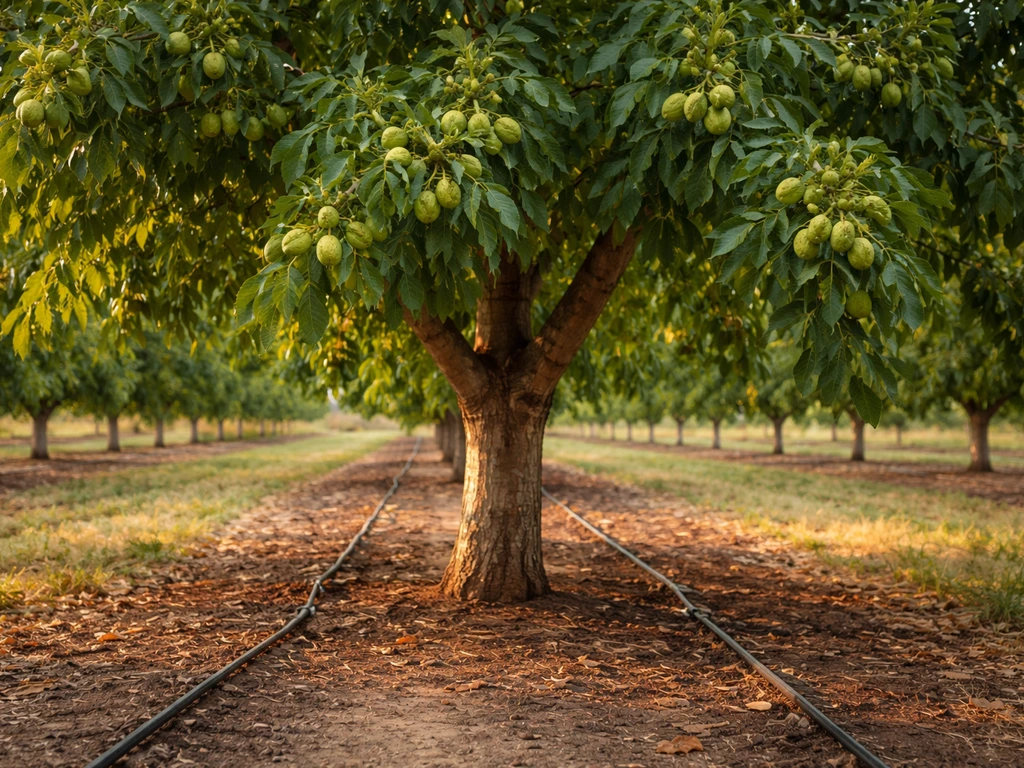
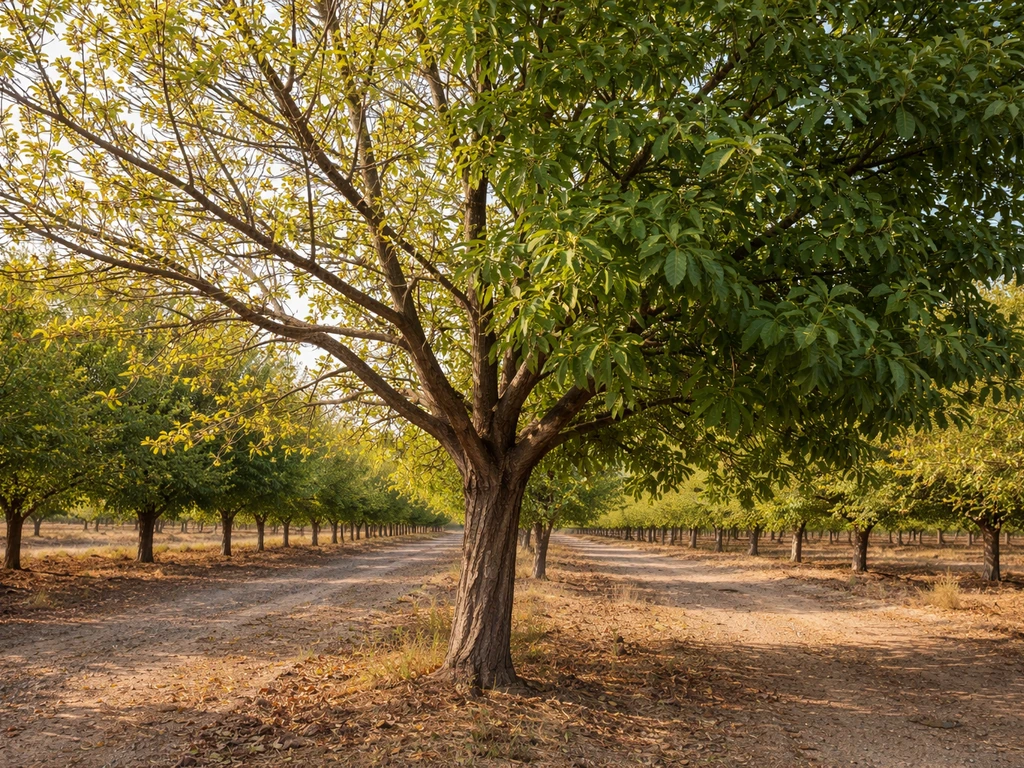
A fully mature walnut tree, especially in an orchard setting, has very high water demand from late spring through early fall. Demand peaks during hull split and nut fill (mid to late summer), when water stress directly reduces kernel quality and yield. In California walnut production regions, weekly evapotranspiration-based water needs during peak summer often run 2 inches or more per week for the orchard as a whole. By September, that drops to roughly 1.0 to 1.5 inches per week, and by October, you're typically looking at just 0.4 to 0.8 inches per week as the tree winds down before dormancy.
Seasonal water amounts you can use as a starting estimate
Here's a season-by-season breakdown for a mature walnut tree in a temperate climate with warm summers. These are approximate weekly targets that assume no significant rainfall is contributing.
| Season / Period | Approximate Weekly Water Need | What's Happening |
|---|---|---|
| Early spring (bud break to leaf-out) | 0.5 – 1.0 inches | Shoot growth beginning; demand is moderate |
| Late spring (active shoot growth) | 1.0 – 1.5 inches | Rapid vegetative growth; demand rising |
| Peak summer (nut fill, hull development) | 1.5 – 2.5 inches | Highest demand; stress here cuts yield and quality |
| September (approaching harvest) | 1.0 – 1.5 inches | Nut maturing; demand declining but still significant |
| October (post-harvest, leaf drop) | 0.4 – 0.8 inches | Tree winding down; minimal irrigation needed |
| Dormancy (winter) | Little to none | Tree dormant; rely on rainfall unless extremely dry |
For a home garden tree rather than a commercial orchard, total annual water demand for a mature English walnut in a climate like California's Central Valley can run 40 to 60 inches of total water per year when you account for evapotranspiration across the full season. In cooler, wetter climates (parts of the Pacific Northwest, much of Europe), natural rainfall covers a larger portion of that, and supplemental irrigation needs drop considerably. Black walnuts native to the eastern U.S. tend to be more drought-adapted once established and often need less supplemental water in humid climates.
How to calculate watering for your specific yard
The most reliable method for figuring out how much to water your walnut is the evapotranspiration (ETc) approach. It sounds technical, but the practical version is fairly straightforward: you take the reference ET for your local weather (available from many state and regional agricultural weather services) and multiply it by a crop coefficient (Kc) for walnuts. The result is the crop water use, expressed in inches per day or week. This is the standard FAO methodology, and it accounts for actual weather conditions rather than assuming averages.
Walnut Kc values typically range from around 0.9 to 1.1 during peak growth, which means walnuts use slightly more water than the reference grass evapotranspiration benchmark in hot, dry conditions. If your local reference ET is running 0.25 inches per day in July, your walnut tree's estimated daily water use is roughly 0.25 × 1.0 = 0.25 inches per day, or about 1.75 inches per week. From there, subtract whatever rain you've received and you have your irrigation deficit.
Adjusting for soil type, tree size, and mulch
ETc gives you the water demand at the canopy level, but how you deliver and retain that water depends on your site. A few practical adjustments to keep in mind:
- Sandy soils drain fast and hold less water per inch of depth, so you'll need more frequent applications to keep the root zone adequately moist, even if total weekly volume is similar.
- Clay soils hold water longer but can waterlog if you apply too much at once. Slow, infrequent deep soaking works better than frequent light applications.
- Loam sits in the middle and is the most forgiving. Water moves through at a reasonable pace and is retained well.
- A 3 to 4 inch layer of wood chip or organic mulch over the root zone can reduce evaporative loss significantly, potentially cutting irrigation needs by 20 to 30 percent during hot weather.
- Tree size matters a lot for volume calculations. A 10-year-old tree with a 20-foot canopy spread needs water delivered across a much wider root zone than a 5-year-old tree. Always water at and beyond the drip line, not at the trunk.
- In hot, dry climates like the Southwest, tree water demand climbs faster than regional ET tables might suggest if the tree is in a south-facing or reflective heat zone.
Converting inches per week to gallons
To convert from inches per week to gallons, you need to know the area you're irrigating. One inch of water applied over 1,000 square feet equals approximately 623 gallons. So if your mature walnut has a canopy spread of roughly 30 feet in diameter (about 700 square feet of root zone area) and needs 1.5 inches per week, that's around 650 gallons per week. A smaller home garden tree with a 15-foot canopy might need 160 to 200 gallons per week at peak. Large trees can easily exceed 500 gallons per week during hot stretches, which is why USU Extension notes that large trees may require hundreds of gallons per week depending on size and location.
Signs you're watering too little or too much
Both under-watering and over-watering can hurt a walnut tree, and the symptoms sometimes overlap, which makes visual diagnosis tricky. Soil and plant monitoring gives you a more reliable read than leaves alone.
Under-watering signs
- Reduced shoot growth: if new growth is shorter than expected compared to prior seasons, water stress during spring is often the cause.
- Leaf margin scorch or premature leaf drop: walnut leaves will brown at the edges and drop early when the tree is heat- and drought-stressed.
- Shriveling or undersized nuts: sustained moderate to high water stress (stem water potential below roughly -8 bars) during nut fill directly reduces kernel development.
- Dry soil below 6 inches when probed: if a screwdriver or moisture probe doesn't penetrate easily past a few inches, the root zone is too dry.
- Wilting during the hottest part of the day that doesn't recover by morning: temporary midday wilting is normal, but if leaves haven't recovered by early morning, the tree is stressed.
Over-watering signs
- Yellowing leaves (chlorosis) that isn't explained by nutrient deficiency: waterlogged roots can't take up oxygen, which disrupts nutrient absorption.
- Soft, mushy soil that stays wet for several days after irrigation: this is a red flag for root rot conditions, which walnuts are particularly susceptible to (Phytophthora root and crown rot).
- Crown rot symptoms: bark discoloration or bleeding at the base of the trunk, especially when combined with wet soils near the trunk, often points to overwatering.
- Standing water around the root zone: walnuts do not tolerate waterlogged soil. Good drainage is not optional.
- Stunted growth despite adequate nutrition: this is a classic symptom of roots that can't function because they're oxygen-deprived.
Using soil moisture tools to verify
The most reliable way to catch problems early is to actually measure soil moisture at root zone depth, not just check the surface. A tensiometer or capacitance-based moisture sensor placed at 18 to 24 inches depth (roughly mid-root zone for a mature walnut) gives you real-time feedback on whether water is penetrating and being used.
If you don't have sensors, use a soil probe or a long screwdriver to check penetration and feel the soil at 12 and 24 inches after each irrigation event. The goal is moisture you can feel, but not saturation. OSU Extension recommends evaluating soil moisture in increments down to the crop's effective rooting depth to confirm where moisture is being depleted and where irrigation water is actually reaching.
Best irrigation methods and how to schedule them
Drip irrigation
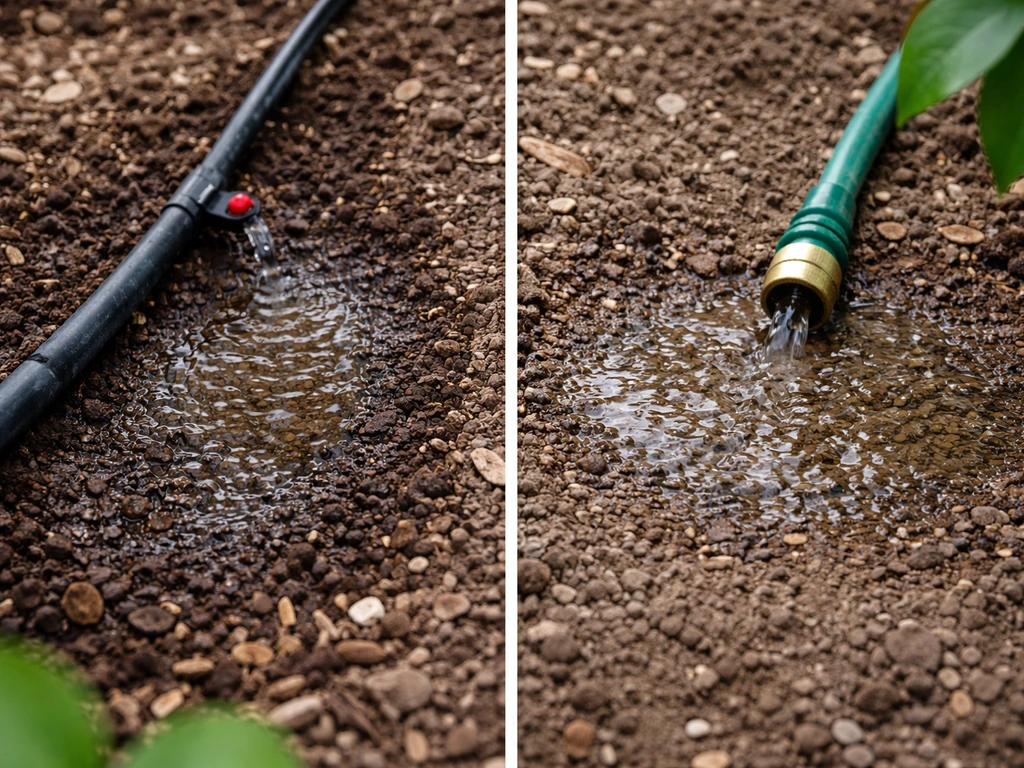
Drip is the most efficient method for established walnut trees in dry climates. Water is delivered slowly at or below the soil surface, minimizing evaporation and keeping foliage dry (which matters because wet leaves can increase disease pressure in walnuts).
UC IPM walnut guidance also emphasizes irrigation and cultural precautions that help avoid conditions that injure green tissue, which can influence which watering approach you choose when you need to manage leaf-wetting and related disease risk irrigation and cultural precautions that help avoid injuring green tissue.
UC ANR microirrigation guidance recommends wetting about 30 to 60 percent of the orchard root zone volume. For a home tree, that means arranging emitters in a ring around and beyond the drip line, not clustered at the trunk. A typical setup might use emitters rated at 1 to 2 gallons per hour, with run times calculated to deliver the weekly water need in 2 to 3 sessions.
Deep soaking (basin or flood)
For home garden trees without drip infrastructure, deep soaking by hose or soaker hose around the drip line works well. The key word is deep: a slow, long soak that wets the soil to 24 to 36 inches is far more effective than a quick surface wetting. A good rule of thumb is to run the hose slowly for 45 to 90 minutes in a slow circle around the drip line, let it move to the next spot, and check penetration with a probe afterward. UC IPM specifically recommends using a hose, soaker hose, or drip at the drip line and beyond.
Sprinklers
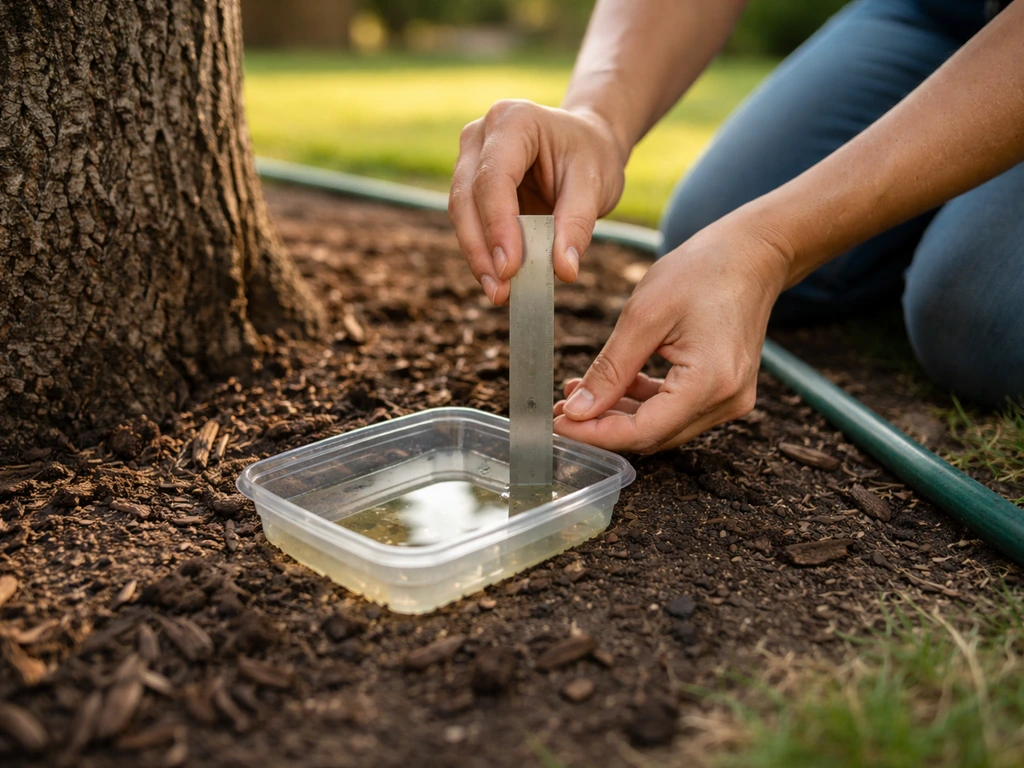
Overhead sprinklers are less ideal for walnuts for two reasons: they wet the foliage and green tissue, which can encourage fungal disease, and they're less efficient in hot, windy conditions due to evaporation losses. If overhead irrigation is your only option, run it in early morning so foliage dries quickly and minimize wetting frequency. To verify how much water you're actually applying, place straight-sided cups or rain gauges in the irrigation zone and measure the catch after a typical irrigation cycle. A catch of 0.5 inches per cycle three days per week gives you 1.5 inches per week total, which is a useful benchmark during peak summer.
Scheduling frequency and depth
For established trees, fewer, deeper waterings are better than frequent shallow ones. Two to three deep waterings per week during peak summer is usually more effective than daily light watering. The goal is to wet the soil to the full rooting depth (18 to 36 inches for an established walnut), let it partially dry down, and then recharge it. Shorter irrigation intervals with less water per session may be appropriate when trees show signs of stress, but extending intervals too long is what causes problems: the soil dries out faster than the tree can signal it, and by the time you see leaf symptoms, the tree has already been under stress for days.
Managing water during drought and unusually wet periods
What to do in drought
When water is genuinely limited, regulated deficit irrigation (RDI) is a managed strategy that reduces water to walnuts at specific, less-critical growth stages while protecting supply during the most sensitive periods. The framework is simple: hull split and nut fill in midsummer are non-negotiable for yield and quality. Modest reductions during late spring (after shoot growth is established) and post-harvest are more tolerable. Sustained stem water potential below about -8 bars during critical periods can affect both crop productivity and long-term tree health, so that's your floor. In a real drought, prioritize irrigation during July through September over everything else.
Practical steps during drought include: adding mulch immediately to reduce evaporative loss from the root zone, reducing cover crop competition in home settings, monitoring soil moisture more frequently, and considering temporary shading for young trees (which are more vulnerable than established ones). If you're choosing which trees in a mixed garden to prioritize, a young walnut in its first or second year is actually more drought-vulnerable than a well-established mature tree, because it simply doesn't have the root depth to access deeper soil moisture.
What to do in unusually wet periods
In wet springs or rainy summers, the risk flips to overwatering and root disease. The most important step is to stop supplemental irrigation entirely when rainfall is meeting or exceeding weekly ETc demand. Track cumulative rainfall against your weekly target and subtract it from your irrigation schedule. Beyond cutting back irrigation, check that soil drainage is adequate.
If water is pooling near the root zone after rain, that's a site problem that no irrigation schedule adjustment will fix. Improving drainage around young trees (raised planting beds, amended backfill) is worth addressing early. For established trees in poorly drained sites, the main lever you have is to keep irrigation off completely during wet periods and accept that the site may not be ideal.
English/Persian walnut vs black walnut, and orchard vs home garden
Not all walnuts have the same water requirements, and the differences are meaningful enough to affect how you approach irrigation. If you're trying to decide which species to grow, the best walnut tree for your situation depends heavily on your climate, and water management is part of that picture.
English/Persian walnut (Juglans regia)
This is the commercially dominant species and the one most research, including the California walnut irrigation data referenced throughout this article, is based on. English walnut is moderately drought-tolerant once established but is not as tough as black walnut, and commercial yields are very sensitive to water stress during nut fill. In arid growing regions, supplemental irrigation is essential from spring through harvest. Annual crop water use can reach 40 to 60 inches in hot, dry climates. English walnut prefers deep, well-drained soils where roots can access moisture from depth, which is why it performs best in valley floor conditions with good irrigation infrastructure.
Black walnut (Juglans nigra)
Black walnut is native to the eastern United States and is considerably more drought-resilient than English walnut once established, partly because it develops a deeper and more aggressive root system. In its native range, it rarely needs supplemental irrigation after the first couple of years. In drier western climates or during establishment, it still benefits from consistent moisture, but it handles periodic dry spells better than English walnut without showing yield collapse.
If you're growing in a humid-summer climate and wondering whether you can grow walnut without irrigation infrastructure, black walnut is almost certainly the better bet. The trade-off is that black walnut produces smaller, harder-shelled nuts with a stronger flavor, and the juglone it releases from its roots affects what can grow nearby.
Orchard vs home garden irrigation
Commercial orchard irrigation is calculated on a per-acre basis, and when you see reports quoting inches per week, that figure represents the total evapotranspiration across the entire orchard footprint, including all vegetation. Converting to gallons per acre is straightforward: 1 inch of water per acre equals roughly 27,154 gallons. For a home garden tree, you're working at a much smaller scale and should think in terms of the specific root zone area under and beyond the canopy. The principles are the same; the scale and precision requirements are different. A home grower doesn't need a pressure chamber, but they do need a soil probe and a willingness to check moisture at depth rather than just watering on a fixed schedule.
Your practical next steps
Here's how to put this into action today, regardless of where you are in the growing season:
- Find your local reference ET (ETo) data. Most U.S. states have agricultural weather networks (CIMIS in California, AgriMet in the Pacific Northwest, CoAgMet in Colorado) that publish weekly ETo values by location. Look up your nearest station.
- Multiply ETo by a Kc of roughly 1.0 for peak-season walnut to get your weekly crop water demand in inches.
- Subtract any rainfall you've received that week from that number to get your irrigation deficit.
- Convert inches to gallons using the canopy area of your tree (area in square feet × inches needed × 0.623 = gallons needed).
- Check your soil moisture at 12 and 24 inches depth before and after irrigation to confirm water is penetrating to root zone depth and that you're not overshooting.
- Adjust your schedule based on what you see: dry at 18 inches after a few days means you need more volume or frequency; still wet at 24 inches three days later means you're overwatering.
- Add mulch to the root zone if you haven't already. A 3 to 4 inch layer over the root zone is one of the single most cost-effective steps you can take to reduce water demand.
- Water at the drip line and outward, not at the trunk. Keep irrigation water away from the crown and bark at the base of the tree.
Walnut is a tree that rewards careful water management more than most. Get the soil moisture right during the critical summer window and you'll see it in healthier shoot growth, better nut fill, and fewer disease problems. The numbers in this guide give you a defensible starting point; the soil probe and your own observations will tell you where to go from there. If you're starting from a nut and wondering, “will a walnut grow into a tree,” the early establishment watering guidance in this article is the key first step.
FAQ
If I know the weekly gallons, how many times per week should I irrigate my walnut?
No, weekly totals are only the starting point. The key is delivering that volume in a way that wets the soil to the walnut’s effective rooting depth. If your soil is sandy, you usually need shorter, more frequent run times to reach depth without runoff, while heavier clay may require longer, slower irrigation so water can infiltrate instead of pooling.
Is it better to water a walnut daily or fewer deeper sessions?
Assuming your soil is draining well and you irrigate slowly, the tree can tolerate a longer interval better than a schedule that repeatedly wets only the surface. Shallow, frequent watering encourages roots to stay high where they dry out faster. A practical check is to probe at 12 and 24 inches after irrigation, you want moisture you can feel at depth, not just dampness at the top few inches.
How can I tell if yellowing or wilting is from too much or too little water?
Watch for changes in soil moisture at root-zone depth, not leaf color alone. Wilting, scorch, and slow shoot extension can show up with both under-watering and over-watering because saturated roots can’t take up oxygen. If soil at 18 to 24 inches stays wet for multiple days, reduce irrigation and verify drainage.
Do walnut water needs change during heat waves or windy weeks?
At peak summer, temperature and wind can increase daily evapotranspiration, so the “inches per week” target may shift during heat waves. If you use the ETc approach, update the reference ET with current weather rather than relying on last month’s average. If you do not track ET, compensate by monitoring soil moisture trends, you can’t safely assume the same schedule will hold through sudden hot spells.
How do I confirm my irrigation system is delivering the water amount I calculated?
Yes. Even if your weekly total is right, a slow leak or miscalculated emitter output can cut the effective water delivered to the root zone. A simple way to verify is to measure catch in rain-gauge cups or place a bucket under the system outlet(s) for a known run time, then compare actual delivered volume to what you planned.
If I add mulch, should I still water the same amount?
Mulch changes how much supplemental irrigation you need, because it reduces evaporation from the soil surface. However, mulch can also mask symptoms of overwatering. Use soil probes to decide, if the root zone is staying moist at 18 to 24 inches, you should cut back even if mulch makes the top look dry.
What should I do about walnut watering during rainy seasons?
If rainfall frequently covers your weekly crop water use, you may need little or no supplemental irrigation. The practical rule is to subtract effective rainfall from your weekly ETc deficit, but also check soil drainage. If water remains pooled near the trunk after a storm, stop irrigating and focus on improving drainage rather than trying to compensate with less water later.
Should I change emitter placement or hose coverage as my walnut grows?
Yes, because walnuts do not have uniform rooting depth early on. Newly planted trees have a smaller effective root zone, so watering should stay concentrated near the trunk and be applied more consistently to keep that zone moist. As roots expand, you can gradually widen the irrigated area toward and beyond the drip line.
When during the year can I reduce watering without hurting nut quality?
Too early in the season can increase risk of late flush issues and disease pressure, and too late can reduce nut quality and timing of wind-down before dormancy. Instead of relying on a fixed calendar, follow growth stages: prioritize consistent moisture through shoot growth, and keep irrigation strong through hull split and nut fill, then taper as temperatures drop and ETc falls.
What’s the safest way to cut water when water supply is limited?
If you have water to spare, avoid frequent “partial wetting” because it may not reach mid-root depth. If water is limited, deficit strategies should still protect hull split and nut fill (the non-negotiable window) and ensure the tree does not fall into prolonged severe water stress. The decision aid is to monitor soil moisture at 18 to 24 inches, so you can maintain enough depth moisture during critical weeks.
What if my walnut seems to be struggling even when I’m watering correctly?
If the soil is not draining, even perfect scheduling can fail because oxygen starvation can damage roots. Before changing irrigation amounts, verify by observing drainage behavior after rain or irrigation, water pooling is a red flag. Improving drainage with raised beds or amended backfill is often more effective than trying to “water less” on a site that stays saturated.
If I must use overhead sprinklers, how can I minimize problems for my walnut?
A common guideline is to avoid wetting foliage during warm weather, especially if disease pressure is an issue. If you only have overhead irrigation, run it early morning so leaves dry quickly, and reduce frequency rather than watering lightly every day. You can also verify actual applied water with catch cups to ensure you’re not overapplying during evaporation losses.