Walnuts grow across a surprisingly wide swath of the United States, but the answer depends heavily on which species you mean. Black walnut (Juglans nigra) is native to the eastern US and grows wild from the Great Plains to the Atlantic Coast. English walnut (Juglans regia), the kind you buy at the grocery store, is the dominant commercial crop and thrives mainly in California's Central Valley. Get those two mixed up and you'll end up with either the wrong expectations or the wrong tree in the ground.
Where Do Walnuts Grow in the US: Regions and Growing Zones
Marcus Hendricks
11 Apr 2026
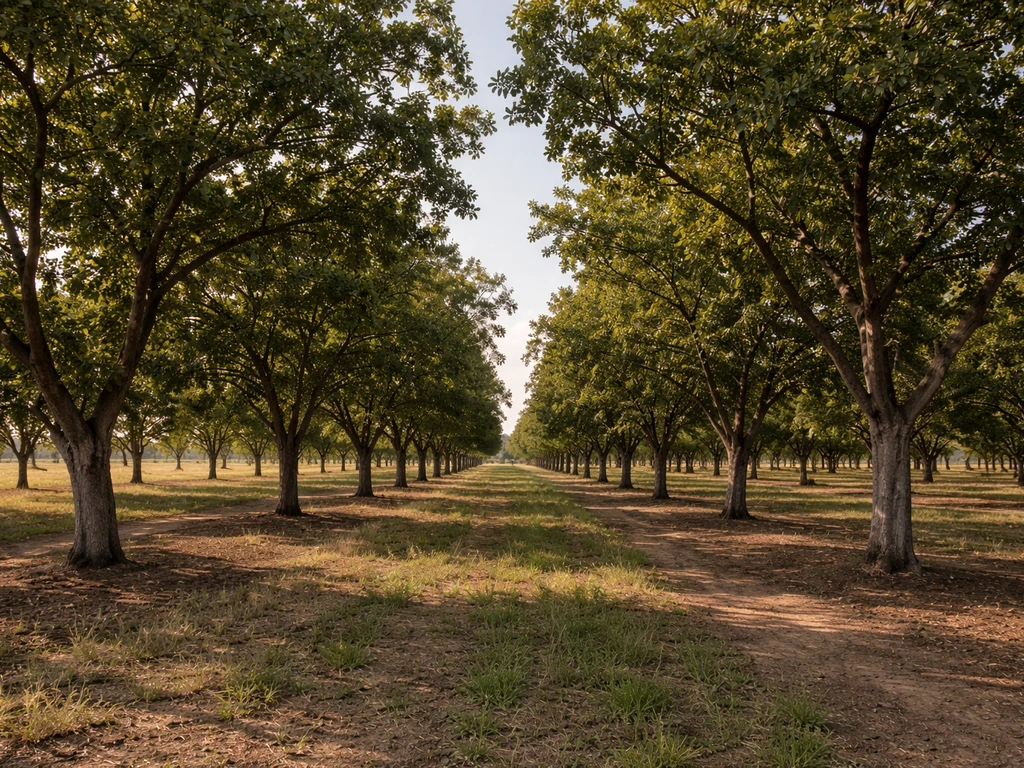
Walnut tree basics and key species in the US
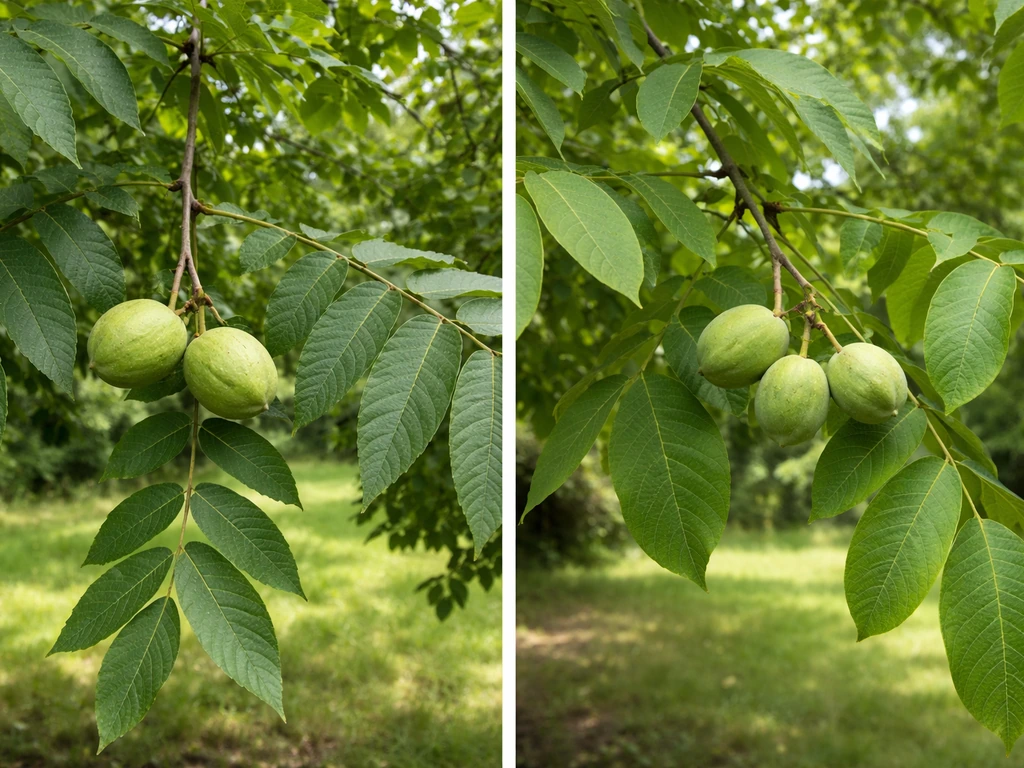
Three walnut species matter most for US growers. Black walnut is the native powerhouse of the East and Midwest, valued for both its timber and its richly flavored nuts. English walnut (also called Persian walnut) is the commercial standard, grown at industrial scale in California and in smaller quantities across the West and parts of the South. Butternut (Juglans cinerea), sometimes called white walnut, is a third native species distributed across the Northeast and upper Midwest, though it's been hit hard by butternut canker disease and is far less common today. There's also Arizona walnut (Juglans major), a smaller tree native to the desert Southwest with occurrence records across parts of New Mexico, Arizona, and Texas. If you're deciding what to plant or trying to understand what you've found growing near you, knowing which species you're dealing with changes almost everything about how you interpret the growing conditions.
Understanding how walnuts grow from a biological standpoint helps clarify why these species have such different regional footprints. Black walnut is a cold-hardy, deep-rooted hardwood adapted to rich bottomland and upland soils. English walnut is more cold-sensitive but responds well to the mild, dry winters and long, warm summers of California's interior valleys. Neither tree is a casual, low-maintenance planting, but both reward the right location.
Native range: where walnuts naturally grow
Black walnut is found throughout the eastern United States according to the US Forest Service, and the USDA Forest Service includes a natural range map for the species showing its spread across most of the eastern half of the country. It's concentrated in the central Appalachian region and the Midwest, particularly in states like Missouri, Ohio, Indiana, Illinois, Kansas, and Kentucky, but it extends south into the Gulf States and north into southern New England and the Great Lakes region. Flowering time shifts significantly with latitude: trees in the southern part of the range begin flowering around mid-April, while those at northern latitudes don't start until mid-June.
Butternut's native range overlaps with black walnut's in the Northeast and upper Midwest but doesn't extend as far south or west. The Forest Service's Silvics of North America documents its distribution and ecological context in detail, noting it as a species of mixed northern hardwood forests. It's worth knowing butternut exists, but for practical growing purposes most US gardeners will be working with black walnut or English walnut.
If you want to see exactly where black walnut has been documented at the county level, the Biota of North America Program (BONAP) maintains county-level distribution maps for Juglans nigra. The US Fish and Wildlife Service also has an interactive species page for black walnut with occurrence mapping that's useful for confirming presence in your area. These are reliable, free tools and worth bookmarking before you spend money on trees.
Best-growing regions by climate
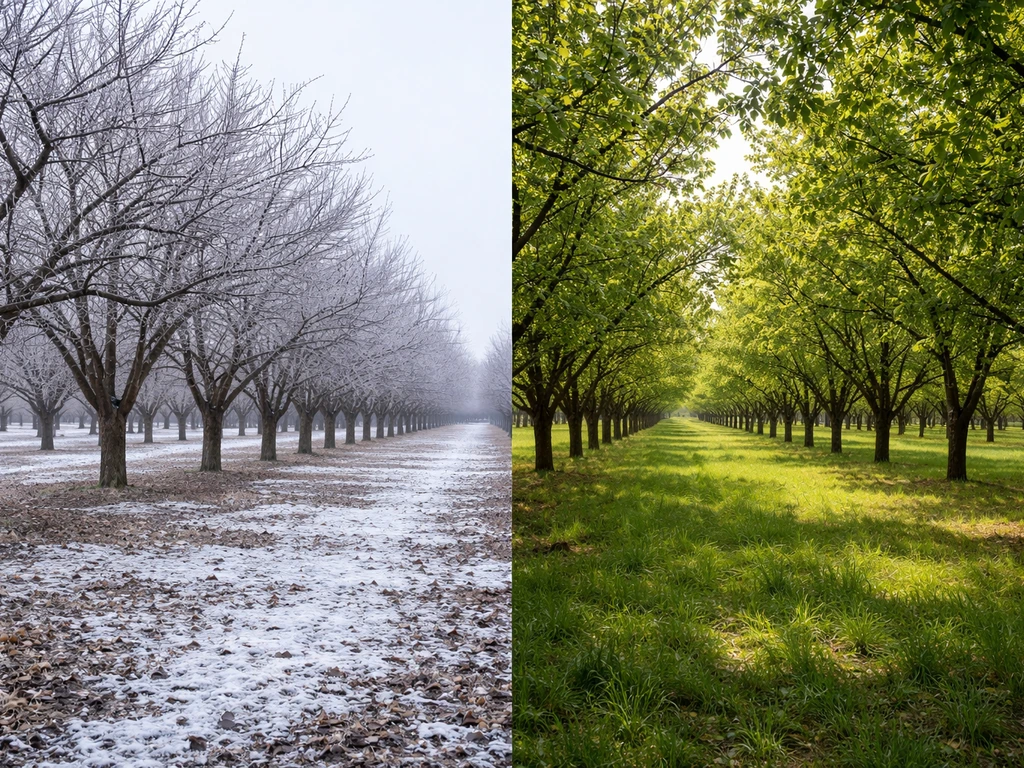
Climate is where the two main species diverge sharply. If you want to understand the full picture, it helps to look at what climate walnuts grow in before committing to either species. The short version: black walnut is suited to USDA Hardiness Zones 4 through 9, while English walnut is generally best in Zones 5 through 9, with the commercial sweet spot in California's Zone 9 valleys.
English walnut has a meaningful winter chilling requirement, typically somewhere in the range of 400 to 1,500 hours below 45°F depending on cultivar. The USDA NASS 2024 California walnut production forecast specifically flagged that 2024 chilling hours were low, which affects bloom timing and nut set. That's not an abstract concern: inadequate chilling disrupts the synchrony between male and female flowers, reducing pollination and shrinking nut size. In climates with unpredictable or insufficient winters, English walnut production becomes a gamble.
Black walnut is more cold-tolerant but can struggle in the deep South where summers are extremely humid and soils tend to be heavier and poorly drained. It also doesn't do well above Zone 4 in terms of nut production, since early frosts can damage crops and shorten the growing season too much for nuts to fill out properly. The Midwest and Mid-Atlantic offer the most reliable conditions for black walnut.
A practical regional guide: where to find or grow walnuts by area
| Region | Best Species | Hardiness Zones | Notes |
|---|---|---|---|
| California Central Valley | English walnut (Juglans regia) | 8–9 | Primary commercial production area; Chandler and Howard are dominant cultivars |
| Pacific Northwest (Oregon, Washington) | English walnut | 6–8 | Viable in valley lowlands; maritime climates can lack enough summer heat |
| Midwest (MO, OH, IN, IL, KS) | Black walnut | 5–7 | Core of black walnut's native range; ideal soils and climate |
| Mid-Atlantic and Appalachians | Black walnut | 5–7 | Strong native presence; also suits English walnut in warmer, southern pockets |
| Southeast (GA, AL, MS) | Black walnut (limited) | 7–9 | Humidity and drainage issues; English walnut rarely suitable here |
| Northeast (NY, PA, New England) | Black walnut, Butternut | 4–6 | Black walnut grows well in PA and NY; butternut historically common but now declining |
| Great Plains (KS, NE, OK) | Black walnut | 5–7 | Native range edge; drought stress is a concern in western portions |
| Southwest (AZ, NM, TX) | Arizona walnut (Juglans major) | 6–9 | Arizona walnut is native here; English and black walnut are marginal |
| Mountain West (CO, UT, ID) | Black walnut (selected sites) | 4–7 | Limited to lower-elevation valleys with adequate frost-free season |
California deserves special attention because it's the engine of US walnut production. Where walnuts grow in California is its own detailed subject, but the core of it is this: the Sacramento and San Joaquin valleys provide the combination of cold but not severe winters, hot dry summers, and deep alluvial soils that English walnut thrives in. Yolo, Tulare, San Joaquin, and Stanislaus counties together produce a massive share of the US commercial crop.
For anyone curious about growing conditions just across the northern border, where walnuts grow in Canada follows similar rules: black walnut is present in southern Ontario, and English walnut is possible in the mildest parts of British Columbia's Lower Mainland, but the growing season constraints tighten significantly north of the US border.
Commercial production vs home garden reality
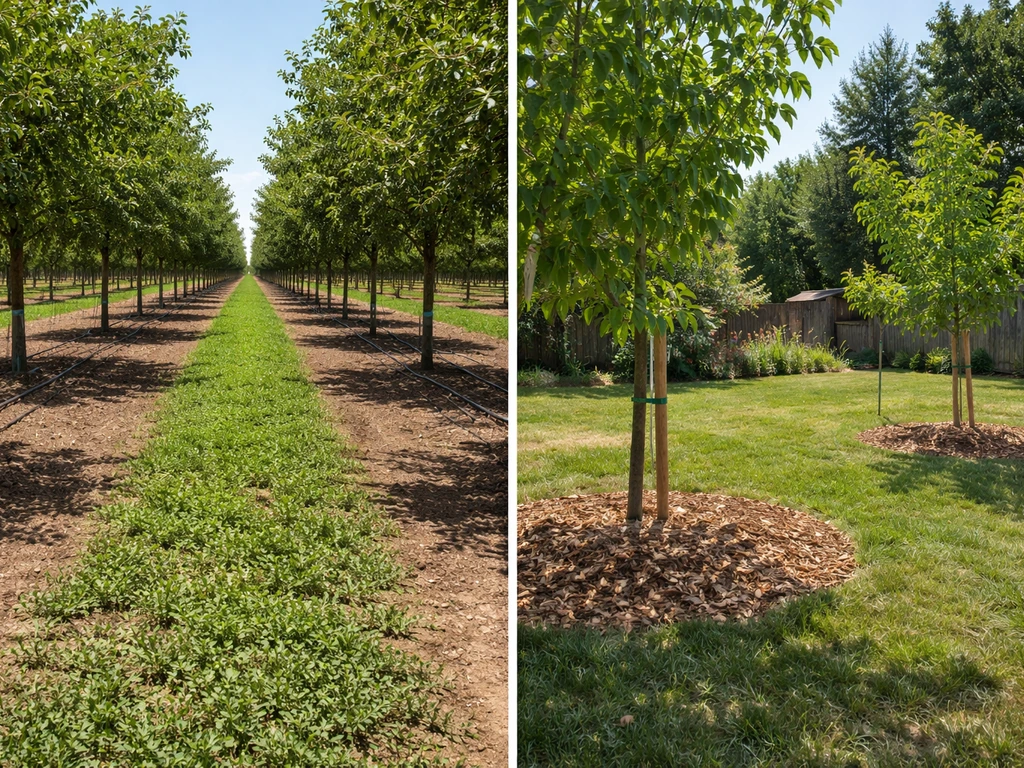
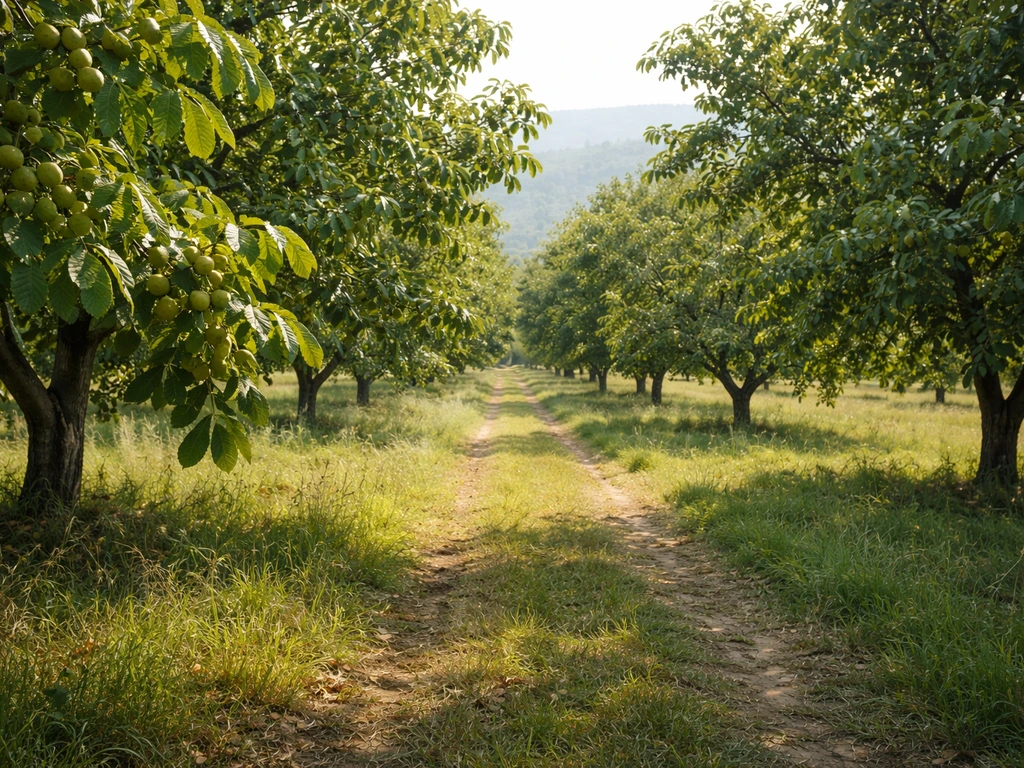
Commercial English walnut orchards in California are highly engineered operations. UC ANR's walnut fact sheet documents typical orchard spacings of 30 x 30 feet, 24 x 24 feet, and hedgerow configurations, with training systems built around a modified central leader approach. Cultivar selection matters enormously at commercial scale: Chandler is the dominant variety in new plantings because of its high yield and light kernel color, followed by Howard. Commercial operations also run carefully timed irrigation programs, since UC ANR notes that improper watering schedules can promote root disease.
Black walnut plantation culture in the Midwest follows a different model, focused more on timber value than nut production. Purdue Extension's plantation management guidance recommends an aggressive spacing of 12 x 12 feet (roughly 300 trees per acre) for plantation culture, with the expectation that trees will be thinned over time as the stand matures. This is very different from English walnut orchard design and reflects black walnut's role as a dual-purpose timber-and-nut tree.
Home gardeners planting either species face a simpler but still serious set of decisions. A single black walnut tree can work as a landscape tree that also produces nuts, but it needs space (both for its own canopy and because of juglone, discussed below). The University of New Hampshire Extension explains that juglone can accumulate in garden soils, including in saturated conditions, affecting plants in the root zone and dripline juglone, discussed below. A backyard English walnut is realistic in California or the Pacific Northwest with the right cultivar. Anywhere else, you're working against either climate or soil constraints, and you should go in with realistic expectations about yield and tree health.
What to check before you plant
Soil depth and drainage
Both species want deep, well-drained soil. For black walnut, extension resources point to a soil pH of 6.0 to 7.5 for best performance, with fertile loams or sandy loams being ideal. Purdue Extension narrows that for plantation culture to a pH of 6.5 to 7.2, emphasizing that drainage, compaction, and organic matter all interact. The US Forest Service Silvics notes that internal drainage and depth to gravel are key site characteristics for black walnut; shallow or gravelly soils limit root development and reduce both growth rate and nut yield. A compacted backyard corner or a spot with standing water after rain is not suitable for either species.
Chilling hours and heat
English walnut needs enough cold in winter to break dormancy properly but not so much cold that late frosts kill the flowers. Insufficient chilling disrupts the timing between male catkins and female flowers, a problem called dichogamy. Walnut flowers are wind-pollinated and monoecious (both sexes on the same tree), but because male and female flowers often open at different times on the same tree, good overlap between trees or across cultivars matters for nut set. UC Cooperative Extension research on spring bloom events in California walnuts specifically connects low chilling hours to disrupted bloom timing, reduced pollination, and smaller nuts. If your winters are too warm, this is a real yield problem, not just a theoretical one.
Juglone and companion planting
Black walnut produces juglone, a chemical compound present in its leaves, stems, and roots that inhibits the growth of many plants within the tree's root zone and dripline. In a r/NativePlantGardening discussion about black walnut and juglone, commenters share firsthand garden observations alongside an extension horticulturist perspective, highlighting where misinformation differs from lived results blank" rel="noopener noreferrer">misinformation versus lived garden experience. NC State Extension confirms this as a documented effect, and Purdue Extension has detailed guidance on black walnut toxicity and which plants are sensitive versus tolerant. Tomatoes, apples, blueberries, and many ornamental plants are among the sensitive species. The effects can persist in the soil even after a tree is removed. If you're planting a black walnut in a garden setting, plan the placement carefully and know what you can and can't grow nearby.
Sunlight and spacing
Both species are full-sun trees and perform poorly in shade. In a home garden context, you want a spot with at least 6 to 8 hours of direct sun daily. For spacing, even a single tree will eventually have a canopy spread of 40 to 60 feet for a mature black walnut, so don't underestimate the footprint. Commercial English walnut spacing (24 to 30 feet between trees in orchard rows) gives you a sense of the minimum elbow room a productive tree needs.
How to identify walnut trees near you and verify your location
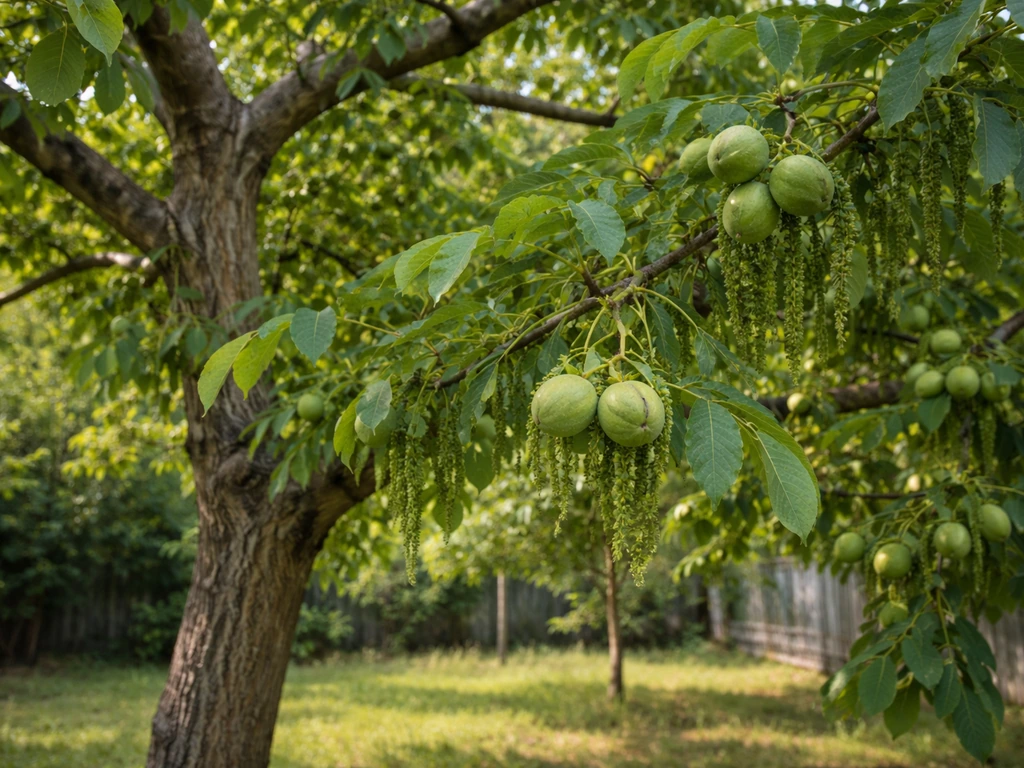
If you're trying to figure out whether walnut trees are already growing in your area, or whether you've spotted one on a hike or along a road, a few identification cues are reliable. Black walnut has large compound leaves (typically 15 to 23 leaflets), a distinctive round green husk around the nut in fall, and deeply furrowed dark bark on mature trees. Crushing a leaflet releases a strong, spicy, unmistakable smell. The nuts themselves stain anything they touch dark brown or black. Butternut looks similar but has sticky, more elongated husks and lighter bark.
To verify whether a specific species grows in your county, BONAP's county-level distribution maps are the best free tool available. The US Fish and Wildlife Service interactive map for black walnut is another solid option. For determining whether your site is climatically suitable, your state's Cooperative Extension service is the most practical resource: most land-grant university extension programs have walnut-specific publications, and some have county agents who can advise on local soil and microclimate conditions. For English walnut in California, UC ANR's fruit and nut resources are extremely detailed and freely available online.
If you want a broader view of where walnuts grow globally and how US distribution fits into the bigger picture, that context helps explain why certain species ended up adapted to certain climates. And if you're specifically focused on the commercially dominant type, the full details on where English walnuts grow go deeper into cultivar selection and regional suitability across the country.
The bottom line is this: if you're in the eastern or central US, black walnut is your native option and likely already growing somewhere near you. If you're in California or the milder parts of the Pacific Northwest, English walnut is realistic with the right cultivar and site. Everywhere else, you're looking at species that are possible but not easy, and you should do the local homework before investing in trees that will take years to produce. Start with your state extension service, check the county-level occurrence maps, and match the species to your hardiness zone and winter chill profile before you dig a single hole.
FAQ
How can I tell whether a walnut tree I see locally is black walnut or an English (Persian) walnut?
Look at the leaves and bark at maturity. Black walnut typically has compound leaves with many leaflets (often around 15 to 23) and very dark, deeply furrowed bark, plus a very distinct spicy smell when you crush a leaflet. The nut husk is usually round and green, and the tree can stain surfaces dark brown or black when nuts drop. English walnuts often look smoother or less deeply furrowed, and their husks are generally less round. If you want a confident ID, match the tree location to county-level occurrence maps for the species you suspect.
What if my USDA Hardiness Zone looks suitable, but walnuts still fail to produce nuts?
Zone alone can miss two common issues discussed in the article: winter chilling for English walnut and early frost length of season for black walnut. For English walnuts, too-warm winters can cause male and female flowers to miss each other, reducing pollination and nut size. For black walnuts, a warm-but-short season or early fall frosts can prevent nuts from filling. Also check site drainage, because both species underperform in compacted soil or spots that stay wet after rain, even if the zone is correct.
Can I plant just one walnut tree and still get nuts?
Walnuts are wind-pollinated and monoecious, but “one tree” still may not guarantee nut set because timing can differ for male catkins and female flowers on the same tree. If you have only a single tree, fruiting is more reliable when you choose cultivars whose bloom overlaps with local conditions. In commercial orchards, growers manage pollination with compatible cultivars, and that same logic applies to home plantings, especially in marginal chilling areas.
Do black walnut and English walnut need the same soil conditions?
They are similar on drainage and depth, but the sweet spots differ slightly. Both prefer deep, well-drained soil, but black walnut is often most successful in fertile loams or sandy loams with a soil pH roughly in the mid range (about 6.0 to 7.5). English walnut also depends strongly on having enough winter chill and avoiding overly wet or compacted ground, because root problems can follow poor water management.
Is juglone only a problem while the tree is still alive, or does it affect gardens afterward too?
It can persist. The article notes that the effects can remain in the soil even after the tree is removed, which means you should not assume cleanup is instantaneous. If you are planning beds for sensitive plants, choose placement well outside the projected canopy dripline and consider avoiding the most sensitive crops for multiple seasons after removal.
How far away should I plant vegetables, fruit bushes, or ornamentals from a black walnut?
A practical decision rule is to keep sensitive plants outside the mature tree’s dripline, not just a few feet from the trunk. Because the juglone effect is strongest in the root zone and can extend under the tree, you should plan on a wide buffer and test with local guidance for sensitive species. If your garden layout is tight, consider choosing tolerant plants or shifting those beds to a different part of the yard.
What should I do if I’m in a borderline climate for English walnut?
Treat chilling as the main risk, not just temperature highs or lows. Since English walnuts typically need substantial chilling hours to synchronize bloom, a site with unusually warm winters can lead to reduced pollination and smaller nuts. Before buying trees, verify expected local chilling using your state extension resources, and consider selecting a cultivar known to perform better under your winter profile, then plan for irrigation that supports consistent growth without promoting root disease.
Are walnuts hard to grow in the deep South or other hot, humid areas?
Black walnut can struggle there because of humidity, heavier soils, and site conditions that can limit performance, even though it tolerates cold better than English walnut. In practical terms, you need excellent internal drainage and careful soil prep, and you should expect that nut production is less consistent if early frosts and shorter seasons limit crop filling. For English walnut, you also risk insufficient chilling in warm regions.
If I want county-level confirmation, what’s the best way to use occurrence maps?
Use them to confirm likely presence, then verify with ground truth. County occurrence maps can show where a species has been documented, but they do not guarantee that every suitable spot in that county is currently producing nuts. Combine the map with the tree’s physical ID cues and with local extension guidance about soils and microclimates, because a single ravine, slope, or drainage difference can make a big difference for walnut establishment.
What’s the quickest way to check whether my specific site drains well enough for walnuts?
Do a simple drainage observation after a rain event. If water stands for a long time or the ground stays soggy, both black and English walnuts are poor candidates because they rely on depth and internal drainage for root development. Also watch for soil compaction, because compacted corners of a yard can cause chronic stress even when the broader yard seems sunny and warm.