Most palms don't grow true nuts at all, at least not in the botanical sense. What people usually mean when they ask about nuts on palm trees is the coconut, and technically that's a drupe (a fleshy fruit with a hard inner shell enclosing a seed), not a nut. A few other palms produce edible seeds or kernels that get lumped into the "nut" category in everyday language. The species worth knowing for edible production are coconut (Cocos nucifera), African oil palm (Elaeis guineensis), and date palm (Phoenix dactylifera), with a handful of others like açaí and peach palm rounding out the list. Every single one of them needs a frost-free tropical or subtropical climate to reliably produce fruit.
What Nuts Grow on Palm Trees? Coconut and More
Marcus Hendricks
16 May 2026
What makes a "nut" anyway, and why palms are complicated
Botanically, a true nut is a dry, hard, one-seeded fruit that doesn't split open at maturity. Think acorns, hazelnuts, or chestnuts. Walnuts and almonds, despite what the grocery store implies, are actually drupes. And coconuts? Also drupes. The palm family (Arecaceae) produces fruit that is almost universally a single-seeded drupe or a berry-like structure, not a true nut. The outer part is fleshy or fibrous (exocarp and mesocarp), and inside there's a hard endocarp (the "shell") surrounding the actual seed.
In everyday conversation, people call the coconut a nut because you crack it open like one. That hard brown sphere you see at the grocery store is actually just the endocarp with the fibrous mesocarp (husk) stripped away. The white flesh inside is the seed's endosperm. So when you eat coconut meat or drink coconut water, you're consuming the seed contents, not a fruit wall. This matters because if you're trying to grow palm "nuts," you need to understand what part of the plant you're actually cultivating and harvesting.
This is also why you shouldn't conflate palm-grown edibles with temperate tree nuts like walnuts, pecans, or hazelnuts. Those are genuinely different fruit structures from different plant families with completely different climate requirements. If you're curious about growing those species, that's a separate track from anything palms offer.
The main palms people grow for edible "nuts" or kernels
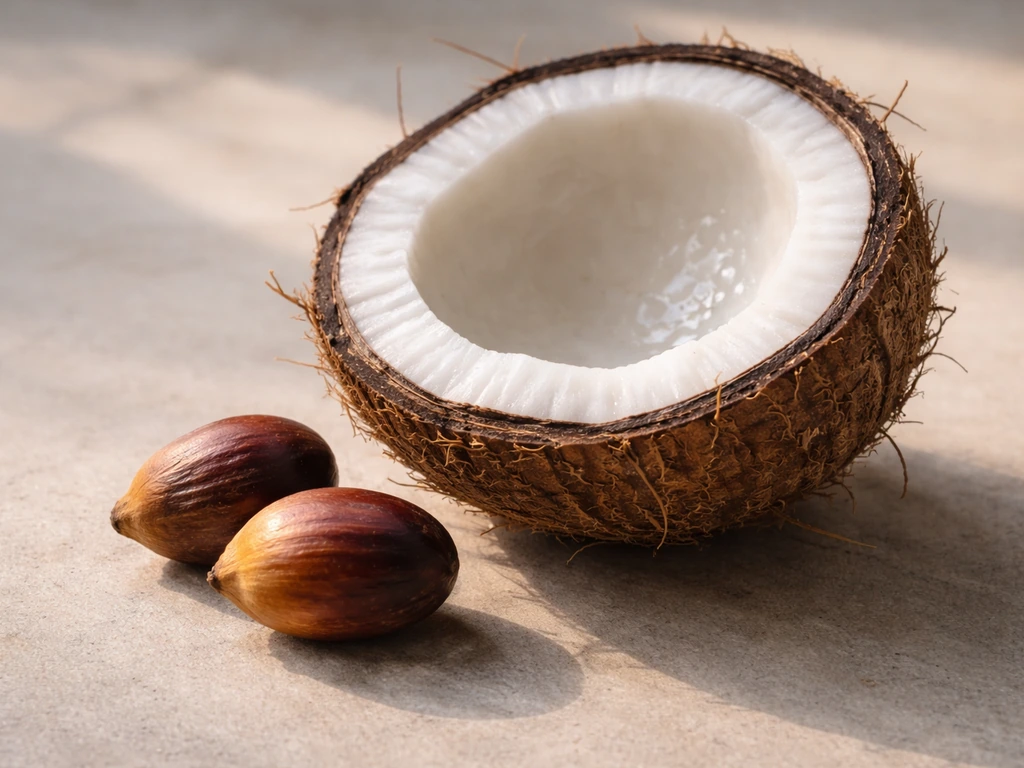
Coconut is by far the most widely recognized. Cocos nucifera is the only species in its genus, and it's been cultivated across tropical coastlines for thousands of years. The "nut" you harvest is the entire inner drupe, typically 6 to 12 inches in diameter depending on variety, with the husk removed. Dwarf varieties (like Malayan Dwarf or Fiji Dwarf) are popular for home growing because they fruit faster and stay shorter, though they're still full-sized palms by most garden standards.
African oil palm (Elaeis guineensis) produces palm kernels, which are the hard seeds inside the fruit. The kernel oil is distinct from palm oil (which comes from the fruit's mesocarp). The fruits grow in massive clusters weighing up to 100 pounds, and while it's economically the most important oil crop in the world, it's not a common backyard plant outside West Africa and Southeast Asia.
Date palm (Phoenix dactylifera) produces the familiar brown dates. The seed (the hard elongated pit inside each date) isn't usually eaten, so dates are more accurately a fleshy drupe grown for the fruit wall rather than the seed. Still, date palms are sometimes included in "nuts on palm trees" discussions because the seeds can be ground into flour or used for livestock feed. Dates are also one of the more cold-tolerant "palm fruit" options, handling occasional dips to around 20°F once established.
Two more worth mentioning: peach palm (Bactris gasipaes) produces starchy, orange-red fruits with edible seeds that are eaten throughout Latin America, and açaí palm (Euterpe oleracea) produces the small purple berries with a thin edible pulp over a large seed. Both are strictly tropical and rarely grown outside their native range or controlled greenhouse environments in North America.
| Palm Species | Edible Part | Fruit Type | Climate Need | USDA Zones |
|---|---|---|---|---|
| Coconut (Cocos nucifera) | Seed endosperm (white flesh + water) | Drupe | Humid tropical | 11–12 |
| African Oil Palm (Elaeis guineensis) | Kernel (seed) and mesocarp oil | Drupe | Tropical | 11–12 |
| Date Palm (Phoenix dactylifera) | Fleshy mesocarp (the date fruit) | Drupe | Hot, arid subtropical | 9–11 |
| Peach Palm (Bactris gasipaes) | Starchy fruit and seed | Drupe | Tropical | 11–12 |
| Açaí Palm (Euterpe oleracea) | Thin pulp over large seed | Drupe | Tropical, wet | 11–12 |
How palm fruits and seeds actually form
Palms flower on large branching structures called inflorescences that emerge from between the leaf bases. Most productive palms are monoecious (both male and female flowers on the same plant) or dioecious (separate male and female plants). Coconut is monoecious, so a single tree can self-pollinate, though cross-pollination from nearby trees improves fruit set. Date palms are dioecious, meaning you need at least one male and several female trees to get fruit. In commercial date orchards, the ratio is often around 1 male per 20 to 50 female trees.
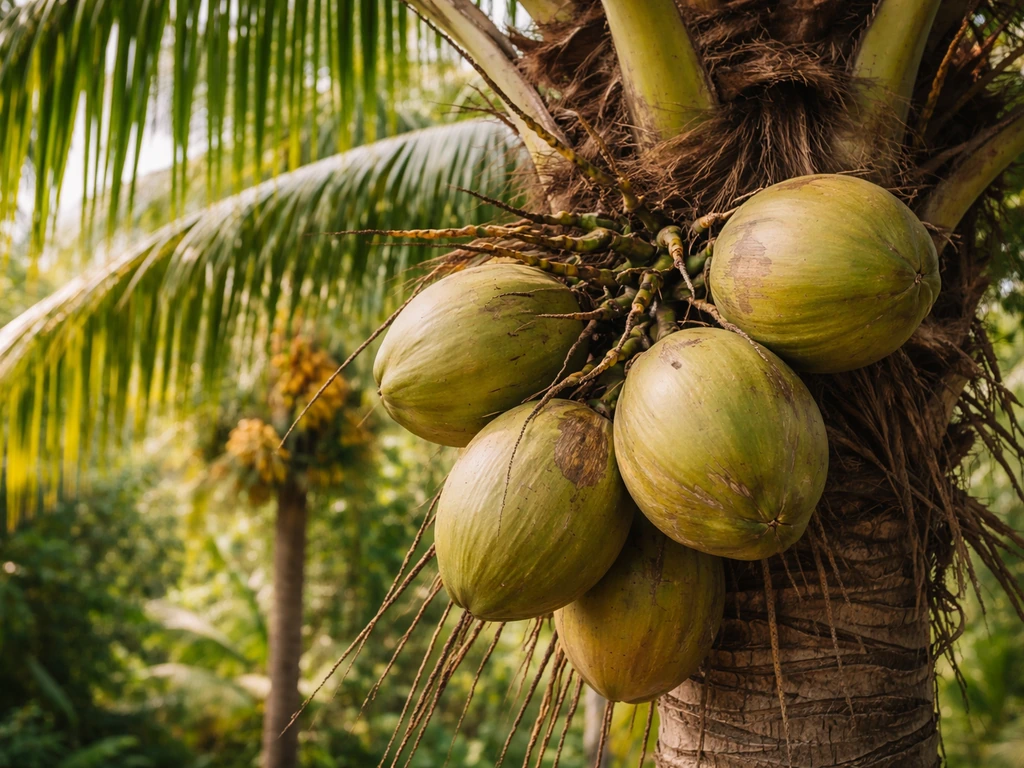
After pollination, the fruit develops slowly. In coconut, it takes about 12 months from pollination to a fully mature "dry" coconut with hardened endosperm, while young green coconuts are harvested for drinking water at around 6 to 9 months. The fruit transitions from a smooth green or yellow husk to brown as it matures and dries on the tree. The fibrous husk (mesocarp) surrounds the hard endocarp (what most people call the shell), and inside that is the seed with its white flesh and liquid endosperm.
To identify the harvestable part correctly: on a coconut palm, you want the entire inner drupe after husk removal, or the whole unhusked fruit if harvesting fresh. On a date palm, you harvest the soft, fleshy fruit off the cluster when it reaches full color and sweetness. On oil palm, the whole fruit cluster is harvested and processed to separate kernel from mesocarp pulp. None of these require you to crack open a true nut wall the way you would with a walnut or pecan.
What palms actually need to produce fruit
Temperature and frost tolerance
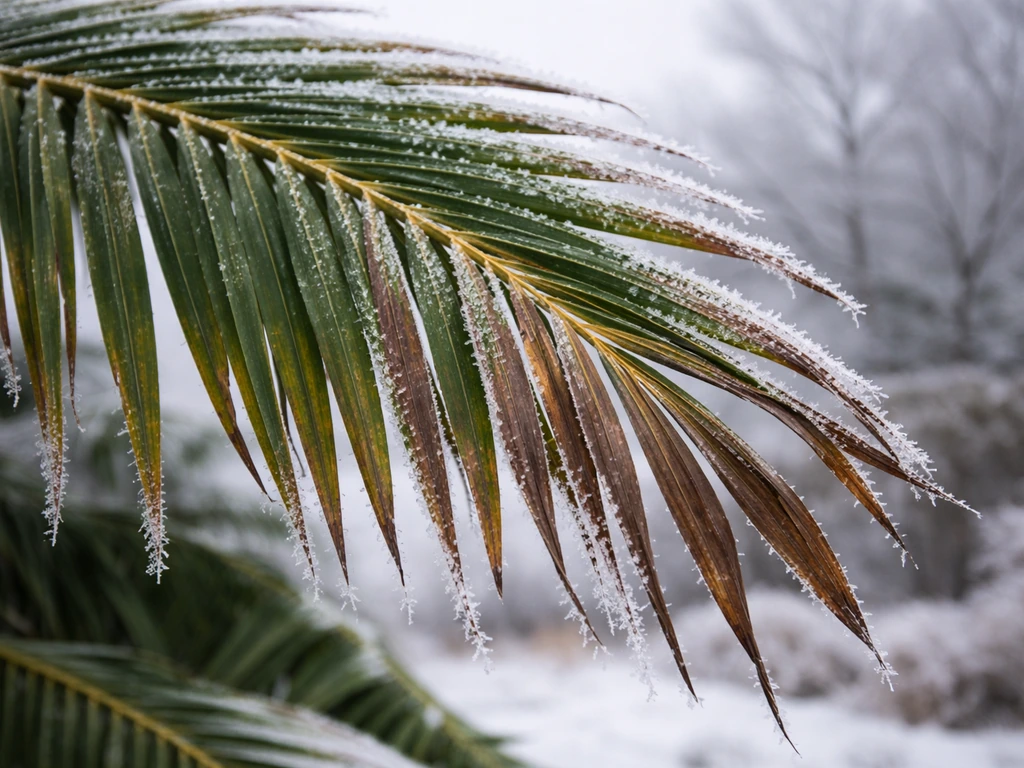
Frost is the hard limit for almost every productive palm. Coconut palms are seriously damaged below 32°F and stop producing fruit after any significant cold event. Even in USDA Zone 10, most coconut palms struggle to set consistent fruit because winter temperatures regularly dip too low. Zone 11 and above (think south Florida tip, Hawaii, Puerto Rico, and coastal tropical areas) are the reliable zones for coconut production. Date palms are more forgiving, tolerating Zone 9 with some winter dormancy, but they need very hot, dry summers with low humidity during fruit ripening. Humid subtropical climates (like Florida or the Gulf Coast) don't suit dates well because the humidity causes fruit to rot before ripening.
Sunlight
All productive palms need full sun, meaning at least 6 to 8 hours of direct sunlight daily. Coconut and oil palms evolved at tropical coastlines and open clearings with intense, direct sun for most of the day. Shading by buildings or taller trees will significantly reduce or eliminate fruiting, even if the palm survives. Don't plan on growing a fruit-producing palm as an understory plant.
Soil and water
Coconut palms are famously tolerant of sandy, well-drained, even salty soils, which is why they thrive on tropical beaches. They don't like waterlogged roots. What they do need is consistent moisture during fruit development, ideally 50 to 70 inches of annual rainfall or equivalent irrigation spread throughout the year. Date palms are the opposite: they want alkaline, well-drained soils (even sandy desert soils) and minimal humidity, though they need deep irrigation during the growing season. If your soil is heavy clay with poor drainage, neither species will be happy without serious amendment.
Where these palms actually thrive
For coconut production, you're looking at true tropical climates: Hawaii, South Florida (Zone 11+), Puerto Rico, the U.S. Virgin Islands, and equivalent tropical regions globally. Parts of Zone 10b in South Florida can produce coconuts, but yield and quality are inconsistent compared to fully tropical zones. In California, even the warmest parts of Southern California (Zones 10–11) don't provide enough sustained heat and humidity for coconut fruiting, though ornamental coconut palms can survive there.
Date palms are the most geographically flexible of the fruit-producing palms in terms of latitude, but they swap one limitation (frost) for another (humidity). The Coachella Valley in California, parts of Arizona, and southern Nevada can produce excellent dates because summers are brutally hot and dry. Medjool dates grown in the Coachella Valley are a well-established commercial industry. Gulf Coast states from Texas through Florida can grow date palms as ornamentals, but the summer humidity prevents reliable fruit development and causes fungal issues during harvest.
If you're in Pennsylvania, the Midwest, the Pacific Northwest, or any region with hard winters or cool summers, productive palm cultivation for edible fruit simply isn't realistic outdoors. You can grow some cold-hardy palms (like windmill palm or needle palm) as ornamentals in Zones 7 to 8, but none of those species produce significant edible fruit. Container-grown coconut palms kept in greenhouses are possible as curiosities but are unlikely to fruit without tropical-level heat and light year-round.
Realistic timelines and what to expect from growing
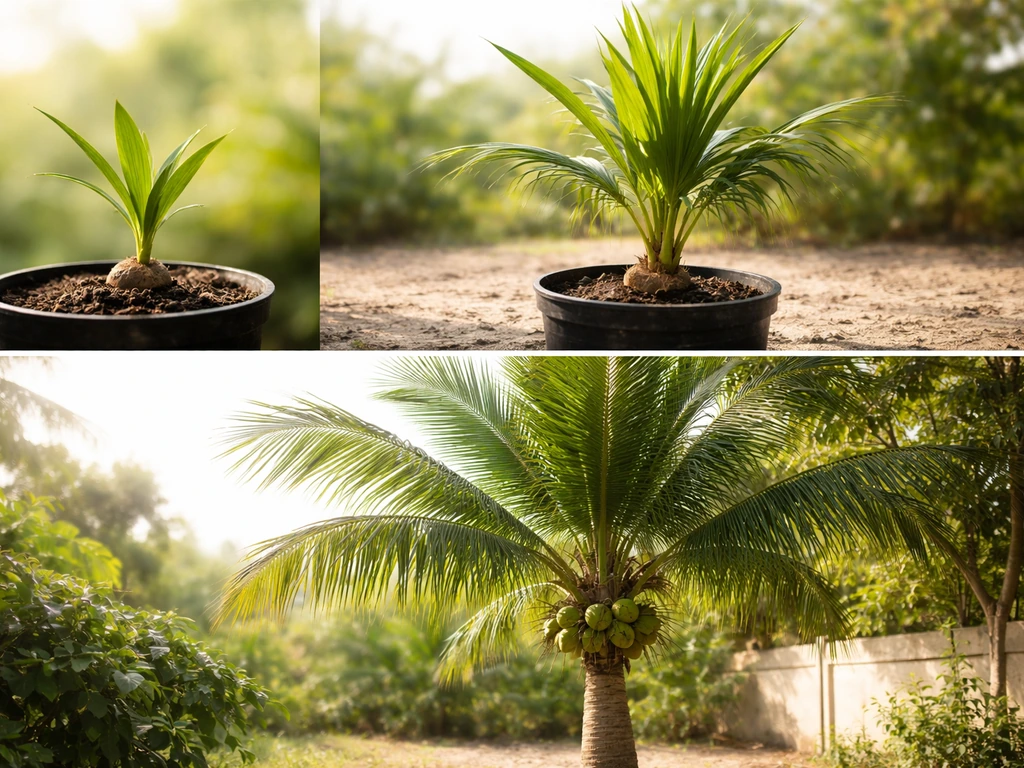
Growing a coconut palm from a seed (the entire coconut) to first fruit takes 6 to 10 years under good conditions. Dwarf varieties tend to fruit faster, sometimes in 3 to 5 years from planting of a young nursery tree. Once a coconut palm starts producing, it can bear 50 to 200 coconuts per year depending on variety, climate, and care. That's actually a reasonable yield for a home grower in the right climate.
Date palms take 4 to 8 years from planting to first significant harvest, and remember you need both male and female trees unless you buy tissue-cultured female varieties that are offset-propagated from known producers. Commercial growers hand-pollinate female flower clusters with dried pollen from male trees to ensure good fruit set. Full production isn't typically reached until a date palm is 13 to 15 years old.
Pollination is a practical issue worth planning for before you plant. For coconut, a single tree can self-pollinate, but having two or more nearby improves yield. For date palms, you absolutely need a male tree or access to pollen. Some nurseries sell pollen separately for hand application, which is worth knowing if you have limited space and don't want to devote ground to a non-fruiting male.
One honest note: if your goal is to grow nut trees at home and you're not in a tropical or hot arid zone, palms are probably not your best path. Species like chestnuts, pecans, and hazelnuts cover a much wider range of climates and are far more suitable for temperate home growers. The idea of growing your own nuts at home in a cooler climate is genuinely achievable, just not through palms. Can you grow nuts indoors? For most of the palm “nuts” people mean, the limiting factors are intense light, heat, and consistent warm conditions that are hard to replicate indoors. For more ideas, explore nuts you can grow at home in your region and what each one needs.
Practical next steps if you want to grow palm "nuts"
- Check your USDA hardiness zone first. If you're below Zone 9, outdoor edible palm production is not realistic. If you're in Zone 9, dates are your only real option, and only in low-humidity regions.
- Identify which species suits your climate: coconut for humid tropical zones, date palm for hot and dry subtropical zones.
- For coconut, source a dwarf variety (Malayan Dwarf, King Coconut) from a reputable tropical nursery. Plant in full sun, fast-draining sandy or loamy soil, and plan for consistent irrigation if rainfall is seasonal.
- For date palms, source sexed plants (confirmed female for fruit, male for pollination) or purchase tissue-cultured offshoots of named varieties like Medjool or Deglet Noor.
- Don't plant in heavy clay without raised beds or substantial amendment. Both coconut and date palm roots need drainage, not standing moisture.
- Set realistic timelines: 3 to 5 years minimum to first fruit from a young nursery coconut palm, 4 to 8 years for dates. Factor this into whether a palm is the right choice for your situation.
- If you're outside viable palm zones, explore temperate nut trees instead. Palms are not a workaround for cold climates.
FAQ
Are coconuts true nuts, botanically speaking?
No. A coconut is a drupe, meaning it is a fleshy fruit type with an inner hard endocarp (the “shell”) surrounding the seed. That is why palm “nuts” behave more like fruit crops than temperate tree nuts such as walnuts or pecans.
What other “palm nuts” can you eat besides coconut, and which part do you harvest?
Oil palm gives edible kernels inside the fruit, date palm is harvested for the fleshy fruit wall, and peach palm and açaí are harvested for their pulp around a large central seed. In each case, you are harvesting a fruit or seed kernel, not a true nut like an acorn or hazelnut.
If I plant a coconut indoors or in a greenhouse, will it fruit?
Often, it will not. Even with a living palm, fruiting depends on sustained tropical-level heat and intense, year-round light, plus time to maturity (typically many years). In most temperate greenhouses it becomes primarily a curiosity unless conditions are exceptionally close to outdoor tropics.
How can I tell what part I’m supposed to harvest on a palm?
For coconut, you harvest the entire inner drupe after removing the husk (or the whole unhusked fruit if you want fresh water). For dates, you pick the soft, sweet fruit on the cluster when fully colored. For oil palm, you harvest whole fruit clusters, then separate kernel from pulp during processing.
Do I need another palm for pollination, or will one tree fruit on its own?
It depends on the species. Coconut can self-pollinate, though nearby trees improve yields. Date palms are dioecious, so you generally need at least one male tree for fruiting on female trees, or access to hand-pollination or appropriate female tissue-cultured stock with known pollen sources.
How many male date palms do you need for a home orchard?
A common commercial guideline is roughly one male for every 20 to 50 female trees, because female clusters need reliable pollen supply. For smaller gardens, having one male reasonably close to several females usually helps, but distance and timing still matter.
How long does it take before palm “nuts” start producing?
Coconut typically takes about 6 to 10 years from seed to first harvest, with dwarf types sometimes quicker (often 3 to 5 years from a young nursery tree). Date palms usually take about 4 to 8 years for significant harvest and often reach full production closer to 13 to 15 years.
Are there any palm species that are cold-tolerant enough to reliably produce outdoors in cooler regions?
Only limited options. Date palms are more tolerant of occasional cold, but humidity and seasonal conditions can prevent proper ripening. For most places with hard winters or cool, humid summers, palms may survive as ornamentals but usually do not produce edible fruit consistently.
Why do date palms fail in humid climates even if winters are mild?
High humidity can trigger fungal problems and can also rot fruit before it ripens. Dates are best in very hot, dry summers with low humidity during the fruit development and harvest window, so a region can be “warm enough” but still not suitable.
Will fertilizer help palms fruit in marginal climates?
Fertilizer cannot replace the core limitations of temperature, sunlight, and moisture pattern. If the climate misses the frost-free threshold, lacks enough direct sun, or stays too humid during ripening, palms typically stall in flowering or fruit set regardless of feeding.
Can I use seed from store-bought dates to grow a palm that fruits?
You might grow a date palm, but fruiting is not guaranteed from unknown seed genetics, and you will also need a male pollen source. For dependable fruiting, many growers use known female plants or tissue-cultured female varieties, because you control sex and provenance rather than relying on chance.
What are the biggest mistakes people make when they try to grow edible palm “nuts”?
The most common are choosing the wrong species for the climate, planting in shade, and ignoring pollination requirements (especially for dates). Another frequent mistake is expecting temperate tree-nut rules to apply, but palms have different fruit structures and very different environmental needs.