The short answer: how much water a cashew tree actually needs
Growing one cashew nut takes roughly 1 to 3 liters of water when you work backwards from per-tree seasonal figures, but that number is almost too simple to be useful on its own. What matters more for a grower is this: a mature cashew tree in active production needs somewhere in the range of 36 liters per day during the critical December-to-March flowering and nut-development window (based on Indian drip-irrigation guidelines), or about 200 liters every two weeks if you're supplementing during dry spells. At the farm scale, Queensland's agriculture department puts full irrigation demand for a mature cashew plantation at around 3.5 megalitres per hectare per year, which translates to roughly 350 liters per tree per year assuming 1,000 trees per hectare. Those are your practical anchors. Everything below is about how to apply them to your specific tree, climate, and soil. If you are also wondering how the nut forms, understanding how does cashew nut grow helps you time irrigation to the stages that matter most.
How cashew trees use water as they grow
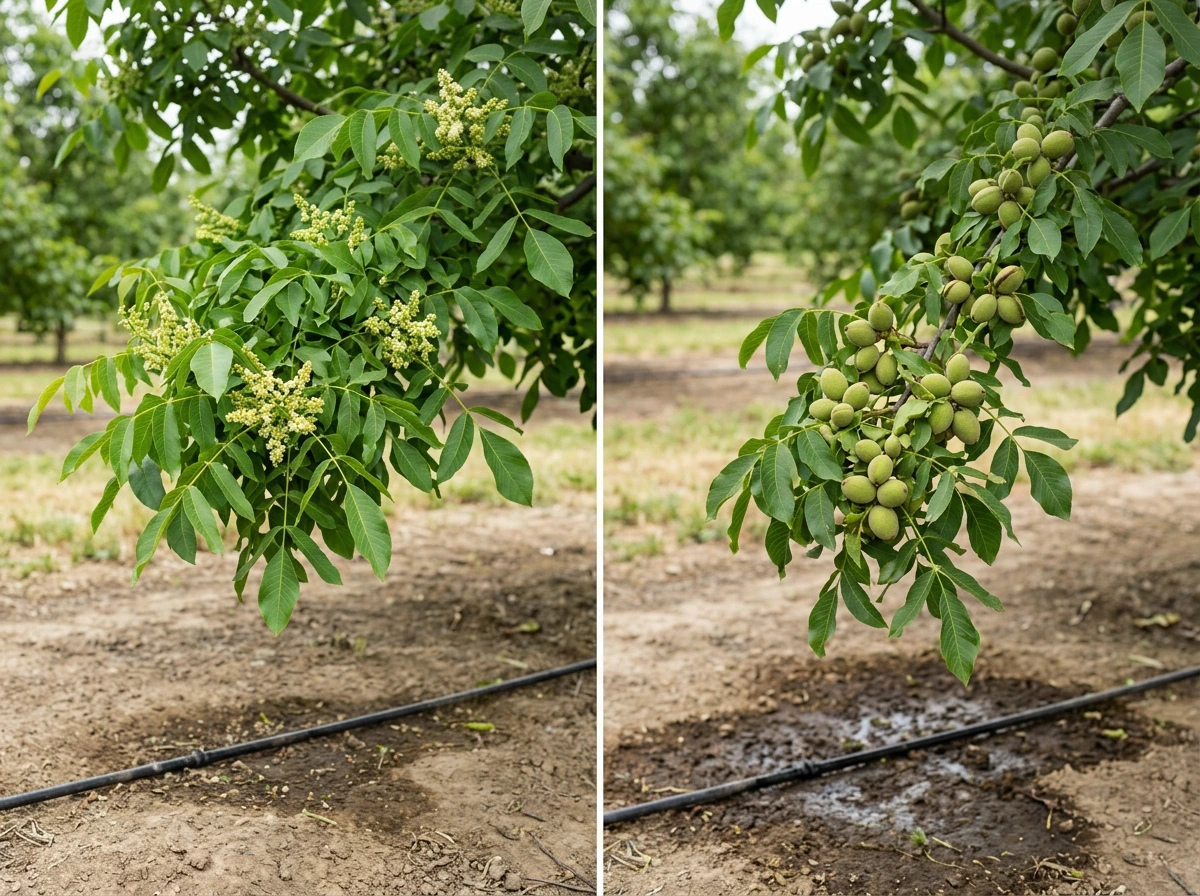
Cashew trees (Anacardium occidentale) are native to northeastern Brazil and evolved in a strongly seasonal tropical climate with pronounced wet and dry seasons. That origin shapes everything about how they use water. They are not thirsty trees by default, but they are sensitive trees: water at the wrong time or in the wrong amount does more damage than drought.
The growth cycle has two very different water-demand phases. During the vegetative growing season (roughly April through November in the Indian production calendar), an established cashew tree draws on stored soil moisture and whatever rainfall is available. This is when the tree builds canopy, deepens its root system, and stores energy. Water demand is moderate and the tree's extensive root system helps it tap deeper reserves. The critical phase is the dry-season flowering and nut development period, typically December through March in major producing regions. This is when supplemental irrigation matters most and when water stress causes the most damage to yield.
For young trees, the math is different. Seedlings and grafted trees in their first two years need consistent moisture to establish their root systems, and studies on cashew grafted genotypes found that watering every two to four days produced the best growth outcomes under nursery conditions. Once the taproot is established, trees become significantly more drought-tolerant, but yield will always reflect the water available during flowering and fruit set. FAO documentation confirms that bearing typically begins after the third year, with full production reached around year ten, so your irrigation investment compounds over time.
The three growth stages that define water demand
- Establishment (years 1 to 3): Highest irrigation frequency needed, lowest total volume per session. Water every 2 to 4 days, focusing on the root zone. The goal is root depth, not shoot growth.
- Early bearing (years 3 to 8): Irrigation becomes more strategic. Reduce frequency during the wet season, increase during dry-season flowering. Yield climbs from near zero to roughly 8 to 10 kg of nuts per tree by year eight.
- Mature production (year 10 and beyond): Full demand. Trees can yield 15 to 20 kg of raw cashew nuts per year under good conditions, and this is when the 36 L/day drip-irrigation figure and the 3.5 ML/ha annual estimate apply most directly.
Estimating water per tree, and what that means per cashew
Let's do the math in a way that's actually useful. Take the MANAGE drip-irrigation example: 36 liters per tree per day during December and January, applied for roughly 60 to 90 days. That's 2,160 to 3,240 liters of supplemental irrigation per tree across the most critical part of the season. Add modest applications before and after that window (mid-December start, end-of-March finish) and you're looking at around 3,000 to 4,000 liters of total supplemental water per mature tree per production year. That aligns reasonably well with the Queensland figure of 3.5 ML per hectare annually when converted at the 1,000-trees-per-hectare scale.
Now translate that to per-nut. A mature tree yielding 15 kg of raw cashew nuts produces roughly 1,500 individual nuts (assuming about 10 g per nut in-shell weight, which is a reasonable average). If that tree used 3,500 liters of supplemental irrigation across the season, you get approximately 2.3 liters per nut. If the tree is younger and yields only 8 kg (around 800 nuts), the per-nut figure rises to over 4 liters. But keep this in perspective: much of the water the tree uses comes from rainfall and stored soil moisture that you didn't pump. The supplemental irrigation figure is what you control.
One important caveat: FAO trials found that applying 200 liters of water per tree every fortnight during the dry season can double cashew yields compared to rainfed production. That means your water investment per nut can actually decrease as irrigation improves yield, because you're spreading the same water input across far more nuts. Good irrigation practice doesn't just save water, it makes each liter more productive.
| Tree stage | Approx. yield per tree | Estimated seasonal irrigation | Approx. water per nut |
|---|
| Early bearing (year 4 to 5) | 2 to 4 kg | 1,000 to 1,500 L | 4 to 7 L |
| Mid-production (year 8) | 8 to 10 kg | 2,500 to 3,500 L | 2.5 to 4 L |
| Mature (year 10+) | 15 to 20 kg | 3,000 to 4,000 L | 1.5 to 2.5 L |
How soil type, climate, and your region change the numbers
Cashew trees do best in well-drained, laterite or sandy loam soils, and that preference is directly tied to water management. Sandy soils drain fast, hold less water, and require more frequent but shorter irrigation cycles. Heavy clay soils hold moisture longer but create the exact conditions where root rot thrives. The Queensland information kit specifically flags cashew's deep root system as a reason to think carefully about irrigation placement, since the tree can access water well below the surface once established.
Soil texture also determines your irrigation trigger point. The standard framework used in commercial orchards is based on soil matric potential, measured with tensiometers or moisture sensors. In sandy or light soils, you irrigate at lower tension thresholds (the soil dries out faster and roots can't pull water as efficiently under stress). In loam soils, you have a wider window before irrigation is urgent. A general rule across tree crops is to irrigate when available water depletion in the root zone hits 30 to 60%, adjusting toward the conservative end for flowering periods when stress is most damaging.
Regionally, the picture shifts substantially. In the humid tropics of West Africa, Brazil, or coastal India, a well-managed cashew orchard may need very little supplemental irrigation outside of exceptional drought years. The 3.5 ML/ha/year figure from Queensland reflects a semi-arid to seasonally dry tropical climate where the dry season is long and pronounced. Queensland cashew guidance also specifies that irrigation at mature production level should allow for about 3.5 megalitres of water per hectare per year to meet crop needs during dry periods or high-yield conditions. If you're growing in a zone with 1,200 to 1,500 mm of annual rainfall reasonably distributed, your supplemental needs may be a fraction of that. If you're in a region with under 800 mm of annual rainfall and a 5-month dry season (which actually suits cashew's fruiting cycle well), you'll be closer to the full figure. The key is matching your supplemental irrigation to what rainfall doesn't provide during the October-to-March window, not irrigating on top of adequate rainfall.
Setting up irrigation and scheduling it properly
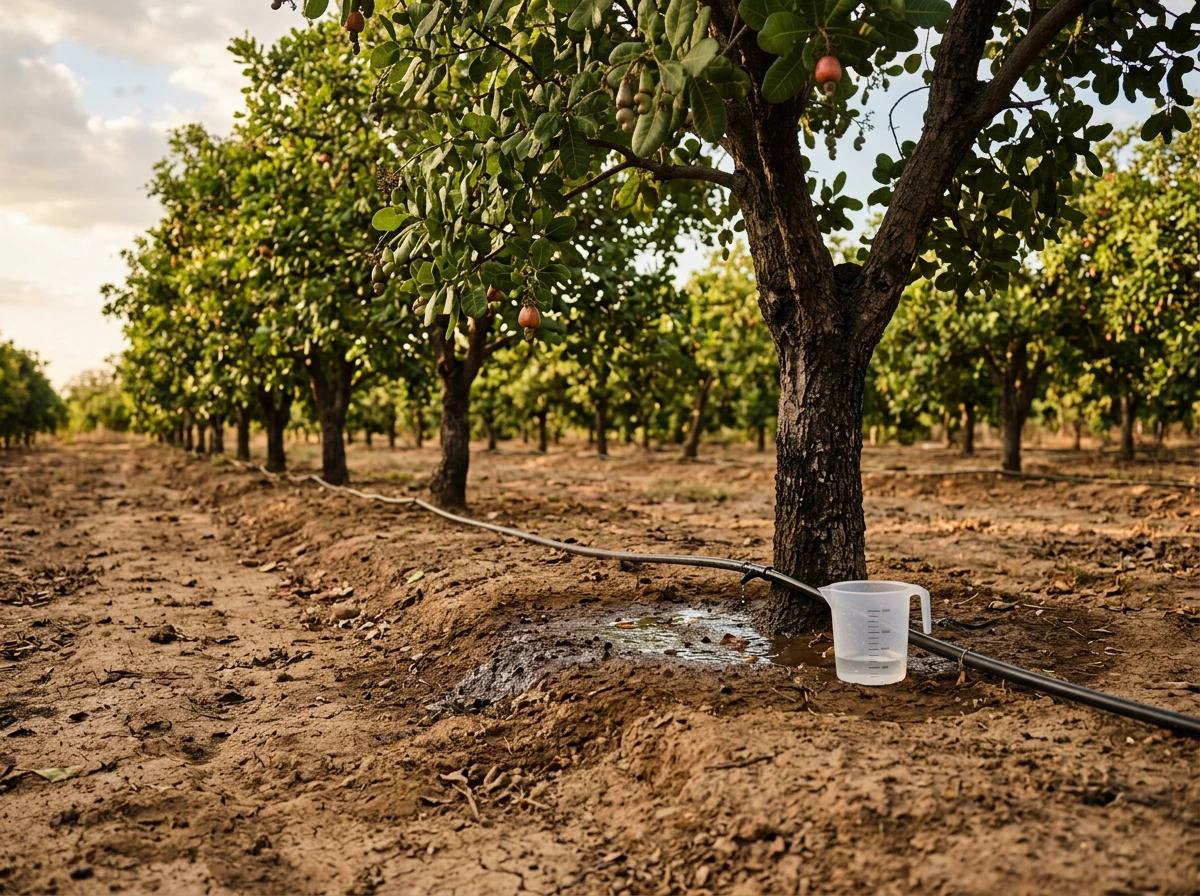
Drip irrigation is the most effective method for cashew orchards, and it's what both the Indian and Queensland production guides recommend. It delivers water directly to the root zone, minimizes evaporation losses, and makes it easy to adjust application rates by growth stage. A single drip emitter placed 30 to 50 cm from the trunk base works well for young trees; mature trees benefit from two to four emitters spread around the canopy drip line to match where the feeder roots are.
For scheduling, the most reliable approach combines two tools: a reference evapotranspiration (ETo) figure from your local weather station or agricultural extension service, and a crop coefficient (Kc) for cashew. Your crop water need is simply ETo multiplied by Kc. This is the standard ETc framework that professional irrigators use. The Kc for cashew varies by growth stage, rising during flowering and nut development and dropping during the vegetative rest phase. If you don't have a specific Kc for cashew in your region, 0.6 to 0.85 across the production season is a reasonable working range, with the upper end applying during the December-to-March critical window.
In practical terms for a small grower without weather station access, here's a simple scheduling approach grounded in the research:
- Young trees (year 1 to 3): Water every 2 to 4 days year-round, applying enough to wet the top 30 to 40 cm of the root zone. Reduce frequency but not volume after rain.
- Established trees outside the flowering window: Reduce to once per week or rely on rainfall if you're receiving more than 25 mm per week.
- December through March (flowering and nut set): Apply 36 liters per tree per day via drip, or 200 liters per tree every two weeks via basin or flood irrigation as a minimum. Do not skip this window.
- After fruit harvest (April onward): Taper off irrigation and allow the dry-season hardening that naturally triggers next season's flowering initiation.
Adjusting for rainfall is straightforward: subtract actual rainfall from your calculated ETc demand for that week. If you received 20 mm of rain and your ETc for the week was 30 mm, apply the equivalent of 10 mm across your tree spacing. At a 7 x 7 meter spacing (49 square meters per tree), 10 mm equals 490 liters per tree, which gives you a sense of scale. Most small growers will simply keep a rain gauge and skip or reduce irrigation events after meaningful rainfall (anything over 15 to 20 mm in the critical season).
Reading your trees: signs of under- and over-watering
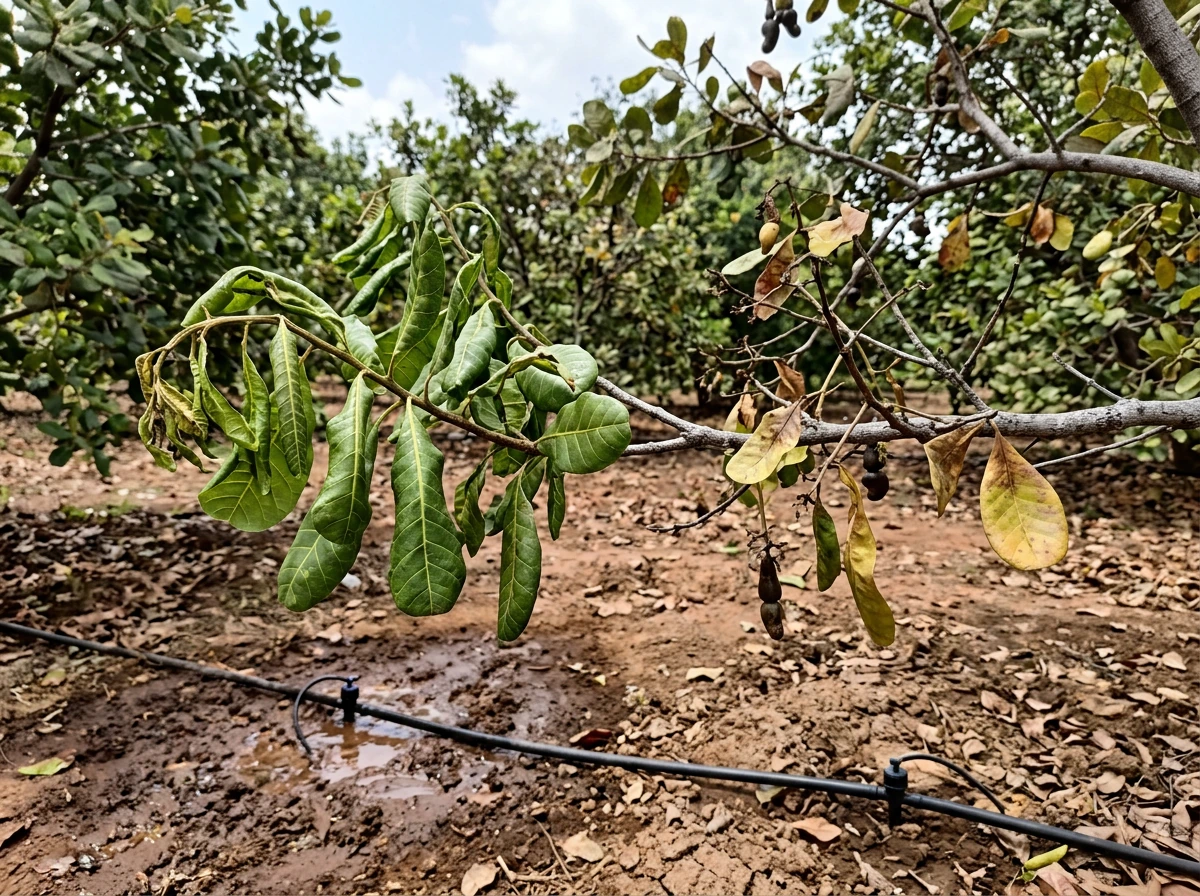
Cashew trees will tell you when they're stressed if you know what to look for. Under-watering presents as wilting of young leaves first, followed by progressive leaf drop if the stress continues. The African Cashew Alliance has documented this sequence specifically in cashew, noting wilting followed by leaf drop as the visible stress signal. Critically, these symptoms appear first on the youngest, most actively growing shoots. If you see mid-canopy wilting on an otherwise healthy tree during the dry season, assume water stress first.
Over-watering is more insidious because the tree can look distressed for reasons that seem contradictory. A waterlogged cashew tree may also wilt, but the wilting happens despite moist soil because roots are being suffocated or attacked by Phytophthora root rot. Phytophthora thrives in prolonged wet, poorly drained soil conditions, and it will kill a cashew tree steadily and silently before you notice canopy symptoms. The diagnostic test: if a tree is wilting but the soil around the base feels wet or saturated, the problem is almost certainly at the roots, not a water deficit. Dig carefully and inspect for dark, waterlogged, or decayed root tissue.
Standing water around the tree base is the single biggest irrigation mistake to avoid with cashews. Their natural habitat is seasonally dry with fast-draining soils, and prolonged soil saturation is genuinely lethal. If your site has any drainage issues, fix them before you plant, or build raised mounds for each tree.
| Symptom | Likely cause | Action |
|---|
| Wilting on young shoots, dry soil | Under-watering | Irrigate immediately; increase frequency or volume |
| Leaf drop during dry season | Prolonged water stress | Apply 200 L per tree and reassess scheduling |
| Wilting despite moist/wet soil | Root rot from overwatering | Stop irrigating; improve drainage; inspect roots |
| Yellowing older leaves, wet conditions | Waterlogging/root suffocation | Reduce irrigation; add drainage channels |
| Slow growth, stunted canopy | Inconsistent moisture during establishment | Switch to every-2-to-4-day schedule for young trees |
Your practical checklist to plan watering from here
This isn't complicated once you have the key inputs. Work through these steps and you'll have a working irrigation plan that you can refine over the first season.
- Determine your tree's age and stage. Young trees (under 3 years) need water every 2 to 4 days regardless of season. Mature trees need targeted dry-season irrigation from around December through March.
- Check your soil type. Sandy or light soils need more frequent, shorter sessions. Loam soils give you a wider trigger window. Clay-heavy soils require drainage improvement before you irrigate at all.
- Identify your dry season. The irrigation window that matters most is when rainfall drops below 25 mm per week and temperatures are moderate (cashew flowers best in a dry, warm period). That's when your 36 L/day or 200 L/fortnight commitment starts.
- Install a drip system if you have more than a few trees. One to two emitters per tree, placed at the drip line for mature trees and close to the base for young ones. This is the single highest-ROI investment in cashew irrigation.
- Set up a rain gauge at the orchard. Track weekly rainfall and subtract it from your irrigation target. In a week where you receive 30 mm, skip your irrigation event. Under 15 mm, apply your full scheduled amount.
- Watch the trees every week during the critical December-to-March window. Check young shoot tips for wilting. Check soil moisture 15 to 20 cm deep before each irrigation event using a probe or tensiometer.
- Taper irrigation after fruit set. Once cashew apples are developing and the dry season is ending, begin reducing irrigation frequency. This controlled drying encourages next season's flower initiation and prevents root rot going into the wet season.
- Keep records. Log how much you applied, when you applied it, what the weather was, and what the tree looked like. By the end of your first production season you'll have the data to fine-tune your schedule and directly compare water use to yield.
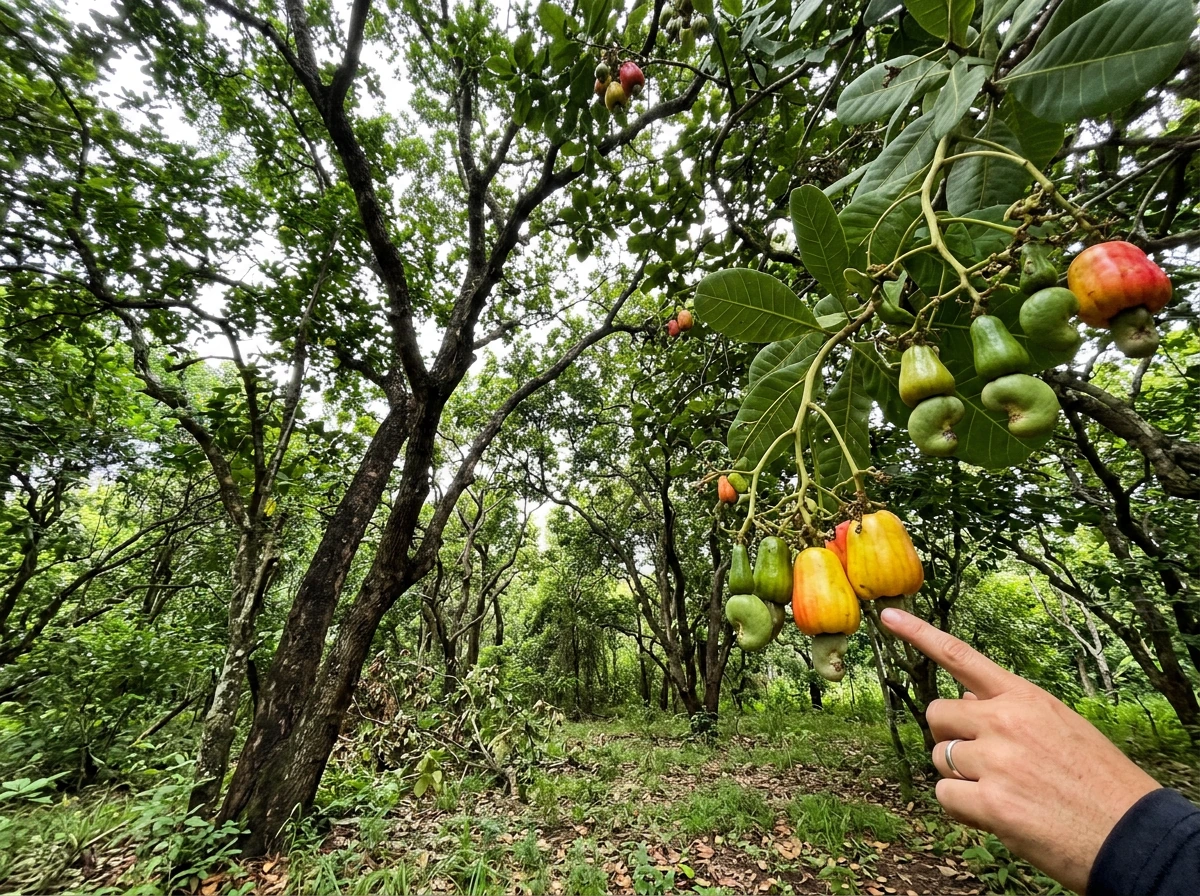
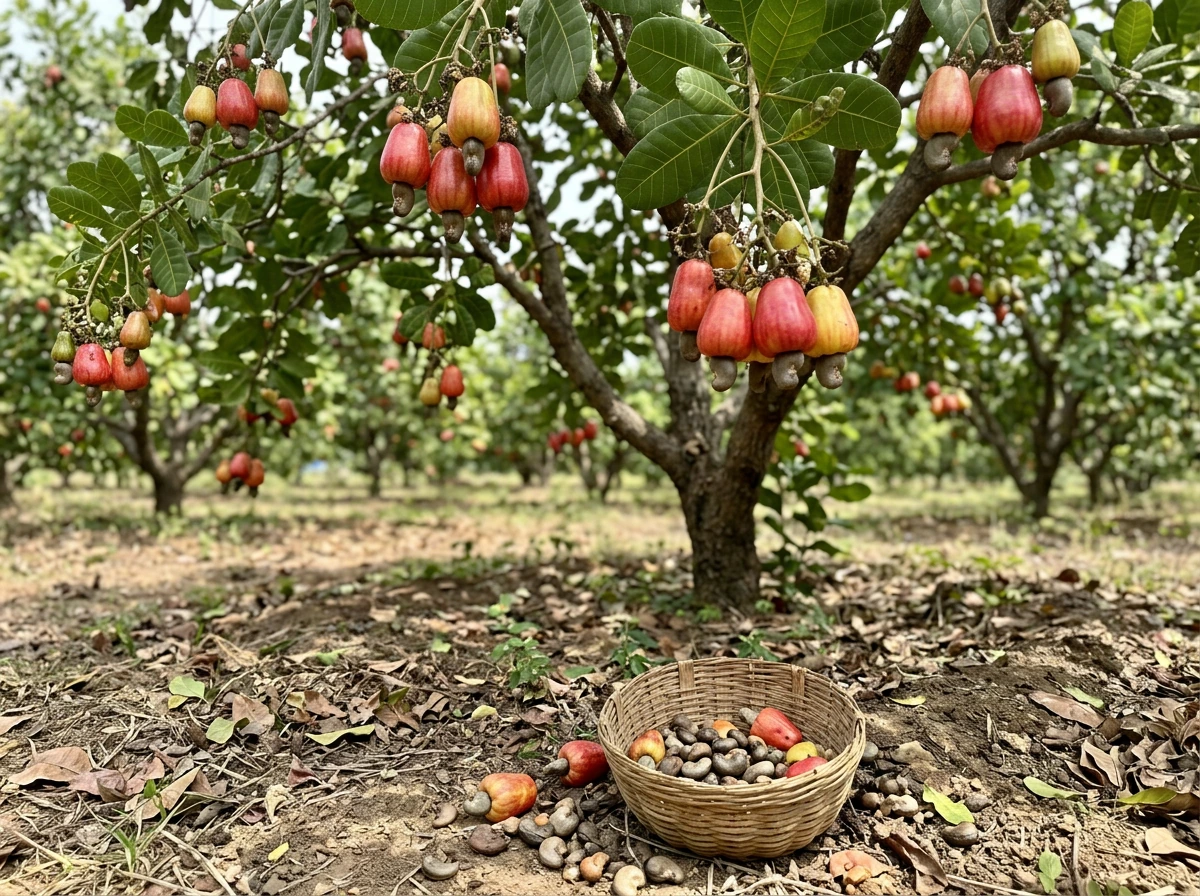
If you want to go deeper on the biology behind why cashews need this specific seasonal water pattern, it connects closely to how the tree actually flowers and forms the cashew apple and nut, which is worth understanding before you commit to a full irrigation setup. If you're also trying to understand how long it takes to grow cashews, the key is matching irrigation to the tree’s seasonal stages, especially the flowering and nut development period how long does it take to grow cashews. how many cashews grow on a tree (Do cashews grow on apples?) The short version is that cashew is unusual in how it develops its fruit, and that development sequence is exactly what your water schedule needs to support. do cashews grow in a shell