Cashew trees in India grow almost exclusively along the country's coastal belts and adjoining lowland areas, concentrated in six major states: Kerala, Maharashtra, Andhra Pradesh, Odisha, Tamil Nadu, and Karnataka. Goa also contributes meaningfully to production. A PIB release citing DCCD reports lists state-wise raw cashew production for multiple years, including Goa among the major producing states blank" rel="noopener noreferrer">Goa also contributes meaningfully to production. Together, these states account for the vast majority of India's raw cashew output, which reached roughly 7.42 lakh metric tonnes harvested from about 10.11 lakh hectares in 2022-23. If you're trying to figure out whether your own region in India can support cashew, the short version is: warm, low-altitude, well-drained land with a clear dry season during flowering is what you're looking for.
Where Do Cashew Trees Grow in India? Regions and Conditions
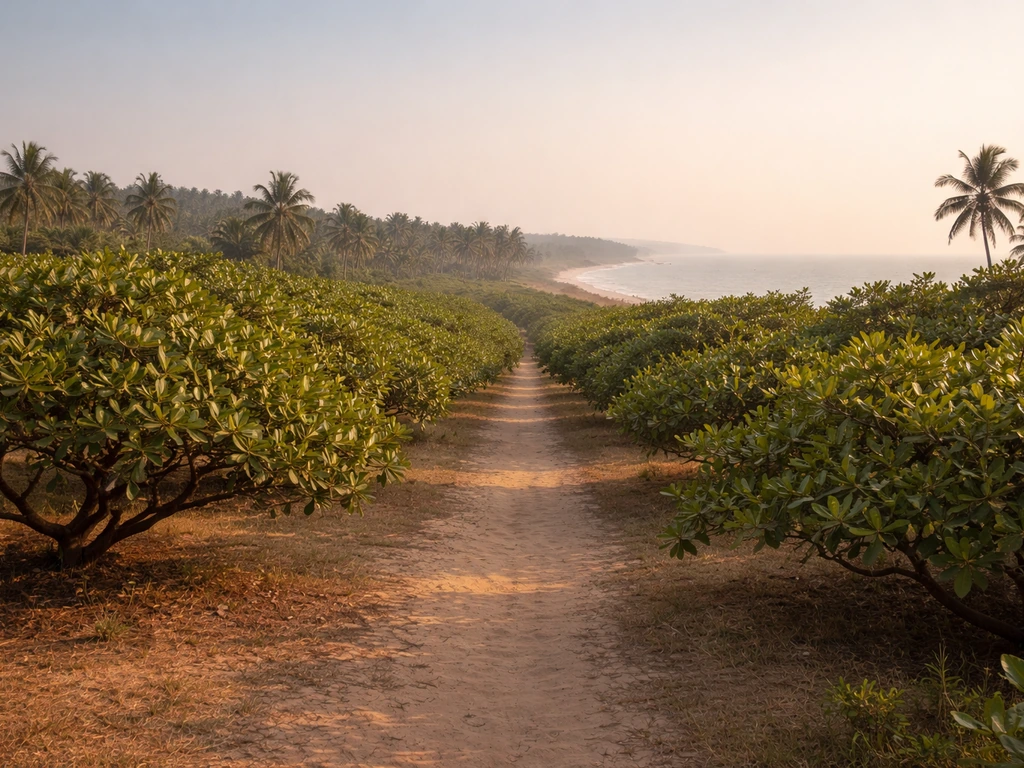
The main cashew-growing states and belts
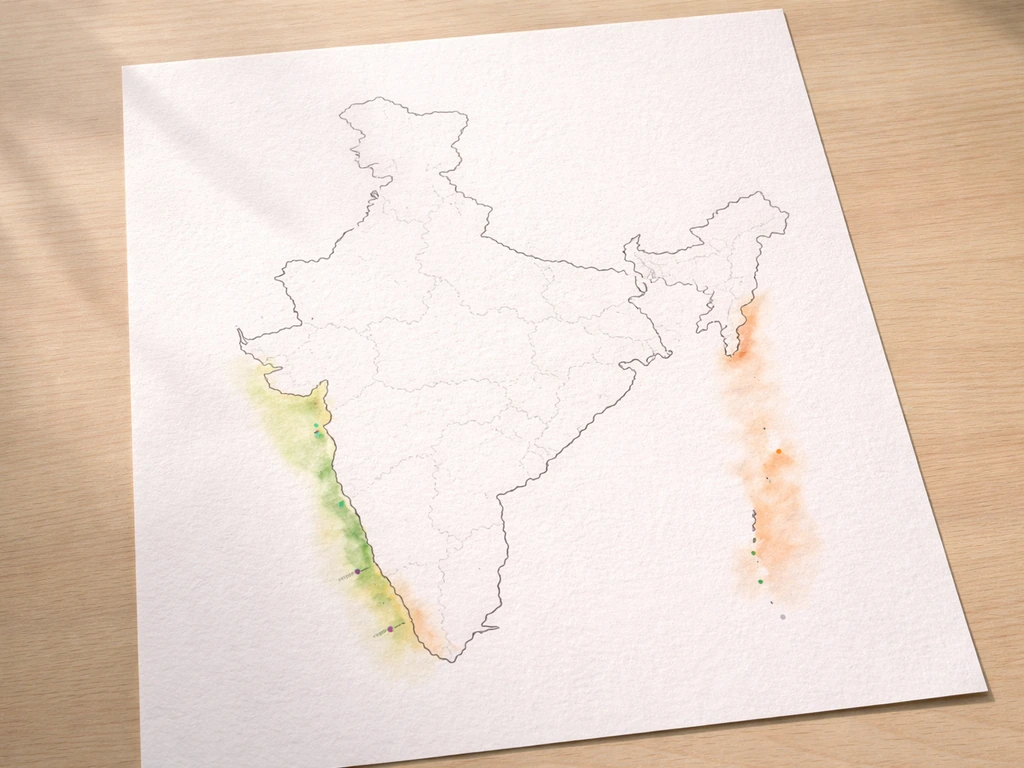
India's cashew production follows two broad coastal corridors, with a few inland extensions where conditions are favorable. The western coast belt runs from Kerala through Karnataka, Goa, and Maharashtra. The eastern coast belt covers Tamil Nadu, Andhra Pradesh, Odisha, and extends into parts of West Bengal. These aren't arbitrary administrative lines; they reflect where the combination of tropical warmth, seasonal rainfall, and free-draining soils naturally converge.
| State | Coast | Notable growing districts/belts |
|---|---|---|
| Kerala | Western | Kollam, Thiruvananthapuram, Kasaragod |
| Karnataka | Western | Dakshina Kannada, Udupi, Uttara Kannada |
| Goa | Western | Throughout the coastal talukas |
| Maharashtra | Western | Sindhudurg, Ratnagiri, Raigad |
| Tamil Nadu | Eastern | Cuddalore, Villupuram, Kanyakumari |
| Andhra Pradesh | Eastern | Srikakulam, Vizianagaram, East Godavari |
| Odisha | Eastern | Ganjam, Puri, Cuttack, Koraput |
Most commercial cashew orchards sit within roughly 100-150 km of the coastline, at elevations below about 600-700 feet (roughly 180-210 m). Beyond that elevation band, temperatures start dropping into ranges that cause real problems for fruit set, and the risk of frost in cooler upland pockets becomes a genuine threat to young trees in particular.
Why these regions work: climate and rainfall patterns
Cashew is a tropical tree that needs warmth consistently. The sweet spot for cashew in India is a temperature range of roughly 20-30°C during its active growing and flowering period. Fruit set drops off noticeably when temperatures fall below about 20°C for extended periods, and at the other extreme, temperatures above 42-45°C during flowering and young fruit development can cause flower and fruit drop. That combination rules out India's cooler highlands and its hottest, driest interior plains.
Rainfall range is broad; cashew tolerates anywhere from about 600 mm to 4,500 mm annually. But here's the part that matters most and often gets overlooked: it's not just how much rain falls, it's when. Cashew flowers from roughly December to February in most Indian regions, and it needs dry or low-rainfall conditions during that window. Heavy or evenly distributed rain year-round is actually a problem. Areas that get most of their rainfall during the monsoon (June to September/October) and then dry out for the flowering season are ideal. That's exactly the pattern you get along India's coastal belts.
The areas receiving around 1,500-2,000 mm annually with a well-defined dry season are considered particularly well-suited, according to ICAR-CCARI guidance. But many successful orchards exist in higher-rainfall areas like parts of Kerala, precisely because the dry-season window still exists even if the annual total is high. Because shea nuts need a warm, dry season and specific West African growing conditions, you will generally find them in parts of the Sahel and savanna regions rather than in coastal India.
Soil conditions and coastal vs. inland performance
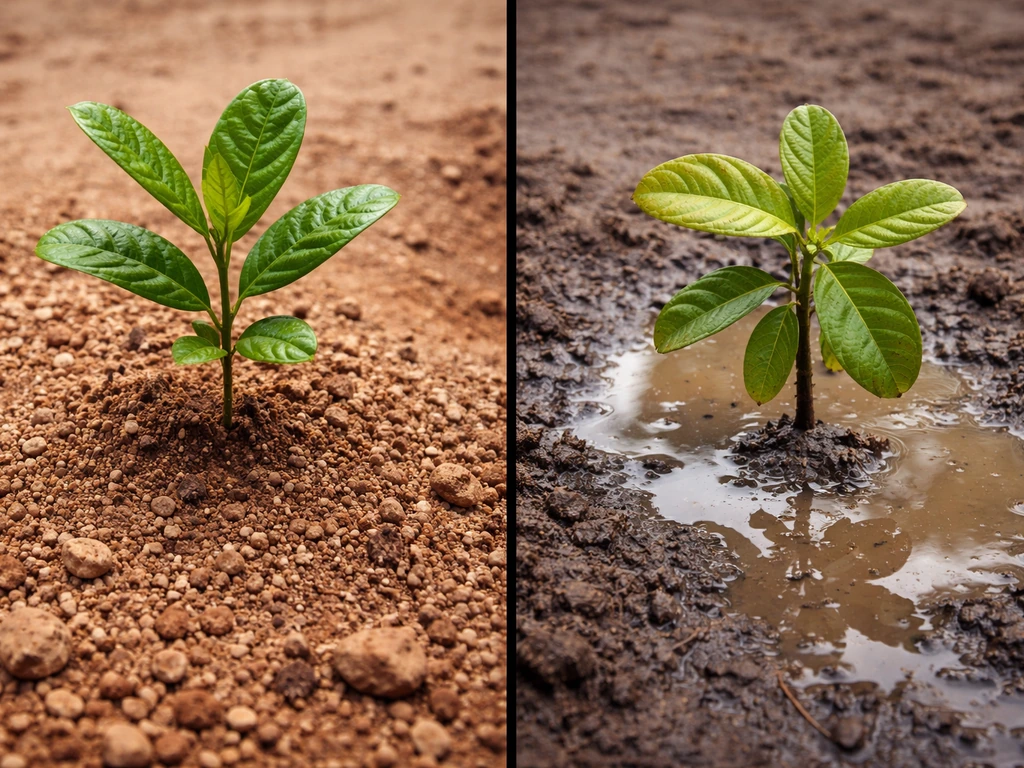
Cashew is often described as a forgiving tree when it comes to soil fertility, and that's broadly true. It grows on laterite soils, red sandy loams, and even degraded land that most other crops won't touch. If you're trying to answer cashew nuts grow in which soil, it also helps to know that cashew can tolerate laterite soils, red sandy loams, and even degraded land. Laterite soils, common across Kerala, Karnataka, and parts of Goa and Maharashtra, are actually well-regarded for cashew when compared to pure sandy soils, because they retain just enough moisture without waterlogging.
What cashew absolutely will not tolerate is poor drainage. Waterlogged soils will kill roots and invite root rot. Black soils (heavy clay), which dominate parts of Maharashtra's interior and the Deccan plateau, are unsuitable because they hold water and shrink-swell in ways that damage root systems. Saline soils are also a hard no, and this matters along coastal zones where salt intrusion from the sea is a real concern. Research on cashew rootstocks under controlled salinity conditions shows that even low-level salt stress affects performance, so if you're on a coastal plot with any history of saltwater flooding, that's something to evaluate carefully before planting.
Soil pH above 8.0 is unsuitable. Most of the productive cashew zones in India naturally have acidic to neutral soils in the pH 5.5-7.5 range, which fits the laterite and red soil profiles of the coastal states well. Inland regions with alkaline soils or heavy black cotton soil are where cashew typically underperforms or fails.
Coastal vs. inland: a quick comparison
| Factor | Coastal belt | Inland (non-coastal) areas |
|---|---|---|
| Soil type | Laterite, red sandy loam (well-drained) | Often black/clay or alkaline soils (problematic) |
| Rainfall distribution | Strong monsoon + defined dry season | Variable; some areas too dry or frost-prone |
| Temperature range | Warm, stable year-round | Greater seasonal swings; frost risk at elevation |
| Salinity risk | Present near shoreline; manageable with site selection | Lower, but alkalinity can be a different problem |
| Overall suitability | High across most coastal districts | Selective; limited to pockets with right conditions |
How cashew's biology connects to where it grows
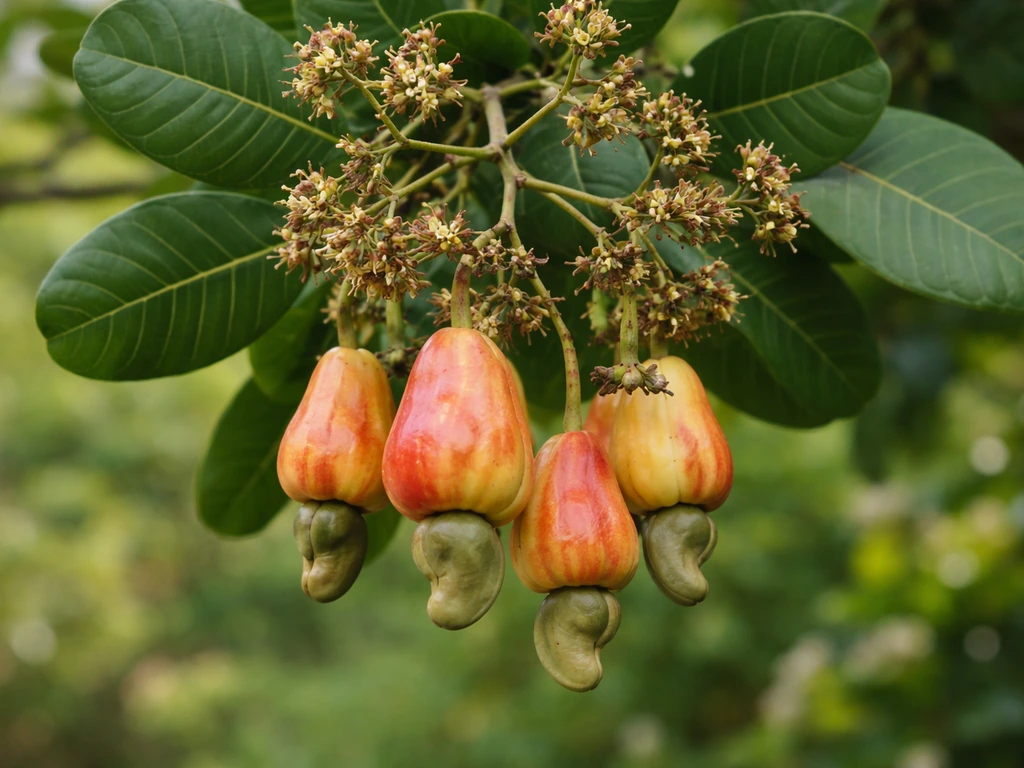
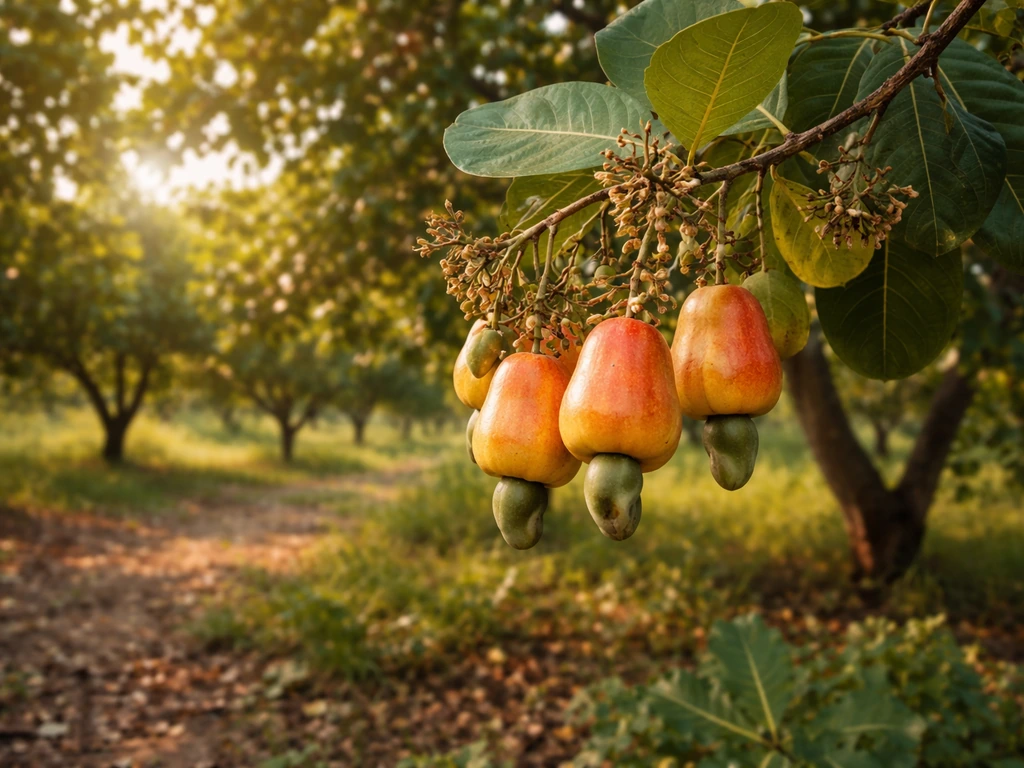
Understanding a little about how cashew forms its nut helps explain why geography matters so much. What most people call a cashew nut is actually the seed of a tropical tree (Anacardium occidentale), attached to the outside of a swollen, fleshy pseudofruit called the cashew apple. The nut hangs below the apple, encased in a shell containing a caustic resin. This structure means the harvest process depends heavily on dry weather at ripening time, because wet conditions during harvest not only make collection difficult but also increase disease pressure.
Flowering and fruit set happen over roughly two and a half months, typically December through February in India's main growing belts. During this window, the tree needs warm days, dry air, and no sustained rain. High humidity combined with warm temperatures creates ideal conditions for fungal diseases like powdery mildew (Oidium anacardii) and other panicle diseases that can devastate a crop. This is exactly why the monsoon-then-dry seasonal pattern of India's coastal states is such a good fit: the rains come down hard from June to October, then ease off just in time for flowering. The biology of the tree and the seasonal climate pattern of coastal India are well-matched.
If you're curious about how the cashew fruit forms and what the cashew apple actually is, that connects to a broader question about how cashews develop on the tree, which is worth exploring separately if you're planning to grow them. And if you are wondering whether cashew grows on trees, the short answer is yes, cashews come from a tropical tree called Anacardium occidentale does cashew grow on trees.
How to check whether your area in India can grow cashew
Rather than guessing, you can run a quick practical checklist against your location. Here's what to assess:
- Temperature: Do you consistently stay above 20°C for most of the year, with no frost risk? If you're in a hill station, plateau above 700 feet elevation, or any area that drops below 10-15°C regularly in winter, cashew is going to struggle.
- Rainfall and seasonality: Do you get a clear dry period from roughly November to February? Check your district's monthly rainfall data. If rain is spread fairly evenly across the year or if the dry period falls at a different time of year, your flowering season will be compromised.
- Annual rainfall total: Somewhere between 1,000 and 3,000 mm is a comfortable range, though cashew survives down to 600 mm with irrigation support and up to 4,500 mm if the dry season holds.
- Soil drainage: Dig a hole about 60 cm deep and pour in water. If it doesn't drain within a few hours, the drainage is too poor for cashew. Black cotton soil areas across Maharashtra's interior, Madhya Pradesh, and the Deccan plateau generally fail this test.
- Soil pH: Get a basic soil test done. pH above 8.0 rules out the site without significant amendment work.
- Elevation: Below 600-700 feet (about 180-210 m) is the practical safe zone for most cashew varieties in India. Some cultivation happens at higher elevations in sheltered, warm microclimates, but these are exceptions.
- Salt risk (coastal plots): If your land is close to the sea or has a history of saline flooding, test soil electrical conductivity (EC). High EC soils will need careful rootstock selection and site preparation.
The states that naturally tick most of these boxes are the ones already growing cashew commercially. ICAR reports that stakeholders’ meetings on cashew development involve officials and scientists from multiple cashew states and institutions, including Andhra Pradesh, Karnataka, Gujarat, Madhya Pradesh, Odisha, and Goa stakeholders’ meetings on cashew development in multiple states. If your district is in one of the coastal states listed above, your starting probability is good. If you're in Rajasthan, Uttar Pradesh, Himachal Pradesh, Jharkhand's upland areas, or similar inland/highland zones, you're likely outside the viable range for reliable cashew production.
Practical next steps for assessing cultivation suitability
If your location looks promising based on the checklist above, here's how to move from general suitability to confident planting decisions:
- Contact your nearest Krishi Vigyan Kendra (KVK) or State Horticulture Department office. India's extension system has district-level cashew suitability data and can point you to recommended rootstocks and grafted varieties for your specific area.
- Check with the Directorate of Cashew and Cocoa Development (DCCD), which is headquartered in Puttur, Karnataka, and publishes state-wise and region-wise productivity data. This is useful for benchmarking what yields are realistic in your belt.
- Get a soil test done through your state agriculture department or a private lab. Ask specifically for pH, EC (electrical conductivity for salinity), and texture/drainage assessment. This takes the guesswork out of the soil suitability question.
- Pull monthly rainfall data for your district from the India Meteorological Department (IMD) website or your state agriculture department. Map out whether December-February is genuinely dry (under 50 mm per month ideally) in your location.
- Visit a working cashew orchard in your district or the nearest district where cashew is grown. Talk to the grower about what the first few years looked like, what varieties they're using, and what problems they've encountered. This kind of ground-level knowledge from someone farming the same microclimate is worth more than any general guide.
- If you're planning to establish an orchard, KSACC guidance recommends digging pits of 1 m x 1 m x 1 m (or 1.2 m x 1.2 m x 1.2 m if there's a hardpan layer) about 15-20 days before planting and leaving them open to sun exposure to reduce soil-borne pest pressure. This simple step makes a real difference in early establishment success.
- Look into which cashew clones are recommended for your state. Varieties like Vengurla series in Maharashtra, Ullal series in Karnataka, or Madakkathara series in Kerala have been developed specifically for regional conditions. Using locally-tested grafted planting material is one of the most practical ways to avoid common establishment failures.
One thing worth keeping in mind: cashew in India is primarily a coastal and lowland tropical crop. If you’re specifically wondering cashew fruit where it grows, you’ll get the clearest answer from India’s coastal belts that match the tree’s warmth and dry-season needs cashew fruit where does it grow. It's not a tree that gets grown successfully everywhere in the country, and the gap between a suitable and an unsuitable site is significant. The good news is that within its natural growing belt, it's a relatively tough tree that tolerates poor soil fertility and some degree of drought once established. Getting the site selection right at the start is really where the work is.
If you're also comparing India's cashew zones to how the crop performs in other countries, the conditions that work in coastal India are broadly the same as what makes Australia's tropical north or parts of the southern United States borderline viable for cashew, with the same coastal warmth, seasonal dry period, and free-draining soil logic applying across regions. For a more specific answer on where cashews grow in Australia, focus on the warm, lowland coastal areas where there is a clear dry season and good drainage Australia's tropical north. In the United States, cashew trees grow only in frost-free, warm coastal areas such as parts of South Florida and Hawaii parts of the southern United States.
FAQ
Can cashew trees grow in inland parts of India, not just the coast?
Yes, cashew can sometimes grow outside the main coastal belt, but reliable yields usually require the same “monsoon-then-dry” seasonal pattern. If your area does not have a distinct drier spell from roughly December to February, trees may flower but fruit set and harvest quality often drop.
If my region is warm, will cashew still grow well if winters are humid or rainy?
Very likely not. Even if winter temperatures stay above 20°C, cashew is highly sensitive to prolonged wet, humid weather during flowering and nut development. In upland or hill areas where clouds and drizzle persist during Dec to Feb, disease pressure increases and panicles can fail.
Is Goa a major cashew-growing area in India, and does it depend on specific locations within Goa?
Goa is among the meaningful producing states, but production varies by locality. Coastal areas with better drainage and a reliable dry season tend to do better than low-lying spots where water lingers after the monsoon.
How should I judge my site if annual rainfall is high, but it still has a dry season?
Look for a seasonally dry window rather than only annual rainfall totals. As a rule of thumb, annual high rainfall is not automatically disqualifying if rainfall concentrates in the monsoon months and eases substantially during flowering.
Can cashew be grown on slightly hilly land or windy coastal plots?
Rough terrain and sloped ground can work well because they improve drainage, but extreme exposure can be a problem. Windy sites close to the coast may need shelter because young growth can suffer damage and establishment can be slower under strong saline winds.
What should I do if my coastal field gets occasional saltwater inundation?
Avoid locations with any history of saltwater flooding, even if the tree otherwise seems suited. Salt stress can reduce performance, and the symptoms may appear gradually as reduced flowering, weaker panicles, or poor fruit development over multiple seasons.
How can I tell if my soil drains well enough for cashew?
Cashew orchards often do poorly in heavy clay or waterlogged pockets, even if the rest of the farm looks suitable. A simple check is to observe whether water stands after monsoon rains for more than a short period, and to confirm the presence of free-draining subsoil before planting.
My soil tests show alkaline conditions, is there any point trying anyway?
For pH, use soil testing rather than guesswork. If pH is consistently above about 8.0, cashew commonly underperforms, and correcting alkaline conditions across a whole orchard can be difficult, so site choice is usually the better decision.
Can microclimates within the same district affect cashew outcomes?
Yes. Because flowering and fruit set occur over about two and a half months, even local microclimates matter. Low areas that stay cooler or remain foggy through the season may reduce fruit set compared with nearby slightly higher, drier plots.
What is the fastest decision rule for whether cashew is worth planting in my location?
The safe way is to treat your planting decision as a combination of climate timing, temperature, and drainage. If you are in an inland, cooler, or consistently wet winter area, even “good enough” soil and warmth may not translate into dependable yields.