Yes, walnut trees can grow in Texas, but the honest answer is more complicated than a simple yes. Whether you can actually get a reliable nut harvest depends heavily on which species you plant, where in Texas you're located, and how well you manage the real limitations the state throws at you: chill hours, heat, humidity, soil pH, and disease pressure. Some parts of Texas are genuinely good for walnuts. Others are a tough sell no matter what you do.
Do Walnut Trees Grow in Texas? Types, Regions, Care
Marcus Hendricks
17 Apr 2026
The quick answer for Texas growers
Texas has native walnut trees and can support English (Persian/Carpathian) walnut cultivation in parts of the state, but commercial-style production is difficult and in many areas impractical. Texas A&M AgriLife Extension is blunt about black walnut: no black walnuts are commercially produced in Texas. English/Persian walnut varieties grown successfully in California don't transfer well to Texas either, largely because of walnut blight, a bacterial disease that thrives in Texas's humidity. That said, this doesn't mean you're out of options. It means you need to pick the right species and variety for your specific region, use the right rootstock, and go in with realistic expectations.
Which walnut species can actually grow in Texas
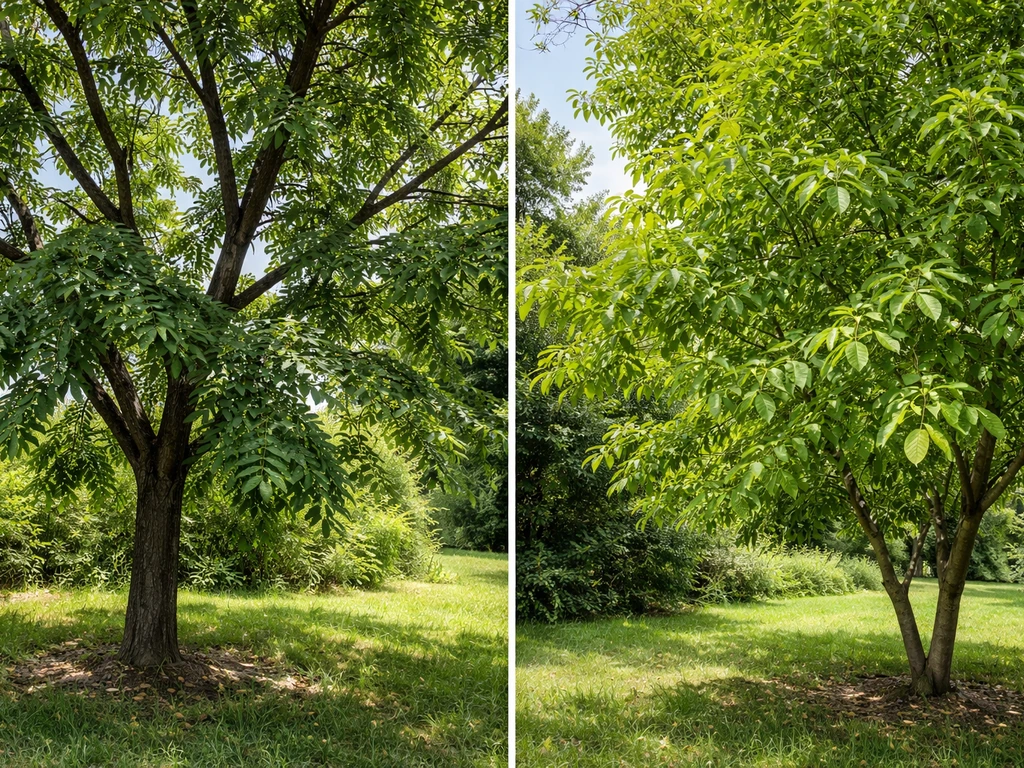
There are two major groups most people are thinking about when they ask this question. If you want to understand the full picture of how walnuts grow on trees and which species are even on the table, it helps to start with the basics. The main categories for Texas are:
- Eastern black walnut (Juglans nigra): Native to eastern North America, produces edible but strongly flavored nuts with very hard shells. Not commercially produced in Texas.
- Texas black walnut (Juglans microcarpa): A native Texas species, smaller tree with small, thick-shelled nuts. Low commercial value but excellent as a rootstock for Texas conditions.
- English/Persian/Carpathian walnut (Juglans regia): The mild-flavored grocery store walnut. Grown worldwide, cultivated in parts of Texas, but highly susceptible to walnut blight under humid conditions.
- California black walnut (Juglans hindsii): Mainly used as rootstock in California; poorly adapted to Texas soils.
Of these, English walnut grafted onto Texas black walnut rootstock (Juglans microcarpa) is the most promising path for Texas growers. Texas black walnut is far better adapted to the state's high-pH, alkaline soils than either Eastern black walnut or California black walnut rootstock. If you're planting in central or west Texas especially, rootstock selection can make or break the tree's survival, let alone its productivity.
Chill hours, heat, and where each walnut does best in Texas
Chill hours, defined as hours with temperatures between 32°F and 45°F, are the single biggest climate variable for walnut success in Texas. Trees need a minimum number of these hours each winter to break dormancy properly and set a reliable crop. Planting a variety that needs 1,000 chill hours in an area that averages 400 is a recipe for poor leafout, erratic fruiting, and eventual decline.
Texas A&M AgriLife Extension recommends varieties for East Texas that require no more than 800 to 900 chill hours. That's a useful ceiling to keep in mind. The state's chill hour averages vary dramatically by region: East Texas can see 700 to 900+ hours in a typical year, the Hill Country and Central Texas averages closer to 600 to 800, the Gulf Coast and South Texas often falls below 400, and the far west panhandle can push above 1,000. Texas A&M publishes county-based chill hour maps that are worth checking before you commit to a specific variety.
| Region | Avg Chill Hours | Best Walnut Option | Key Challenge |
|---|---|---|---|
| East Texas | 700–900+ | English walnut (low-chill varieties) | Walnut blight, humidity |
| Central Texas / Hill Country | 600–800 | English walnut on Juglans microcarpa rootstock | Variable winters, alkaline soil |
| Gulf Coast / South Texas | Under 400 | Not recommended | Insufficient chill hours |
| West Texas / Trans-Pecos | 400–700 (varies) | Native Texas black walnut only | Drought, heat extremes |
| Panhandle | 900–1,100+ | English walnut (higher-chill varieties possible) | Late freezes, wind exposure |
Heat tolerance is the other side of the equation. English walnuts prefer moderate summers and can struggle during extended Texas heat above 100°F, especially combined with dry conditions. Texas black walnut is far more heat and drought tolerant by nature, which is part of why it's such a valuable rootstock. Even if the graft scion (the English walnut top) struggles in brutal summers, a strong Juglans microcarpa root system keeps the tree alive through conditions that would kill a California-rooted tree.
Planting requirements: site, soil, and spacing
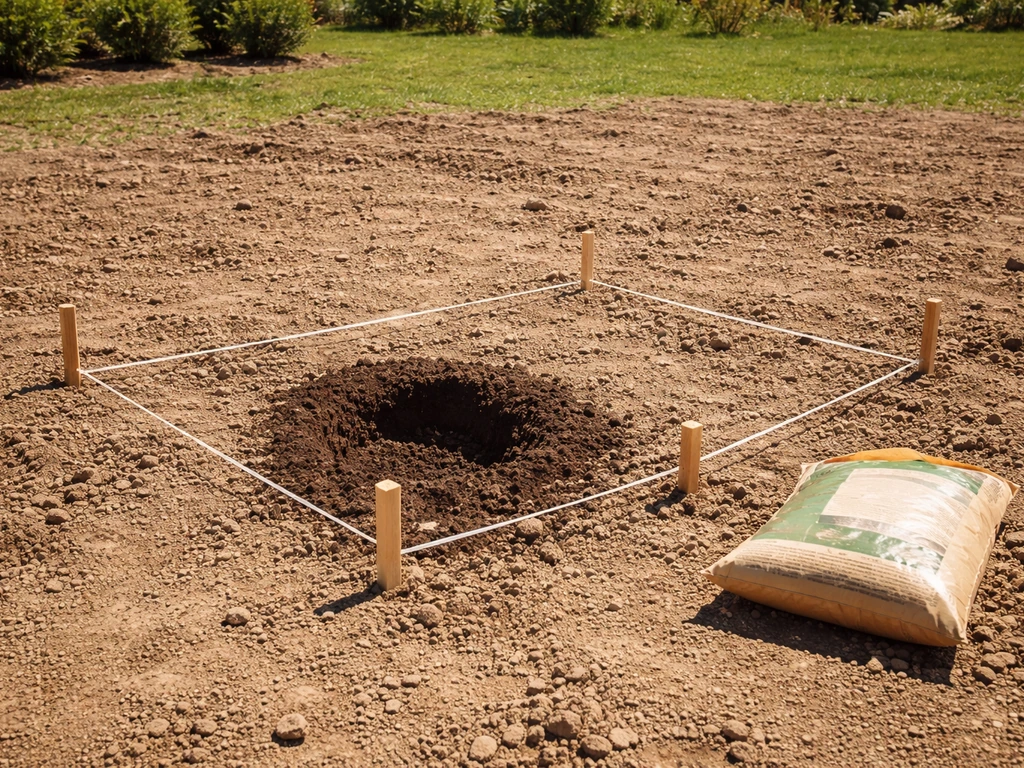
Sun and site selection
Walnut trees need full sun, at least 6 to 8 hours of direct light daily. Don't plant them in a spot that gets afternoon shade from a building or tree line if you want meaningful nut production. Site selection also matters for air circulation, since poor airflow in humid East Texas settings accelerates disease pressure from walnut blight. A gentle slope with good air drainage is better than a low-lying spot where cold air and humidity pool.
Soil pH and drainage
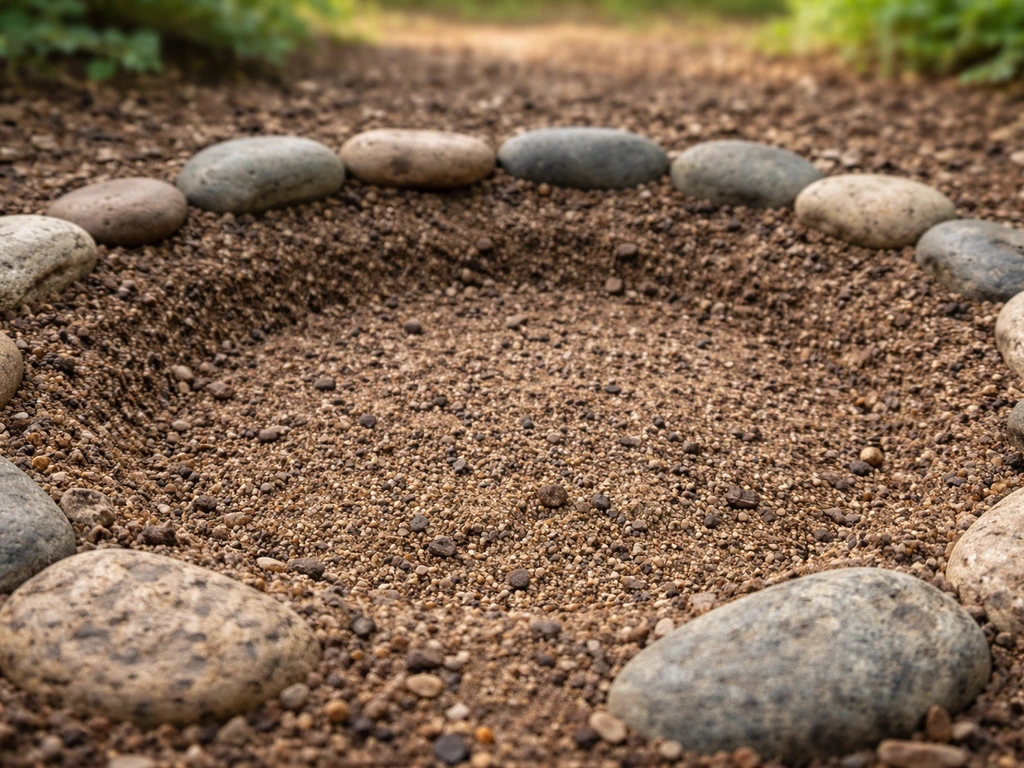
This is where Texas gets tricky. Fertile loams and sandy loams with a pH of around 6.5 to 7.2 are ideal for black walnut in general. The problem is that large portions of Texas, especially central and west Texas, have alkaline soils well above pH 7.5 and often into the 8+ range. Eastern black walnut and California black walnut rootstocks struggle badly in these conditions. Texas black walnut (Juglans microcarpa) is adapted to exactly these high-pH, calcareous soils, which makes it the go-to rootstock for Texas plantings.
Drainage is non-negotiable. Walnuts do not tolerate waterlogged roots. Even a soil that looks fine on paper can be problematic if there's a compaction layer, clay hardpan, or poor drainage history. Before planting, dig a hole 12 to 18 inches deep, fill it with water, and check whether it drains within a few hours. If it sits for 24 hours, that site will stress or kill a walnut tree long before it ever produces nuts. Raised beds or berming can help, but on a deeply poor-draining site, it's better to find a different spot.
Spacing and companion considerations
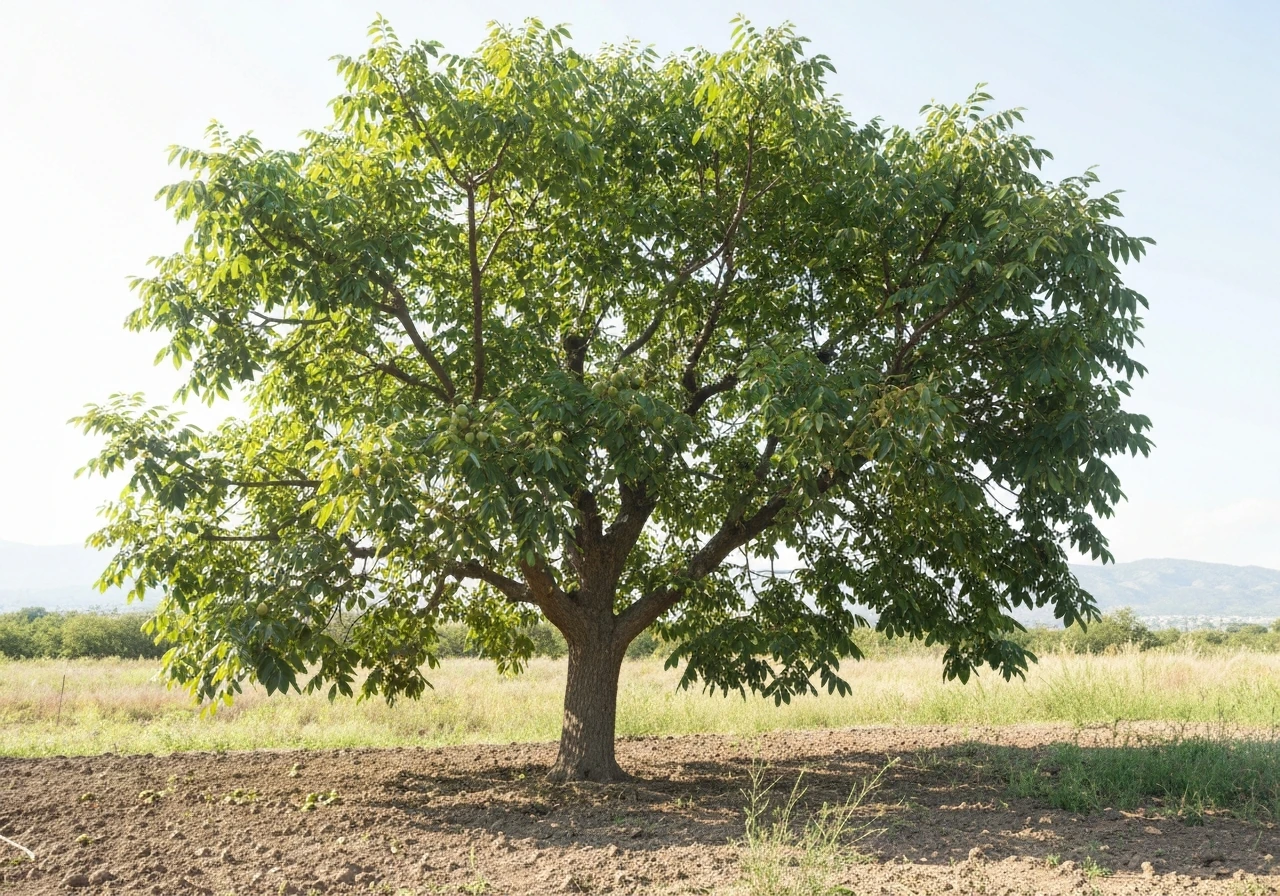
Standard walnut trees need 40 to 60 feet of spacing between trees to avoid crowding at maturity. More compact or semi-dwarf grafted varieties can be spaced somewhat closer, around 20 to 30 feet, but walnuts in general are large trees. Also worth noting: walnut trees produce a chemical called juglone from their roots, husks, and leaves. Many plants are sensitive to it and will decline or die if planted within the tree's root zone. Keep vegetable gardens, tomatoes, peppers, and many ornamental shrubs well away from walnut trees.
Pollination and getting a nut set
Walnut trees are wind-pollinated and produce both male (catkins) and female flowers on the same tree, making them technically self-fertile. However, there's a catch: in many walnut varieties, the male and female flowers don't reach maturity at the same time on a single tree, a condition called dichogamy. This means pollen shed and female flower receptivity may not line up well enough for reliable self-pollination. The practical result is that a single tree may produce nuts, but yields are often significantly better with two or more trees of different varieties planted nearby to improve cross-pollination timing.
This is the same cross-pollination principle that Texas A&M AgriLife Extension applies to pecan orchard management in the state: planting complementary varieties improves pollen overlap and overall fruit set. If you have space for only one walnut tree, you may still get some production, but if you can plant two trees with overlapping bloom periods, you'll get more consistent yields. Check with your nursery about which varieties are protandrous (shed pollen first) versus protogynous (female flowers receptive first) and pair accordingly.
How long until you're actually harvesting walnuts
Patience is required. English walnut trees will begin to produce nuts when they are 4 to 6 years old, but good crops often don't come until the tree is 15 to 20 years old. That's a long runway. You might see a handful of nuts at year five, a modest crop by year eight to ten, and genuinely satisfying harvests somewhere in the second decade. This is one of the most important things to be realistic about before planting.
If you're wondering whether walnut trees produce nuts every year, the honest answer is: not always. Even mature trees can skip or produce lightly in years with late frosts that kill emerging flowers, insufficient chill hours after a warm winter, or significant drought stress during nut development. Texas weather variability makes consistent year-to-year yields more difficult than in more temperate climates.
Texas-specific problems and how to deal with them
Walnut blight and fungal disease
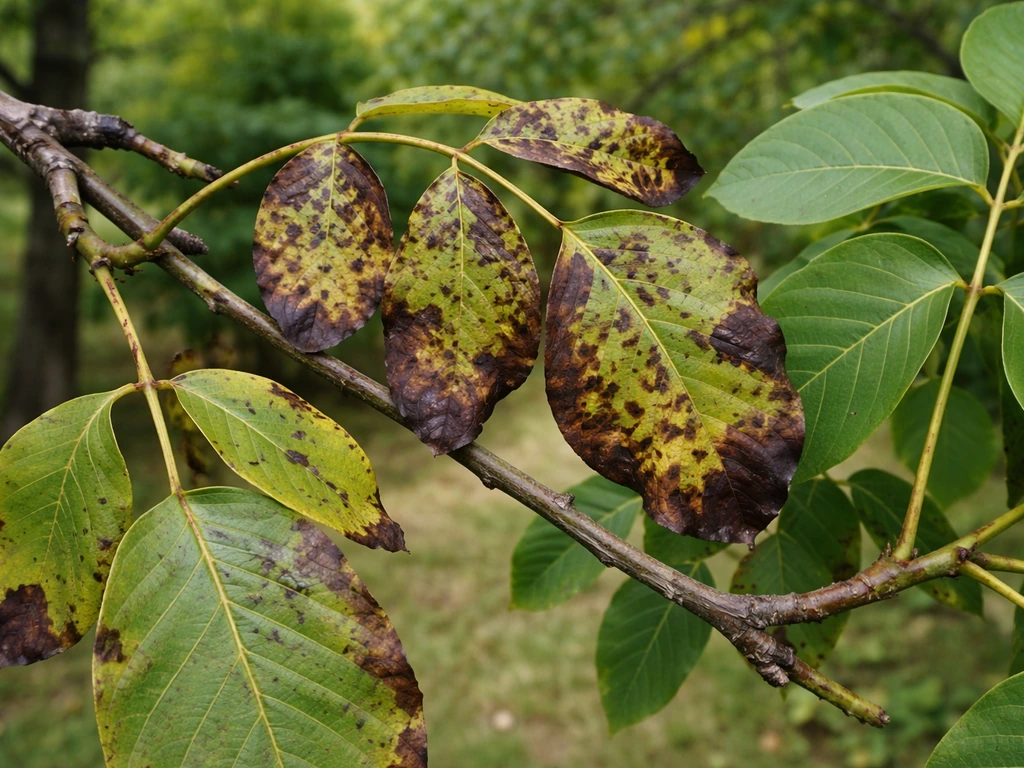
Walnut blight, caused by the bacterium Xanthomonas arboricola pv. juglandis, is one of the main reasons English walnut varieties bred for California don't perform well in Texas. The disease attacks young shoots, catkins, and developing nuts during wet spring weather, which East Texas sees plenty of. Infected nuts turn black and drop early, and heavy infections can nearly eliminate a crop. Under conditions of prolonged high humidity, copper-based fungicide sprays (like Kocide 101 at approximately 2 pounds per 100 gallons of water) are recommended. Timing is critical: applications during bud break and early nut development are most effective. Selecting varieties with better disease resistance and maintaining good air circulation around the canopy reduces pressure significantly.
Drought and heat stress
During extended Texas droughts, walnut trees show stress through early leaf drop, poor nut fill, and bark cracking. English walnuts are more vulnerable than native Texas black walnut. If you're in central or west Texas, the Juglans microcarpa rootstock provides meaningful drought resilience, but the scion above it will still need supplemental irrigation during dry periods, especially in the first five years of establishment. Deep, infrequent watering is always better than shallow daily wetting.
Pest pressure: walnut caterpillar and others
Foliar pests in Texas walnut plantings include aphids, fall webworm, and walnut caterpillar. Walnut caterpillar (Datana integerrima) is a serious threat, capable of completely defoliating a walnut, pecan, or hickory tree if populations go unmanaged. They feed in groups, which makes them easier to spot but also means damage spreads fast once a colony gets established. Texas A&M AgriLife Extension has specific scouting and residential management guidance for walnut caterpillars, and early intervention when colonies are small is far easier than dealing with a full outbreak. Bacillus thuringiensis (Bt) sprays work well on young caterpillars. Aphid populations can usually be knocked back with strong water jets or insecticidal soap before they build to damaging levels.
Insufficient chill hours
In warm-winter years, even East Texas locations can come up short on chill hours. The symptoms look like erratic budbreak, poor leaf development, reduced flowering, and light or absent nut set. There's no fix for a warm winter after the fact, but you can minimize the damage by choosing varieties that require no more than 800 chill hours (staying within about 150 hours of your local average) and avoiding high-chill California varieties marketed without Texas-specific trial data. Matching variety to local chill averages is probably the single highest-leverage decision you'll make.
A practical Texas care plan
Watering
Young walnut trees need consistent moisture during the first two to three years, roughly 10 to 15 gallons per week during the growing season in dry conditions, delivered slowly at the drip line rather than at the trunk. Once established, mature trees can survive on natural rainfall in wetter parts of East Texas but will need supplemental irrigation during drought. During nut fill in late summer, water stress causes hollow or poorly developed nuts, so don't let the tree go dry from July through September.
Fertilizing
In most Texas soils, a soil test before planting and again every two to three years is the right starting point. Nitrogen is usually the most limiting nutrient. A common approach is applying a balanced fertilizer (10-10-10 or similar) in early spring just before leafout, with rates adjusted to tree size. Mature trees in good soil may need only nitrogen supplementation. Avoid heavy nitrogen in late summer, which pushes tender late-season growth that's more vulnerable to early frost damage.
Pruning
Prune walnut trees during late winter dormancy, before buds swell. The goal in early years is establishing a central leader with well-spaced lateral scaffold branches. Remove crossing, rubbing, or competing branches. Once the structure is set, annual maintenance pruning focuses on removing dead wood, improving airflow through the canopy, and keeping the tree at a manageable height. Avoid heavy pruning during the growing season, which can stress the tree and invite disease entry.
Harvest timing
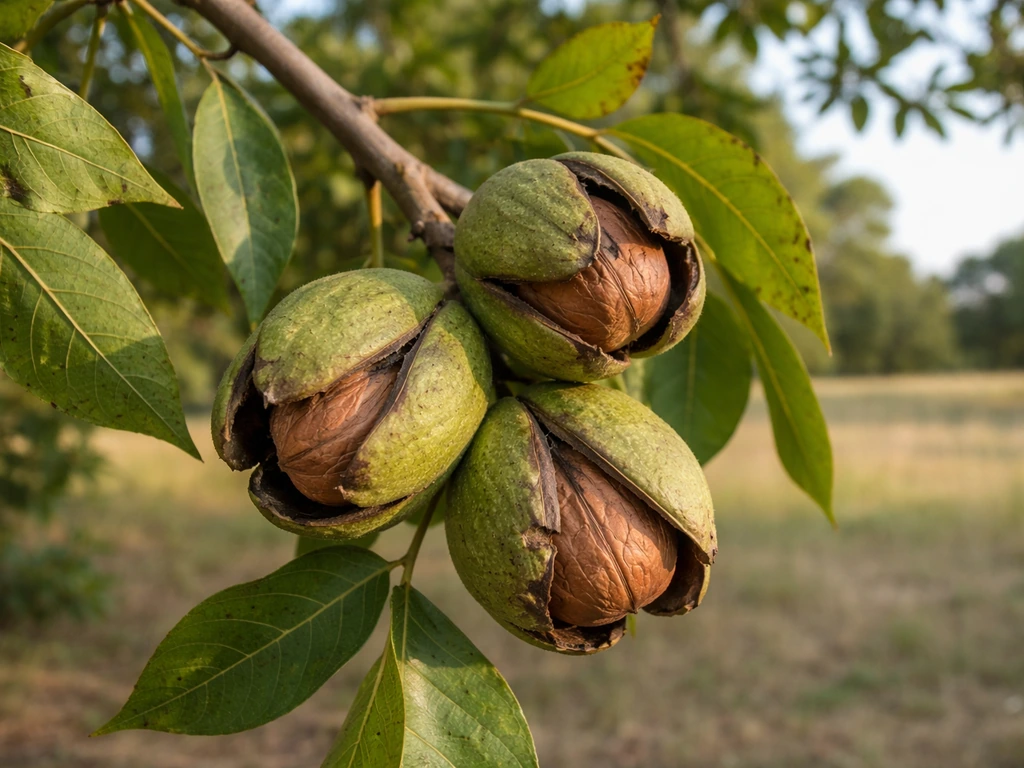
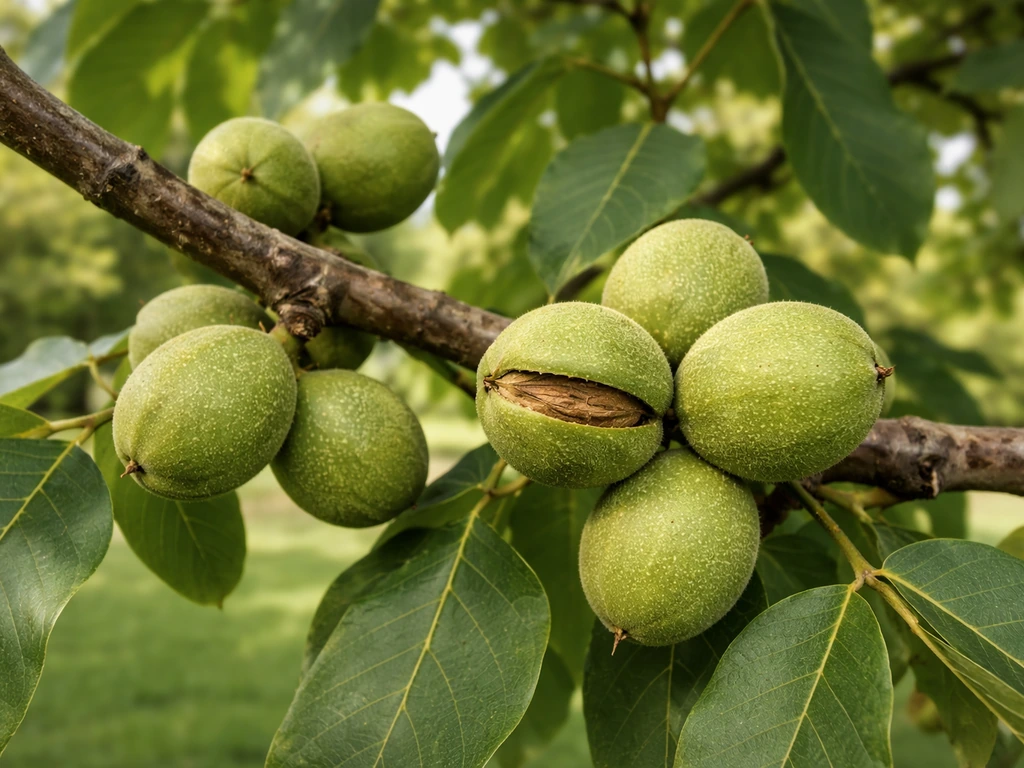
Walnuts are ready to harvest when the outer green husk begins to split and loosen from the shell, typically in September to October in Texas depending on variety and location. Don't wait too long after the husks crack open, since nuts on the ground are quickly claimed by squirrels and can develop mold in wet weather. Wear gloves when handling fresh walnuts because the husk juice stains skin and fabric dark brown and is very persistent. After harvest, remove any remaining husk material and dry the nuts in a single layer in a warm, well-ventilated space for two to three weeks before cracking or storing.
Is Texas the right place for walnuts at all?
Compared to places like England or Ireland, where English walnuts thrive in cooler, more stable climates, Texas presents some real biological headwinds. If you're curious how walnut trees fare in Ireland or how different the growing challenge looks in a cooler, wetter climate, the contrast is striking. Similarly, the question of whether walnuts can grow in the UK comes down to the same chill-hour and humidity calculation, just from the opposite direction.
For context on a global scale, where walnut trees grow in India shows just how wide the native range of Juglans regia actually is, from the Himalayas through Kashmir, with conditions that happen to share some features with Texas hill country but with more moderate summers. The common thread across all these locations is that climate matching, specifically chill hours and humidity management, determines success far more than any amount of care and attention after the fact.
If you're still deciding whether walnuts are the right nut tree for your property, it's worth stepping back and looking at where walnut trees grow best across North America and globally before committing to a planting. For Texas specifically: East Texas growers with 700+ chill hours and good drainage have the best realistic shot at English walnut production, especially using Texas black walnut rootstock and disease-resistant varieties. Central Texas is a stretch but possible with careful variety selection. South Texas and the Gulf Coast are generally not suitable. West Texas is native Texas black walnut territory, not commercial English walnut country. Go in knowing that, pick your variety carefully, and you'll avoid the most common and expensive mistakes.
FAQ
Can I grow English (Persian) walnuts in Texas if I get a good variety from a nursery, but I miss the chill hour target slightly?
You might get growth, but you should expect erratic flowering and inconsistent nut set. A small shortfall can mean delayed or uneven budbreak, while a bigger gap often results in weak catkin formation and poor female flower receptivity. If your site averages under the variety’s chill requirement, prioritize varieties that were specifically trialed for Texas or comparable warm-winter regions, and be realistic about yields.
What’s the biggest mistake people make with walnut spacing in Texas yards?
Planting too close to fences, buildings, or other trees. Even if you can physically fit the canopy, walnuts need airflow to reduce disease pressure and require substantial mature size. Use the larger end of spacing guidance unless you’re sure you have a semi-dwarf form and can prune for a long-term open canopy.
Do I really need two walnut trees to get a real crop in Texas?
Not always, but it’s often the difference between occasional nuts and consistent harvests. Even though walnuts are technically self-fertile, many varieties have non-overlapping pollen shed and female receptivity (dichogamy). Pairing two varieties with overlapping bloom windows improves pollination timing and typically raises yield more than any fertilizer adjustment.
How do I know if my soil pH is too high for walnuts before planting?
Do a full soil test, not just a quick pH probe, and pay attention to calcium carbonate and overall texture. High pH alone can limit certain rootstocks, but drainage and compaction issues make the problem worse. If your test shows strongly alkaline conditions, choose Texas black walnut rootstock, and consider raised beds or berming only if you can still achieve fast drainage.
What water schedule should I follow during the first few years, and what should I avoid?
In dry Texas conditions, focus on deep, slow watering at the drip line and keep moisture steady for the first 2 to 3 years. Avoid frequent shallow watering, because it encourages surface roots that are more vulnerable to heat stress and drought swings. During nut fill (late summer), don’t let the tree dry out, because it can lead to hollow nuts and poor kernel development.
If walnut blight is the main disease concern, is spraying the only solution?
No. Sprays help, but cultural steps often determine whether spraying is manageable. Prioritize disease-resistant varieties, keep the canopy open for airflow, and avoid overhead wetting that keeps foliage humid. Also, align spray timing around bud break and early nut development, because late applications are much less effective once lesions are established.
Can I plant vegetables or fruit trees near a walnut?
Be careful within the walnut root zone. Walnuts release juglone, and many sensitive plants decline if their roots are too close to walnut roots or if the area stays shaded and cool. If you want to grow annuals, consider placing them farther away than your canopy drip line and avoid root-scraping near the walnut.
Why do my walnuts leaf out but fail to set many nuts, even though the tree seems healthy?
Common causes in Texas include chill mismatch after warm winters, poor pollination overlap, drought stress during nut development, or late frosts damaging emerging flowers. Check bloom timing, confirm you have compatible varieties nearby, and monitor soil moisture especially from summer into early nut fill.
My walnut tree is wilting during heat waves. Should I assume it needs more fertilizer?
Usually not. Heat stress and drought symptoms can look similar to nutrient issues, but high nitrogen can actually worsen vulnerability by pushing tender growth. First verify drainage and watering depth, then only supplement nutrients based on a soil test. If the soil is dry, switch to deep irrigation rather than adding fertilizer.
When is the safest time to prune walnut trees in Texas?
Prune during late winter dormancy, before buds swell. Avoid heavy pruning in the growing season because fresh wounds can increase stress and create openings for disease. If you must remove dead or broken wood, make the cuts clean and remove only what’s necessary to prevent bark injury and rubbing.
How do I harvest walnuts in Texas without losing most of them to squirrels or mold?
Harvest soon after husks split and loosen, and plan for daily checks during peak weeks. Nuts that sit on the ground get taken quickly and can develop mold in wet weather. After picking, dry nuts in a single layer in a warm, well-ventilated area for 2 to 3 weeks before cracking or storage, and remove leftover husk material promptly.