Yes, chestnut trees can grow in Texas, but success depends enormously on where in Texas you are, which species you plant, and how carefully you manage the site. Texas is not chestnut country by default. The climate throws curveballs that would challenge even experienced growers: searing summer heat, alkaline soils, inconsistent winter chilling, and fungal disease pressure that tracks closely with humidity. That said, growers in the right zones with the right species have pulled off productive chestnut orchards in Texas, so if you go in with clear eyes and a solid plan, you have a real shot.
Will Chestnut Trees Grow in Texas? Best Types and Care
Marcus Hendricks
15 Apr 2026
How Texas climate shapes your odds
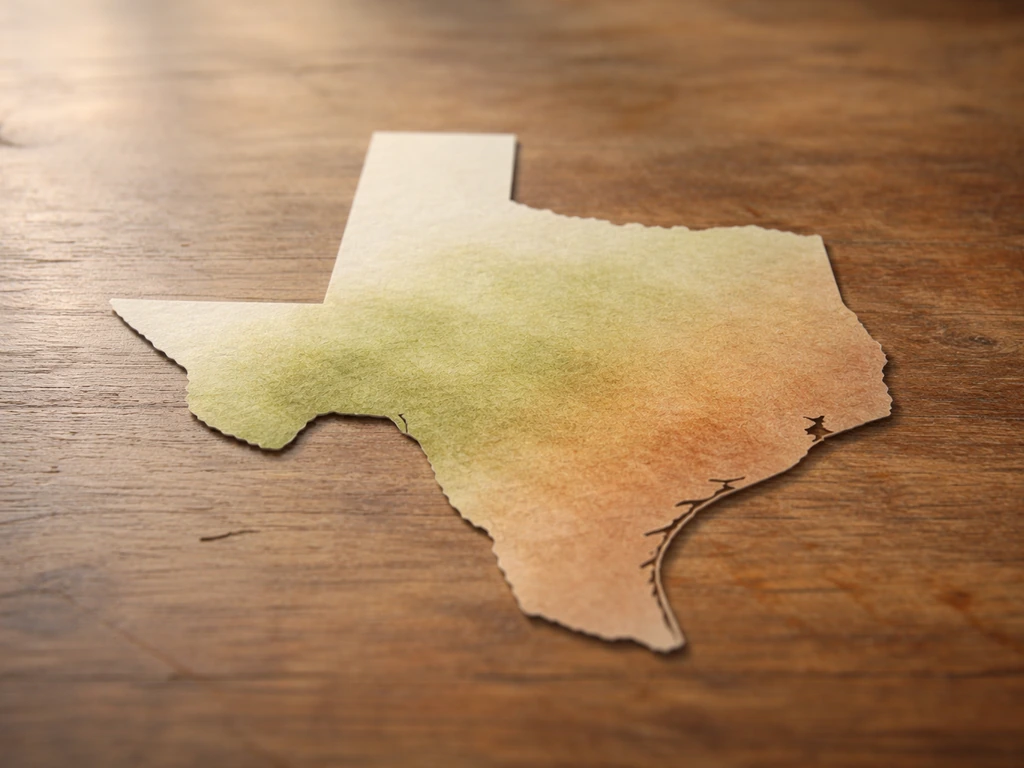
Texas spans USDA hardiness zones 6a in the Panhandle all the way to 9b along the Gulf Coast and in the lower Rio Grande Valley. That's an enormous range, and chestnuts care deeply about where within that range you land. The core issue is threefold: winter chilling, summer heat, and humidity.
Chestnuts need a real dormancy period. Most productive chestnut varieties require somewhere between 400 and 1,000 chill hours (hours at or below 45°F) to break dormancy properly and set a good nut crop. The Texas Panhandle gets plenty of cold. Amarillo regularly sees minimum temperatures at or below freezing for nearly a third of the year, which translates to more than enough chilling for most species. The challenge there is the opposite: hard freezes that can damage flower buds or new growth in spring, plus a shorter frost-free season that compresses nut development time.
Central Texas sits in a useful middle ground. The Hill Country around Fredericksburg, for example, has a frost-free period averaging 219 days. That's plenty of season length for chestnuts to develop and ripen nuts. Dallas-Fort Worth offers similar math, with an average last frost around March 12 and first frost around November 12, giving roughly 245 frost-free days. These Central and North Texas zones tend to be the sweet spot: enough chilling, long enough summers, and not quite the brutal humidity you get on the Gulf Coast.
East Texas is warm and humid. Humidity is chestnut blight's best friend. The further east and south you go, the harder disease management becomes. Southeast Texas essentially mirrors the climate that makes chestnuts miserable in the Deep South. If you want to understand how humidity reshapes the calculus entirely, the challenges growers face in growing chestnut trees in Florida illustrate exactly what you're up against at the extreme end.
West Texas and the Trans-Pecos are dry and hot with alkaline soils. The dryness reduces disease pressure, but the heat stress, drought stress, and soil chemistry create their own serious problems. The Gulf Coast is too warm, too humid, and rarely gets enough chilling. For most of the article, when I talk about promising Texas chestnut ground, I mean North Texas, Central Texas, and higher-elevation parts of the Hill Country and Trans-Pecos.
Which chestnut species actually work in Texas
There are four main chestnut species in play for Texas growers: American (Castanea dentata), Chinese (Castanea mollissima), European (Castanea sativa), and Japanese (Castanea crenata). Beyond the straight species, there are hybrid trees, often American-Chinese or Japanese-Chinese crosses, that were bred specifically to balance blight resistance, heat tolerance, and nut quality. Here's the honest rundown.
| Species / Type | Blight Resistance | Heat Tolerance | Chilling Requirement | Verdict for Texas |
|---|---|---|---|---|
| American (C. dentata) | Very low | Moderate | 600–1,000 hrs | Not recommended; blight will likely kill it |
| Chinese (C. mollissima) | High | Good | 400–600 hrs | Best single-species option for most of TX |
| European (C. sativa) | Low-moderate | Low-moderate | 700–1,000 hrs | Too disease-prone; struggles in TX heat |
| Japanese (C. crenata) | High | Moderate | 300–500 hrs | Useful in warmer zones; smaller nut |
| American-Chinese hybrids | High | Good | 400–700 hrs | Top choice; combines quality and resilience |
| Dunstan hybrids | High | Good | 400–600 hrs | Well-tested in TX; strong track record |
Chinese chestnuts are the workhorse for Texas. They handle blight well, tolerate heat better than European varieties, and their chilling requirements land squarely in the range Texas's better chestnut zones can deliver. Dunstan chestnuts, which are American-Chinese hybrids developed partly for the southeastern U.S. market, have been planted in Texas with solid results. They offer the larger, sweeter nut you'd associate with American chestnuts while carrying enough Chinese genetics to resist blight. For anyone in Central or North Texas, a Dunstan or a quality Chinese variety should be your starting point.
American chestnuts are a sentimental favorite, but I'd steer you away from them in Texas unless you are specifically involved in restoration trials. Chestnut blight (Cryphonectria parasitica) is present in the eastern U.S. and can hitchhike to Texas. An American chestnut in East Texas humidity is a liability. Pure European varieties face a similar problem and also don't love Texas summers. Japanese chestnuts are worth considering in the warmer, lower-chill zones further south, especially as pollinators, though their nut quality tends to be average.
If you are curious how neighboring states handle species selection, chestnut growing in Georgia covers a similarly warm, humid southeastern climate where Chinese and hybrid varieties dominate for exactly the same reasons.
Picking the right site and getting your soil right
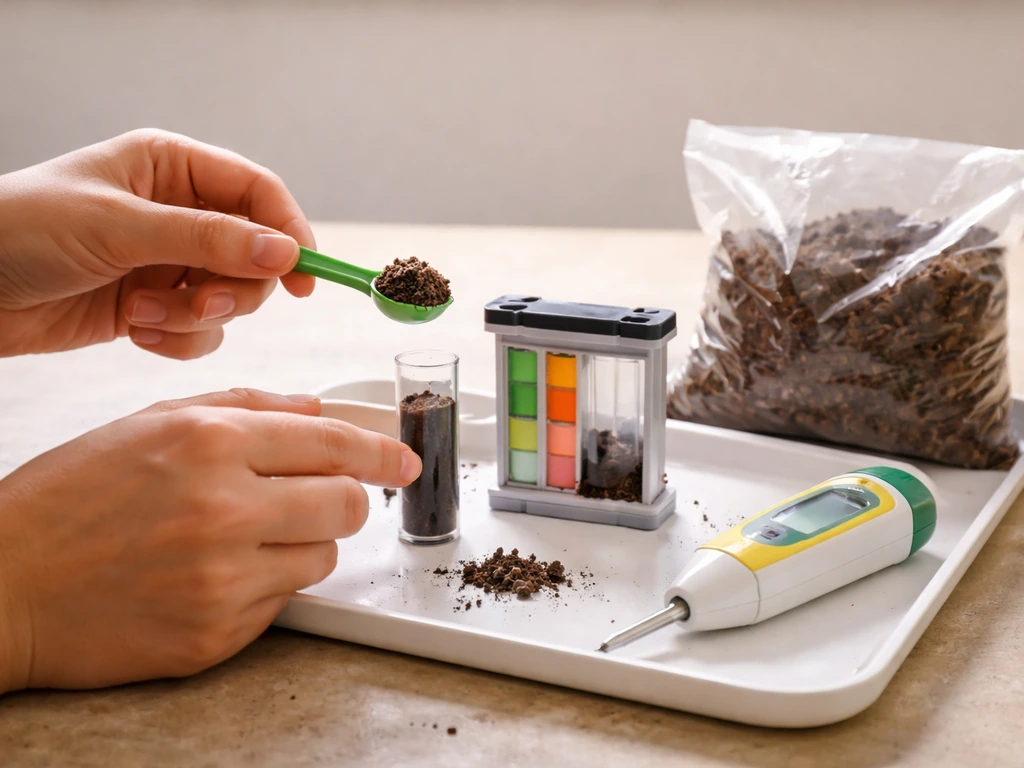
Soil is where Texas trips up more chestnut growers than almost anything else. Chestnuts are notoriously intolerant of alkaline soils. They need a soil pH between 5.0 and 6.5, ideally closer to 6.0. Much of Texas, especially Central Texas Hill Country, West Texas, and the Blackland Prairie, has naturally alkaline soils with pH values of 7.0 to 8.5. Plant a chestnut in pH 8 soil and you'll watch it turn yellow and stall within a couple of seasons from iron and manganese deficiency. Before you do anything else, get a soil test.
If your soil tests alkaline, you have two practical paths: amend a defined planting area with sulfur to bring the pH down over time (plan 1 to 3 years to significantly shift pH in heavy soils), or seek out naturally acidic pockets. Sandy soils in East Texas, certain loamy sites in the Post Oak Savanna region, and some hillside spots with sandy loam profiles can naturally run closer to the 6.0 range. The goal is drainage as much as pH. Chestnuts die from wet feet. They want deep, well-drained soil, ideally 3 feet of root zone without a restrictive hardpan or water table. A slope with good drainage is almost always better than a flat bottom with marginally better soil.
For sun exposure, chestnuts want full sun, at least 6 to 8 hours of direct sun daily. In the hottest parts of Texas, light afternoon shade can reduce heat stress, but avoid planting in areas that stay damp or shaded, as that combination accelerates fungal problems. Good air circulation around the canopy also matters more than people realize. Do not plant chestnuts in low spots where cold air pools in spring either, since a late freeze hitting young flowers can wipe out a whole year's crop.
It is worth noting that one oak relative you might encounter is the chestnut oak, which is native to parts of the eastern U.S. If you have been researching native options, understanding where chestnut oak trees naturally grow will clarify that it is a very different plant from a nut-bearing chestnut, adapted to different soil and climate conditions.
Planting, spacing, and getting your trees established
In Texas, plant container-grown or bare-root chestnuts in late winter to early spring, ideally between late February and early April in Central and North Texas. You want the tree in the ground with time to establish roots before summer heat arrives. Fall planting can work in milder years, but hot dry falls can stress newly planted trees before roots have spread. For the Panhandle, stick closer to April after freeze risk drops.
Spacing depends on your goals. For a home orchard, space trees 20 to 30 feet apart in rows. For commercial-scale planting, 30 to 40 feet between trees and 40 feet between rows is common to allow equipment access and crown expansion. Chestnuts can eventually reach 40 to 60 feet tall with a wide spreading canopy, so do not cram them. Cramped trees compete for light and airflow, which increases disease risk.
Watering during establishment is critical and non-negotiable in Texas. For the first two summers, plan to irrigate deeply and regularly. Young chestnuts need about 1 to 2 inches of water per week when rainfall doesn't deliver it. Drip irrigation works well. Avoid overhead sprinklers that wet foliage and promote leaf fungal issues. Once established (typically year 3 to 4), mature chestnuts are moderately drought-tolerant, but in Texas's heat they will fruit better with supplemental irrigation during dry stretches in summer.
Mulch is your best friend in Texas chestnut culture. Apply 3 to 4 inches of wood chip mulch around the base of each tree, kept several inches away from the trunk. Mulch conserves soil moisture, moderates soil temperature, and suppresses weeds that compete with young trees. In the brutal heat of a Texas summer, the difference between a mulched and unmulched young chestnut is often the difference between survival and failure.
Pollination and realistic nut production
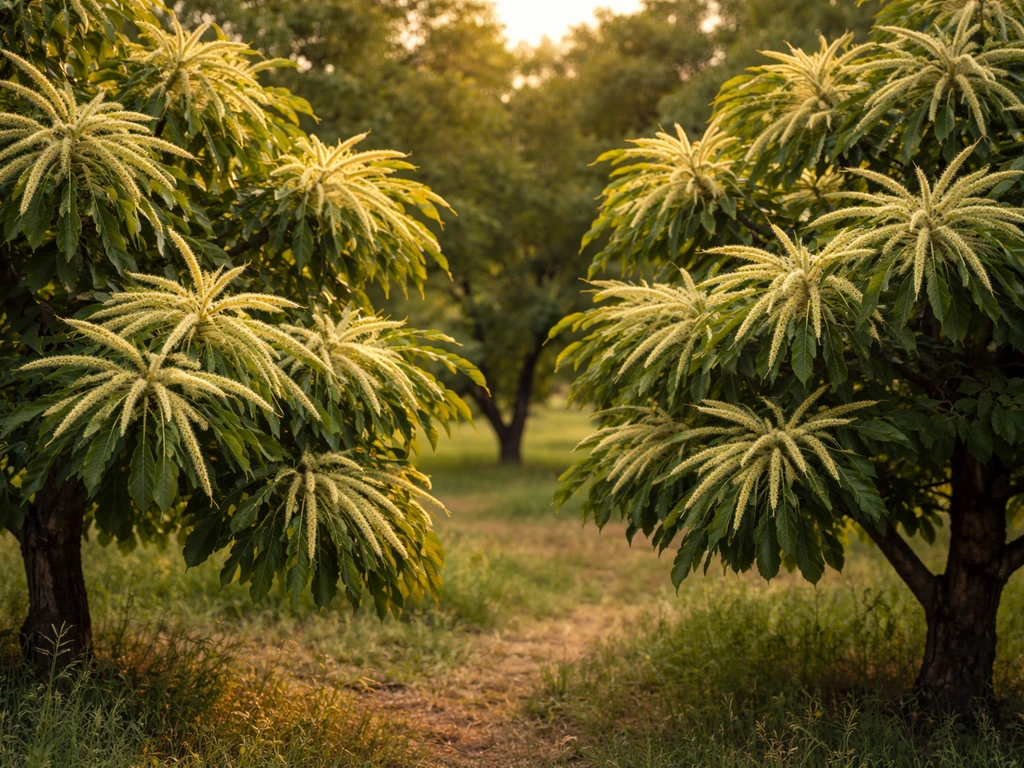
Here is something that surprises many first-time chestnut growers: chestnuts are not self-fertile. You need at least two genetically different trees to get reliable nut production. A single tree will sometimes produce a handful of nuts through incomplete self-pollination, but a real crop requires cross-pollination. Plant at least two different chestnut varieties or seedling trees, ideally within 50 feet of each other for good pollination, though bees can carry pollen much further.
Chestnuts bloom in early to mid-summer in Texas, typically June to July. The catkins (long pollen-bearing flower clusters) are wind-pollinated but bees also transfer pollen effectively. Bloom timing needs to overlap between your trees. This is another reason why buying from a nursery that knows chestnut bloom timing, or buying named varieties with known overlap, matters more than grabbing whatever trees happen to be available.
In terms of timeline, do not expect meaningful nut production before year 3 to 5 from a grafted tree, or year 5 to 7 from a seedling. Once chestnuts are producing, a mature tree can yield 25 to 50 pounds of nuts per year, with some productive trees doing considerably better. Grafted named varieties tend to produce sooner and more consistently than seedlings. For Texas growers trying to decide if the investment is worth it, I'd frame it this way: chestnuts are a long-term commitment, not a quick harvest crop. You are planting for the next decade and beyond.
Texas-specific pests and diseases to watch for
Chestnut blight is the big one. It is caused by the fungus Cryphonectria parasitica and kills susceptible trees by girdling the bark. In Texas, the risk is lower than in the humid Southeast, but it is not zero, especially in East Texas. The practical defense is to start with blight-resistant varieties (Chinese or hybrids) and inspect trees annually for cankers or sunken, discolored bark. There is no cure once blight takes hold in a susceptible tree, so prevention through variety selection is the first line of defense.
Phytophthora root rot is a serious threat in poorly drained Texas soils. It thrives when roots sit in waterlogged conditions, which is why drainage-focused site selection is so important. In clay-heavy soils in North and Central Texas, raised planting beds or planting on slopes reduces Phytophthora risk significantly.
Chestnut weevils (Curculio species) are the most common insect pest. The larvae burrow into developing nuts and can destroy a large portion of a crop. In Texas, managing weevils usually involves collecting and destroying fallen nuts promptly (larvae exit fallen nuts to pupate in soil), using kaolin clay sprays during nut development, and in some cases applying targeted insecticide treatments. Weevil pressure tends to build over time as populations establish, so managing from the first productive year matters.
Gall wasps (Dryocosmus kuriphilus), an invasive pest from Asia that attacks Chinese and hybrid chestnuts by forming galls on leaves and shoots, have been spreading in the U.S. They were not historically present throughout Texas, but their range is expanding. Check with your local Texas A&M AgriLife Extension office about current status in your county.
- Chestnut blight: plant resistant varieties; inspect annually for cankers
- Phytophthora root rot: prioritize drainage; avoid planting in clay bottoms
- Chestnut weevils: collect fallen nuts promptly; consider kaolin clay during development
- Gall wasps: monitor for galls on new growth; check local extension reports
- Leaf spot and mildew: improve airflow; avoid overhead watering
- Deer browse: protect young trees with trunk guards or exclusion fencing
Honest expectations and your next steps today
Let me be straight with you. Growing chestnuts in Texas is doable but not easy, and your location within Texas makes an enormous difference. North and Central Texas, including the DFW area, the Hill Country, and parts of the Post Oak Savanna in East Texas where soils run more acidic, are your best bets. The Panhandle can work with careful variety selection for cold tolerance. East Texas and the Gulf Coast are genuinely difficult due to humidity and disease. South and West Texas face heat, drought, and alkalinity as the primary barriers.
For growers in colder northern zones wondering how Texas compares at the other end of the cold spectrum, chestnut growing in Wisconsin covers what happens when the winter challenge flips entirely, which can help contextualize why Texas's middle-ground zones are actually better chestnut territory than most people assume.
Here is a clear action plan you can execute starting today:
- Find your USDA hardiness zone and confirm your average annual chill hours using data from your nearest weather station or Texas A&M AgriLife's climate tools.
- Get a soil test from your county extension office or a private lab. Test for pH, drainage, and nutrient levels before buying a single tree.
- If your pH is above 6.5, start a sulfur amendment program now, before planting. Acidifying heavy Texas soil takes time.
- Choose Chinese chestnut or a Dunstan-type hybrid as your base variety. Order at least two different named varieties to ensure cross-pollination and overlap bloom times.
- Select your site with drainage as the top priority. A gentle slope with sandy loam or loamy soil at pH 5.5 to 6.5 beats a flat heavy clay site every time.
- Contact your local Texas A&M AgriLife Extension office to ask about local chestnut trial results, current pest pressure (especially gall wasps), and any variety recommendations specific to your county.
- Plan your planting for late February to early April and have your irrigation system ready before the trees go in the ground.
Chestnuts reward patience and preparation. The growers in Texas who have pulled off healthy, productive trees did the homework upfront: right variety, right site, right soil pH, and consistent care through establishment. The ones who struggled usually skipped the soil test or planted an unsuitable variety in a wet, alkaline spot. Get those fundamentals right, and Texas can absolutely grow chestnuts worth harvesting.
FAQ
Can I grow chestnut trees in Texas if I skip worrying about chill hours?
Yes, but only if you plant a variety with enough winter chilling for your specific part of Texas and avoid late freezes. In warmer areas like much of East Texas, low-chill trees can leaf out early and then suffer heavy flower loss, which leads to little or no nut set even if the tree survives.
Is chestnut oak a good way to get chestnuts in Texas without the blight and pH issues?
Chestnut oak is not a substitute. It is a different species with different soil preferences and it does not produce the same edible, nut-bearing chestnuts you are planning for, so treat it as a separate landscape tree rather than a low-maintenance “Texas alternative.”
What’s the best way to handle alkaline soil if I already have a planting spot picked out?
If your soil is alkaline, planting only won’t “fix itself” over time. Even with amendments, the best results usually come from correcting pH in a defined planting area, then checking again with a follow-up test (because heavy clay can resist pH change), while also ensuring the site drains well.
Do I need raised beds for chestnuts in North or Central Texas clay soil?
Raised beds or mounded planting generally help when you have heavy clay or periodic standing moisture, because they reduce waterlogged conditions that drive root rot. If you are in a slope area, planting on the upward side often improves both drainage and cold-air movement compared with the lowest point.
How close do I need two chestnut trees for good nut production?
Do not assume one “nice-looking” chestnut tree will self-pollinate enough for a reliable harvest. Chestnuts usually need at least two genetically different trees for consistent yields, and keeping them within about 50 feet improves odds because bee flight patterns and flowering overlap can vary year to year.
What should I watch for after planting if Texas heat comes early?
If you plant in late winter but summer heat arrives early, the risk is not just thirst, it is that stressed roots cannot keep up with leaf growth. Mulching, drip irrigation scheduling, and avoiding root disturbance during establishment can be the difference between a tree that sets growth and one that stalls.
Is sprinkler irrigation ever okay for chestnuts in Texas?
Overhead irrigation is the main sprinkler-related mistake because wet foliage increases fungal risk during warm periods. If you must water with sprinklers for some reason, water early in the day, reduce run time, and prioritize drip where possible.
How can I tell whether my chestnut problem is drainage, pH, or drought?
A chestnut can look generally healthy and still be failing under the surface if the planting area stays wet. Look for a combination of yellowing (often nutrient lockout in alkaline conditions), poor new growth, and persistent wilting, then confirm with soil moisture checks and a new pH/soil test before adding more fertilizer.
Why might my chestnuts survive winter but produce zero nuts the next year?
Winter damage often shows up as bark injury on young stems or flower bud loss, then the tree “acts fine” until bloom. Protecting against wind and considering microclimate placement (avoid low frost pockets) helps more than extra feeding.
When should I inspect my chestnut trees for blight and cankers in Texas?
Start inspecting as soon as you see spring growth and then continue through the season, because cankers can enlarge quickly once conditions favor the pathogen. Annual inspection is helpful, but spot checks right after storms or humid spells catch issues earlier.
What is the most practical weevil management plan for a small backyard orchard?
You do not need to treat every tree with insecticide. Many growers start with non-chemical actions, especially removing fallen nuts quickly during weevil season to break the life cycle, and using kaolin during nut development, then escalate only if damage climbs over multiple years.
Should I change my variety choice if gall wasp is active in my Texas county?
Yes, and the best timing depends on your county because gall wasp pressure changes as the insect spreads. Contact your local extension office before you buy or plant, and be prepared for the possibility that Chinese and some hybrids may need additional management if galls are confirmed nearby.