The core thing to know upfront: acorns are recalcitrant seeds, meaning they do not tolerate drying out the way a vegetable seed does. Lose too much moisture after collection and the embryo inside is already dying before you ever try to plant. Most germination failures trace back to this single fact. Keep that in mind throughout and a lot of what follows will make more sense.
How acorns become oaks: germination basics
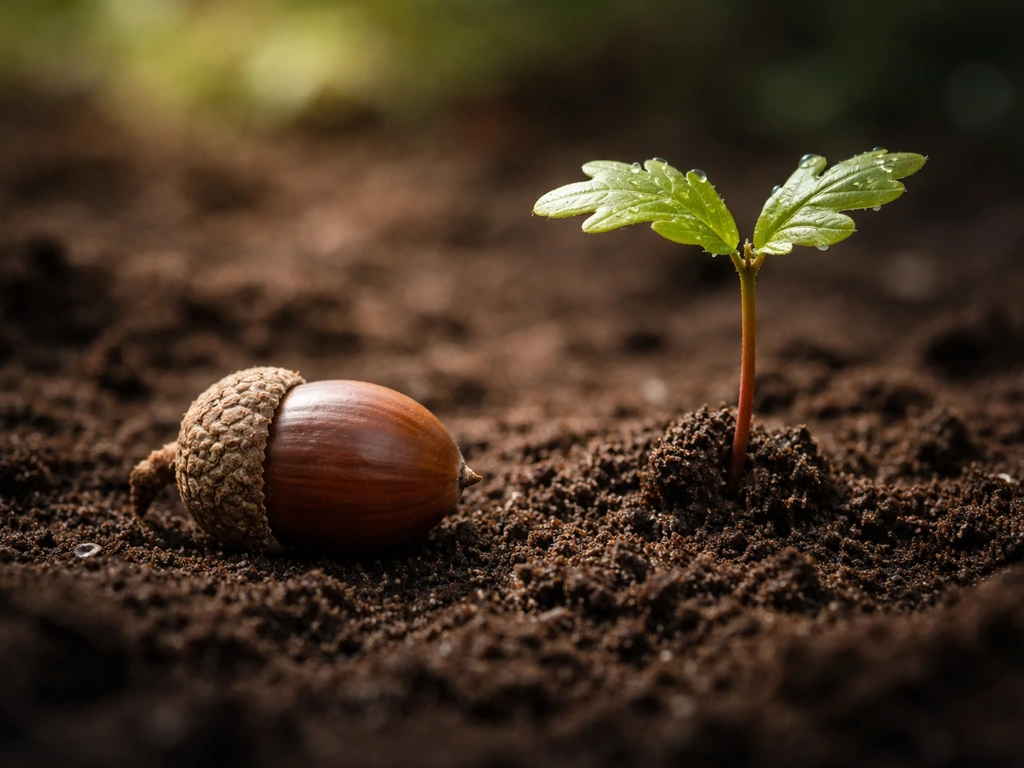
An acorn is a one-seeded nut enclosed in a cup-shaped cupule. Inside is a living embryo surrounded by starchy cotyledons that will fuel early growth. When conditions are right, the radicle (the embryonic root) emerges first, anchoring the seedling before the shoot even appears above soil. That timing matters because it means you might see root activity long before any green breaks the surface, which is not a sign that nothing is happening.
Oaks in the red oak group (red, pin, scarlet) carry a form of physiological dormancy that requires a period of cold and moist conditions before germination can proceed. White oak group species (white oak, bur oak, Garry oak) are less deeply dormant and some will germinate almost immediately after they fall in autumn. This split between groups is the most important biological fact for a grower to know, because it directly determines your stratification plan and your planting window. For some species in the red oak group, the radicle emerges after cold stratification but the shoot may need additional time or a second warming period to fully emerge, so patience is genuinely part of the process.
Collecting the right acorns and timing (fresh vs. stored)
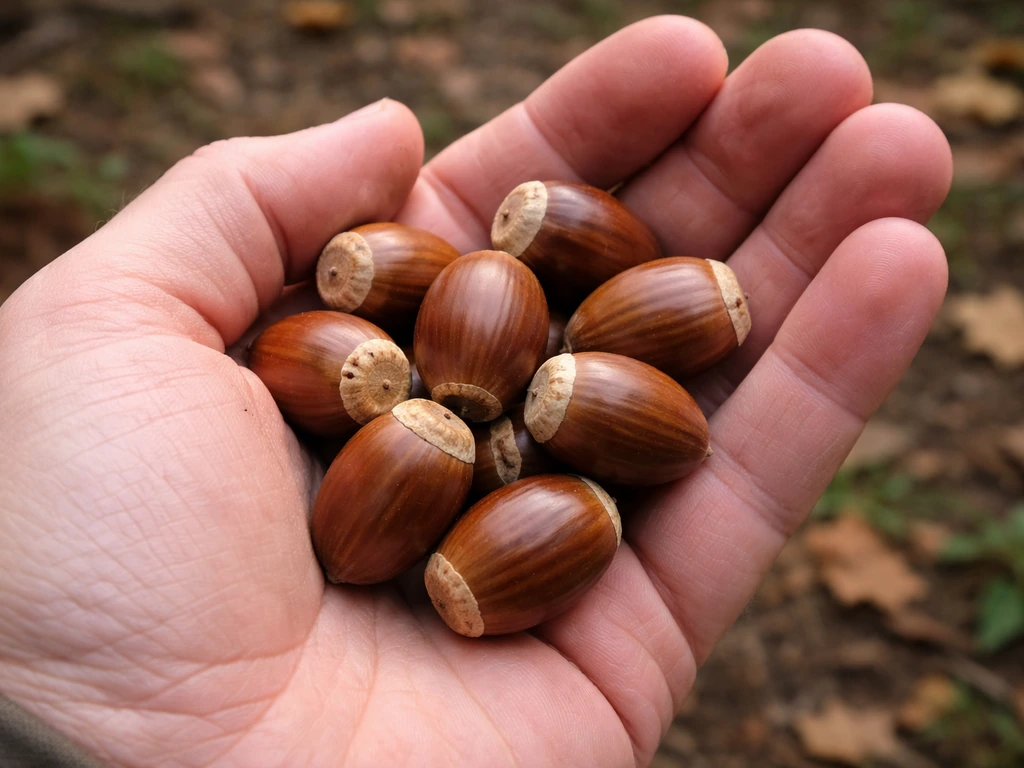
Collect acorns in fall as soon as they drop naturally from the tree. Acorns that you shake loose or pick unripe are poor candidates. You want fully mature, cap-free acorns that have separated on their own. Avoid any with visible mold, cracks, insect exit holes, or a shriveled appearance. Color can vary by species and is not a reliable viability indicator on its own.
The float test is the fastest and most reliable way to sort viable acorns from duds. Place your collected acorns in a bucket of water. Sound, viable acorns will sink; damaged, unfilled, or insect-riddled ones will float. Pull the floaters out and discard them. This works because a viable, fully hydrated acorn is dense, while air-filled or hollow ones are buoyant. If you are wondering how to tell if an acorn will grow beyond just the float test, checking for an intact embryo and firm cotyledons when you crack a sample acorn is another solid approach.
Freshness is non-negotiable. Research specifically on white oak and northern red oak found that acorn moisture content at sowing directly affects both germination rates and early seedling mass, and that moisture loss from drying reduces seedling vigor even when the acorn technically still germinates. USFS research on temperate recalcitrant seeds reports strong relationships between seed moisture content and percent germination for Quercus acorns, reflecting their desiccation-sensitive recalcitrant behavior blank" rel="noopener noreferrer">acorn moisture content at sowing directly affects both germination rates. If you cannot plant or stratify right away, store acorns in barely damp sphagnum moss or a damp paper towel inside a sealed plastic bag in the refrigerator. Do not let them dry out, and do not seal them in an airtight container without any moisture. For longer storage, USFS research found that acorns should be kept fully hydrated, and that blank" rel="noopener noreferrer">Oregon white oak acorns maintained 84% viability after two years of refrigerated storage, though most germinated between 6 and 12 months after entering storage. One important caution: storage temperature preferences are species-specific, and some oaks, including live oak, are damaged by colder refrigerator temperatures. Know your species before you store.
One common question is whether acorns that have not yet reached their final color can be used at all. For that, whether you can grow a green acorn depends on maturity, not just color, and the details are worth understanding before you collect early.
Planting options: direct sow vs. stratify then pot
Direct sowing in fall
For white oak group species that germinate readily, direct sowing in fall right after collection is a perfectly legitimate approach. The soil provides natural cold stratification over winter and acorns often emerge in spring without any intervention. Plant them about half an inch to one inch below the soil surface, loosening the soil to at least 4 inches deep first. The main downside is exposure: squirrels, deer, and rodents will find your planting sites, and you will likely lose a significant percentage to predation. Protect planted sites with hardware cloth or wire mesh staked at the surface.
Cold stratification then container planting
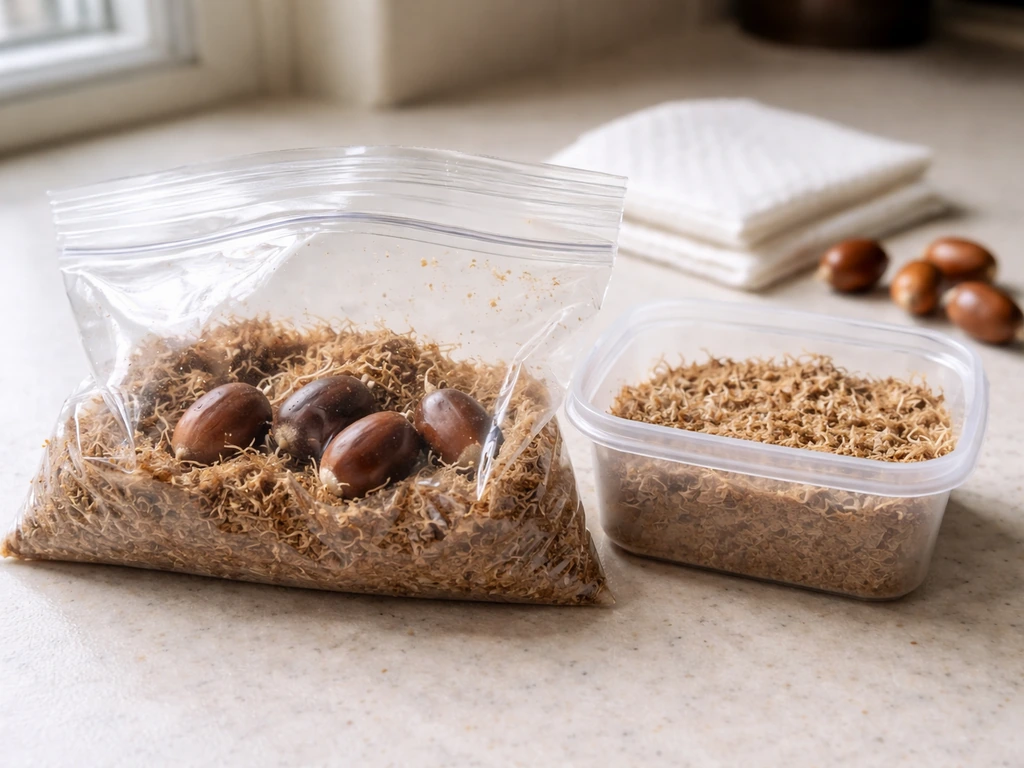
For red oak group acorns, or any time you want more control over germination, cold stratification followed by potting is the more reliable method. After the float test, place viable acorns in a sealed plastic bag or a coffee can with barely damp sphagnum moss or a damp paper towel. Store in the refrigerator at just above freezing, around 1 to 4 degrees Celsius (34 to 40 degrees Fahrenheit). Stratification time varies by species: bur oak needs 30 to 60 days; pin oak and red oak need 30 to 45 days. A 6 to 8 week stratification window for northern red oak was shown in research to significantly increase both germination percentage and speed compared to non-stratified controls.
Check your bag every week or two. When you see the radicle (a small white root tip) beginning to emerge, it is time to pot. Use a deep container (at least 10 to 12 inches) because oak taproots go down fast. Plant the acorn with the radicle pointing downward at about half an inch to one inch deep. Keep the container in a cool location initially, then move it to full sun once the shoot emerges.
There is an important and sometimes overlooked question about using water as part of the germination process. If you have been wondering whether you can grow acorns in water, the short answer is that soaking is useful as a brief pre-treatment but is not a substitute for soil planting. Similarly, acorns that have been sitting in water will behave differently depending on how long they have been submerged, which ties into the question of whether acorns that float will still grow. Floaters are generally poor bets, but context matters.
Comparing direct sow vs. stratify then pot
| Factor | Direct Sow (Fall) | Stratify Then Pot (Spring) |
|---|
| Control over conditions | Low (nature handles stratification) | High (you manage temp and moisture) |
| Predation risk | High (open ground, squirrels) | Low (container indoors or protected) |
| Best for | White oak group, large-scale plantings | Red oak group, small batches, beginners |
| Planting depth | 0.5 to 1 inch | 0.5 to 1 inch |
| Spring germination timing | Variable | More predictable |
| Effort required | Low upfront, higher loss rate | Higher upfront, more seedlings survive |
If you are working indoors with limited space and want the highest success rate, the stratify-then-pot approach wins. If you have a large area to plant and want a more naturalistic process, direct sowing in fall is practical, just expect losses and plant more than you need. If you are curious about managing the whole process indoors from start to finish, growing an acorn indoors is achievable with the right setup.
Soil, light, and watering requirements for seedlings and young oaks
Oak seedlings are not finicky about soil fertility but they are particular about drainage. A well-draining loamy or sandy-loam mix works well for containers. Avoid heavy clay in pots as it holds too much moisture and encourages root rot. In the ground, oaks adapt to a wide range of soil types depending on species, but waterlogged roots are a consistent problem regardless.
Light is straightforward: oaks want full sun, defined as at least 6 hours of direct sunlight per day. Seedlings started indoors need to be hardened off gradually before moving outside, especially if they have been under grow lights. Move them to partial shade for a week before exposing them to full outdoor sun to prevent scorching.
Watering in the first two years is critical. Keep soil consistently moist but not saturated during the growing season. After that, for species like California oaks, UC ANR actually advises scaling back irrigation because overwatering beyond the establishment period can attract gophers and rodents without improving tree growth or survival. Established oaks are generally drought-adapted and do not need regular supplemental water except during prolonged dry periods in their early years.
How long it takes, transplanting, and long-term care
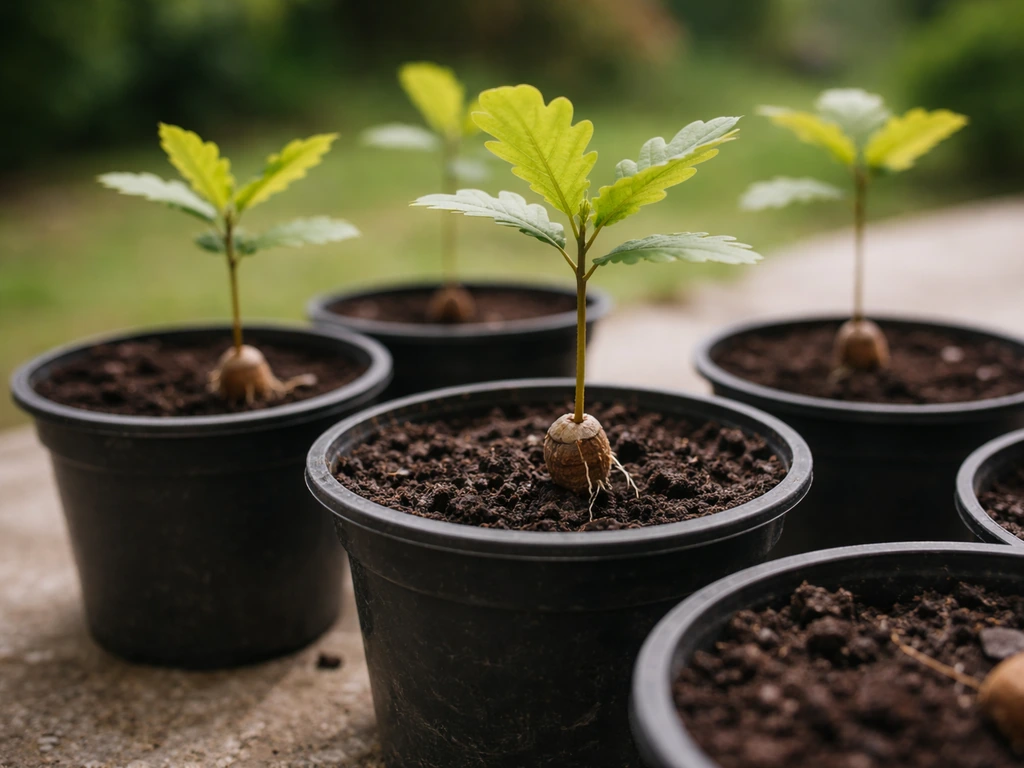
Germination in a pot or in the ground typically happens within 2 to 8 weeks after conditions are right (warmer soil, adequate moisture). You will often see root activity before shoot emergence, so do not panic if nothing shows above soil for several weeks. First-year seedlings may only reach 6 to 12 inches in height, and that is normal. Oaks invest heavily in root systems before prioritizing above-ground growth.
Transplanting to a permanent location is best done in the first or second year, before the taproot becomes too long to move without damage. When removing from a container, try to keep the root ball intact and minimize soil loss from around the roots. In the ground, dig a hole no deeper than the root ball but two to three times as wide. Backfill with native soil rather than amended mixes, which can create an artificial barrier that discourages roots from expanding outward.
Protect transplants with tree tubes or wire cages for the first few years if deer browse is a concern. Mulch around the base (keeping mulch away from the trunk itself) to retain moisture and suppress competing grass and weeds. Do not fertilize aggressively in the first year. Oaks establish best when pushed to develop deep roots through slight water stress rather than being coddled with nutrients and frequent irrigation.
In terms of long-term expectations: most oaks grown from acorns will take 20 or more years to begin producing their own acorns in significant quantity, and full canopy development takes decades. This is a generational planting in the truest sense. If you are planting for nut production specifically, set that expectation now.
Common problems and troubleshooting
Mold during stratification
Surface mold on acorns in a stratification bag is common and often not fatal if caught early. Open the bag, wipe mold off with a dry cloth, and rinse acorns gently. Replace the damp medium with fresh material and return the bag to the refrigerator. If acorns are turning soft or black inside, those are losses. Discard them promptly to prevent the spread of rot to remaining viable acorns.
Poor or failed germination
The most common cause is desiccation: acorns that dried out at some point before or during stratification. There is no recovering a dried-out acorn embryo. A second common cause is insufficient stratification time, particularly for red oak group species. If you stratified for less than 30 days, try again with a longer cold period. A third cause is using acorns that were already non-viable at collection, which is why the float test before stratification saves time. Whether green acorns will germinate is also worth checking if you collected early in the season and are seeing poor results.
Squirrel and rodent predation
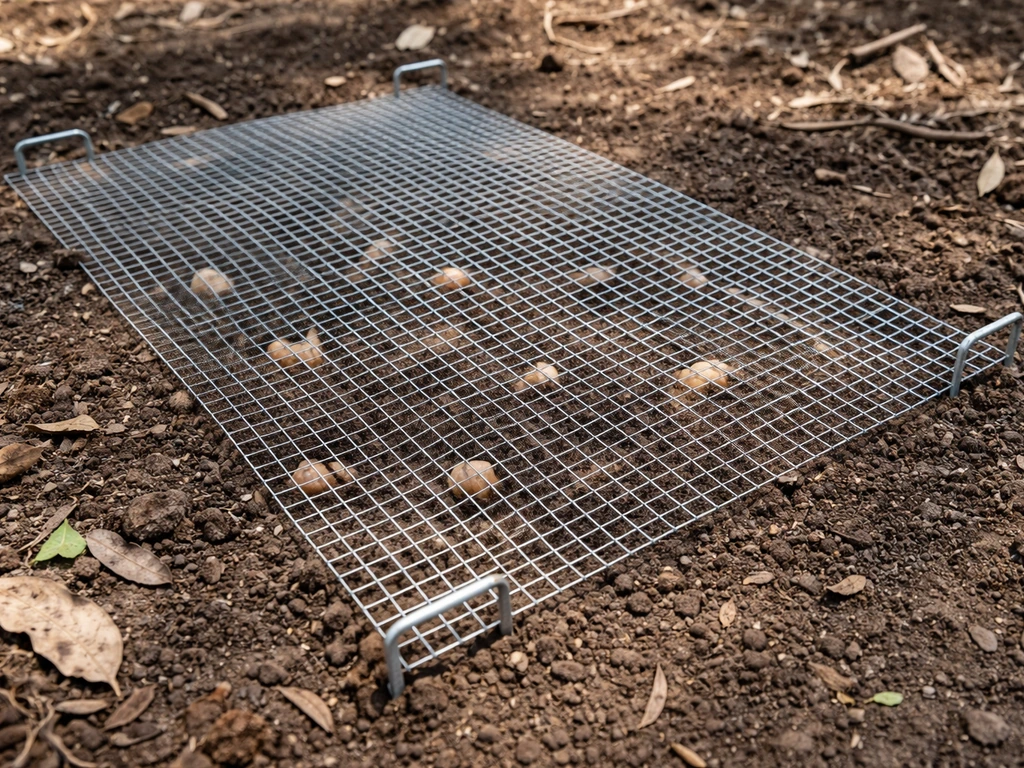
Squirrels will find buried acorns with impressive efficiency. For direct-sown sites, use a hardware cloth cage or screen laid flat over the planting area, staked at the edges. Remove it once seedlings have emerged and grown beyond the seedling stage. For container seedlings, keep pots elevated or indoors until transplant. Gophers are a problem in western states especially, and excessive irrigation post-establishment increases gopher activity around young trees.
Damping off and root rot in seedlings
Damping off (fungal collapse of seedling stems at soil level) happens in consistently wet, poorly ventilated conditions. Use a well-draining mix, avoid overwatering, and ensure good airflow around seedlings indoors. If you notice the base of a seedling turning brown and collapsing, remove it immediately and let the soil dry slightly before watering again.
Regional suitability and which oak species to target by climate and zone
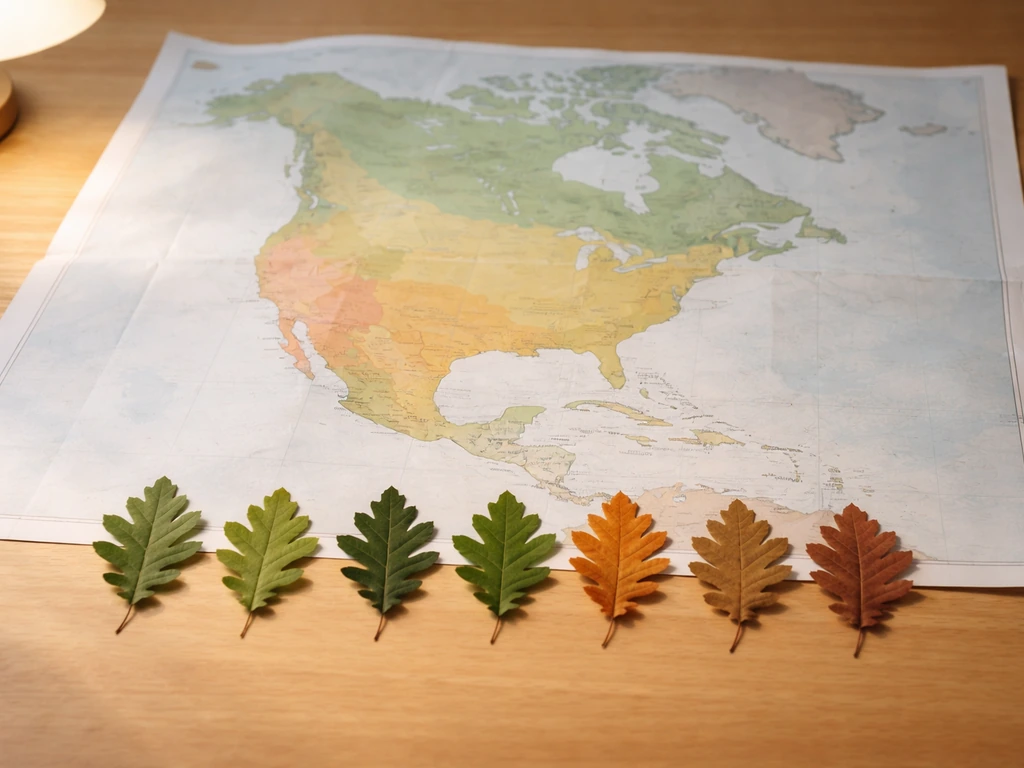
Oak species span nearly every climate zone in North America, which is one reason the genus is such a useful one for home growers. The key is matching species to your zone and conditions. Planting a species outside its natural range wastes time and money, and acorn germination results will not tell you whether the tree will actually thrive long-term in your climate.
| Species | USDA Hardiness Zone | Climate Notes |
|---|
| Northern red oak (Quercus rubra) | Zone 3 and warmer | Cold-hardy, widely adaptable, needs 30–45 day stratification |
| White oak (Quercus alba) | Zone 8a and colder | Slow-growing, excellent in eastern US, tolerates clay |
| Bur oak (Quercus macrocarpa) | Zone 3 and warmer | Extreme cold hardiness, drought-tolerant, great for prairies and Midwest |
| Pin oak (Quercus palustris) | Zone 4 and warmer | Prefers moist soils, needs 30–45 day stratification, 68% germination average for stratified acorns |
| Southern live oak (Quercus virginiana) | Zone 8a to 10b | Warm climate only, semi-evergreen, not cold-tolerant |
| Oregon white oak / Garry oak (Quercus garryana) | Zone 5 and warmer | Pacific Northwest native, high viability in refrigerated storage |
For growers in the Upper Midwest and northern plains (zones 3 to 5), bur oak and northern red oak are the most practical choices. Both are deeply cold-hardy and naturally adapted to continental climates with wide temperature swings. In the eastern US (zones 5 to 8), white oak, red oak, and pin oak all perform well, with species selection depending more on your soil conditions and moisture levels than on cold hardiness. Pin oak prefers moist, slightly acidic soils; white oak tolerates heavier clay; red oak is the most adaptable of the three.
In the Southeast and Gulf Coast (zones 8 to 10), southern live oak (Quercus virginiana) is the dominant native species for warm climates. Its zone range of 8a to 10b makes it unsuitable for anything north of the mid-South. If you are in a borderline zone and want to try live oak from acorns, Clemson's guidance specifically recommends sourcing seed from locally proven trees with documented cold hardiness in your area, not from generic commercial stock. Local provenance matters more for marginal climates than anywhere else.
In the Pacific Northwest, Garry oak (Oregon white oak) is the native choice for western Oregon and Washington. It germinates readily, stores well under refrigeration, and is well-suited to the region's dry summers. California growers have a broader palette of native oaks (valley oak, blue oak, coast live oak) but should stay within their local provenance and follow the UC ANR planting guidance on minimal post-establishment irrigation, which is a real difference from eastern oak management.
One final practical note before you start: the question of timing matters as much as species selection. Acorns collected this fall, stratified properly, and planted in spring give you the best possible odds. Waiting, drying them out accidentally, or skipping stratification for red oak group species will cost you a whole season. Collect fresh, keep them moist, know your species, and the biology will do the rest.