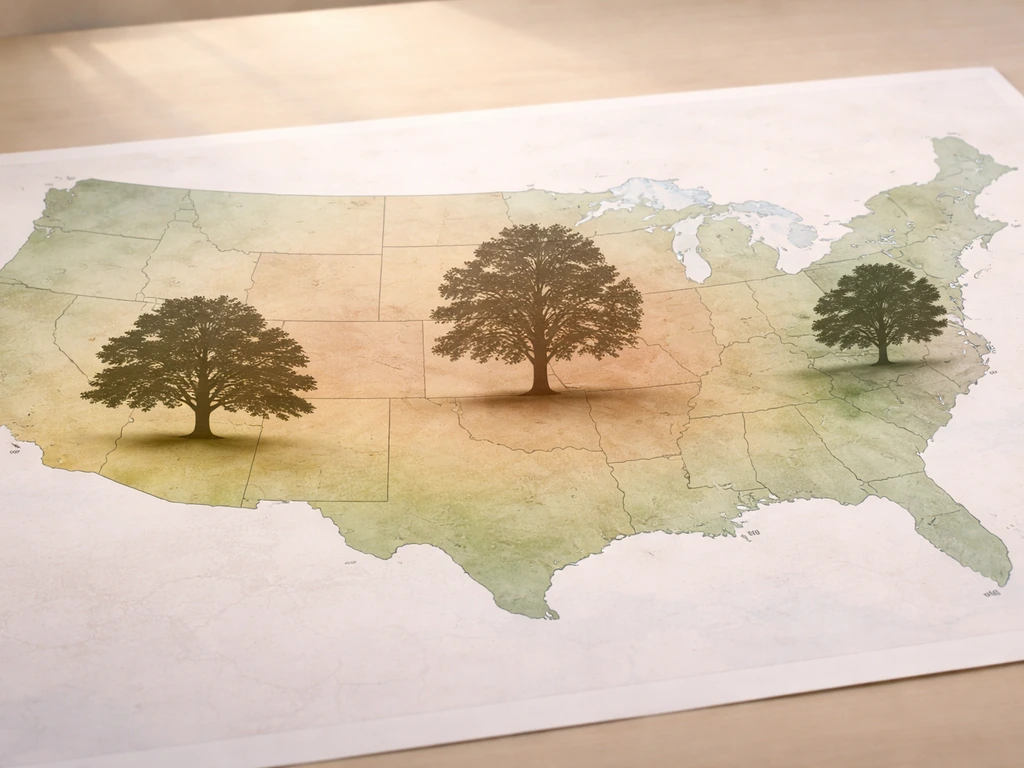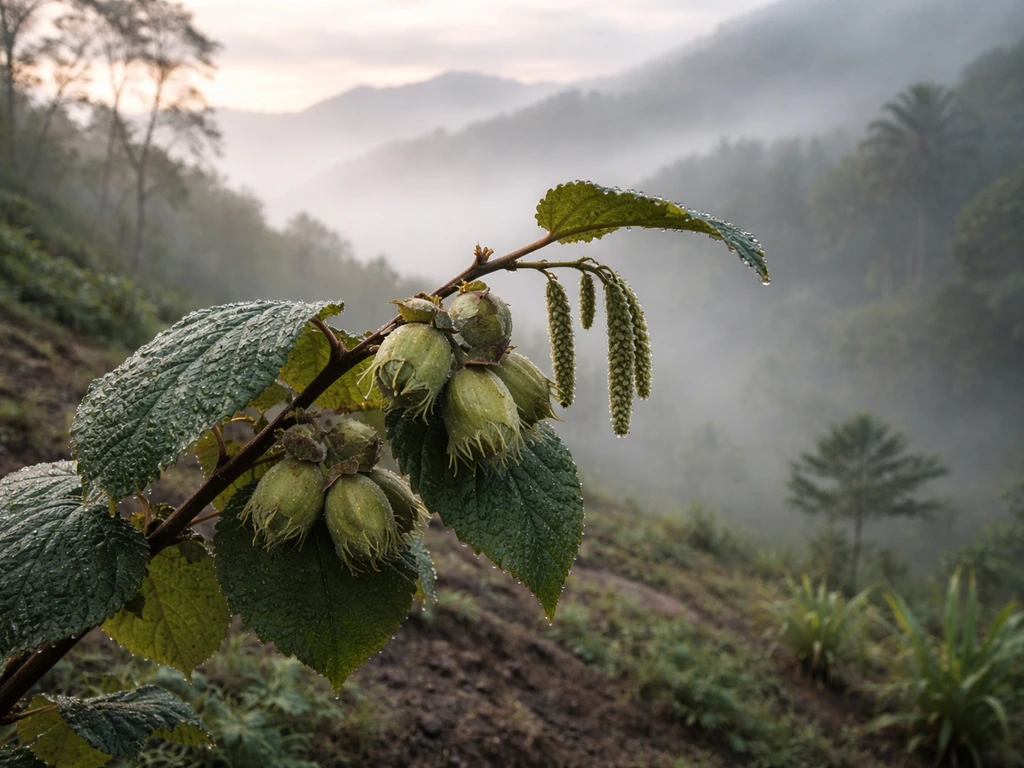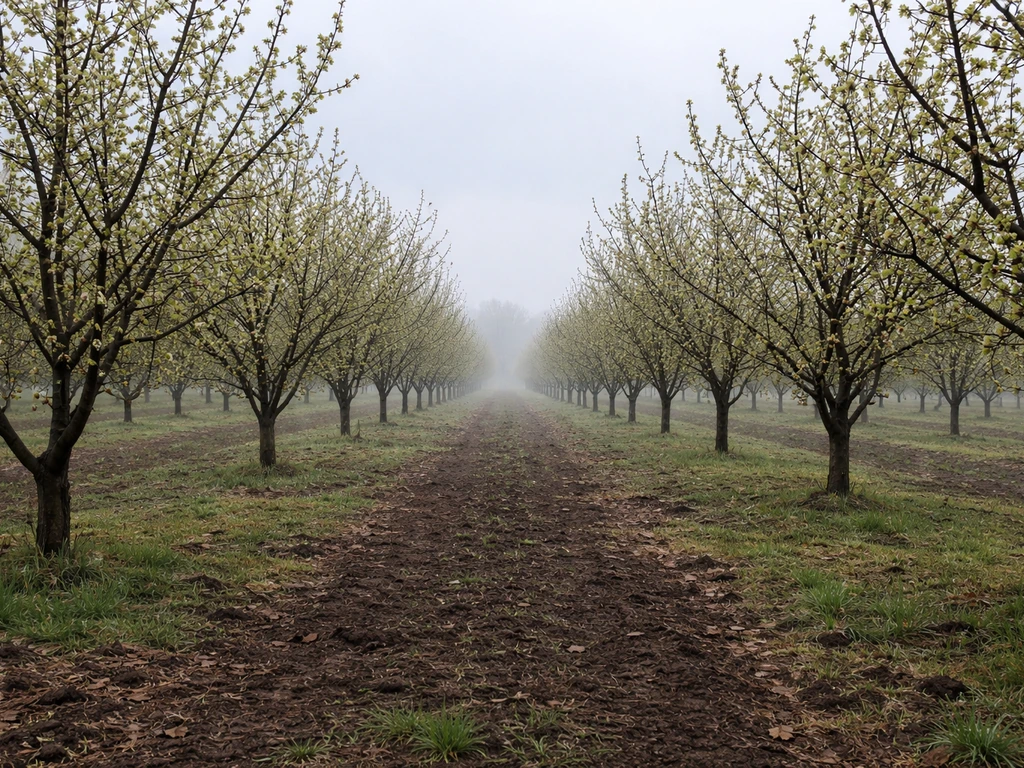
Hazelnuts grow across almost the entire European continent in the wild, from the British Isles and Scandinavia down to the Mediterranean and east into the Caucasus. Commercially, however, production is heavily concentrated in Italy (especially Campania, Lazio, and Piedmont), with Spain, France, and a handful of other countries contributing meaningful volumes. The species doing almost all of this work, both wild and cultivated, is Corylus avellana, the common hazel.
Where Do Hazelnuts Grow in Europe? Regions and Suitability
Marcus Hendricks
13 May 2026
Hazelnut species you'll actually encounter in Europe
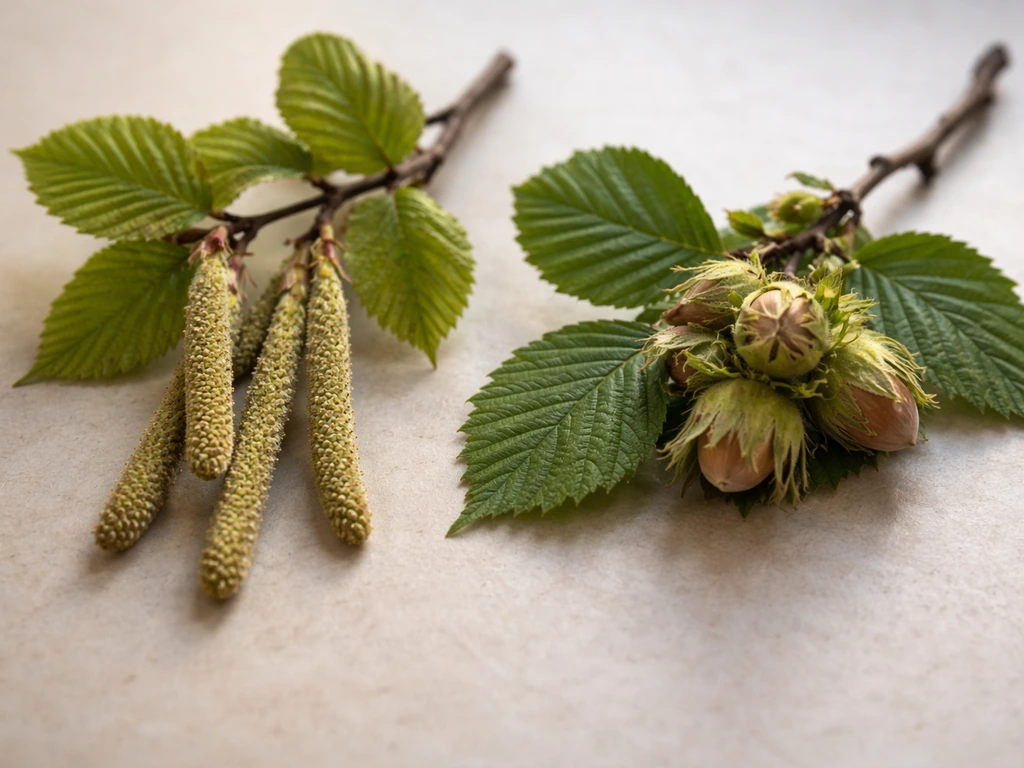
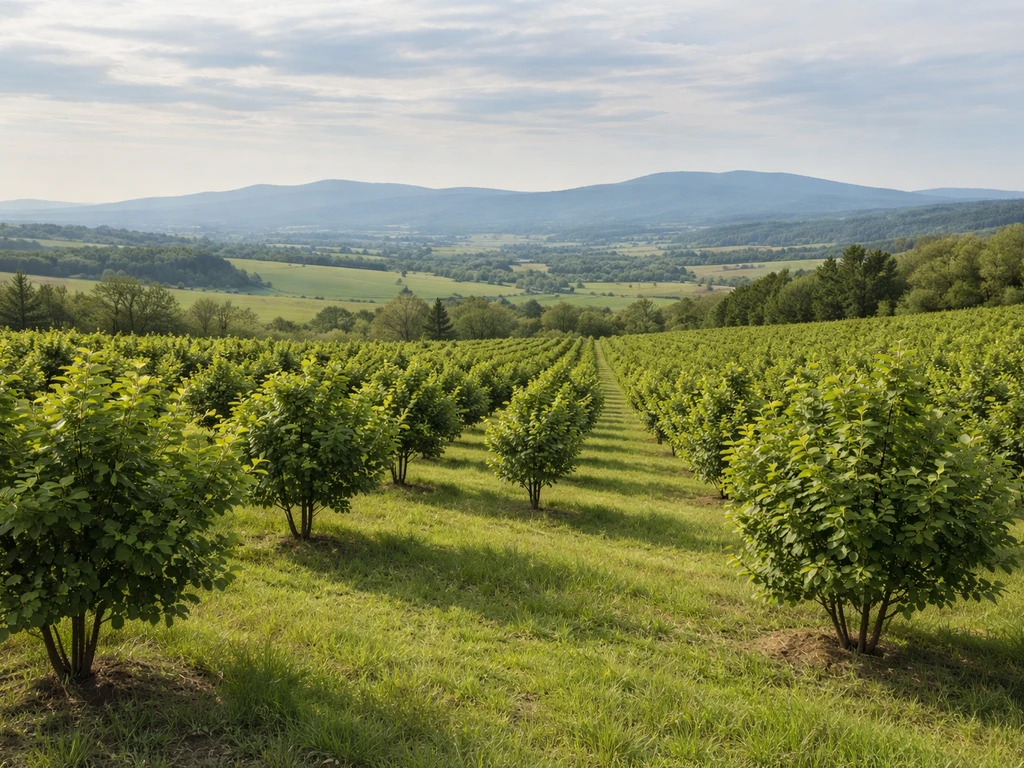
Two species matter most here. Corylus avellana, the common hazel, is the dominant native species across Europe and the backbone of every commercial hazelnut industry on the continent. It's a deciduous, multi-stemmed shrub (occasionally a small tree) that's wind-pollinated and typically found in the understory of mixed deciduous forests. The second species worth knowing is Corylus maxima, the giant hazel or filbert, native to southeastern Europe and western Asia. It produces larger nuts than C. avellana and has been used in breeding, but most commercial European cultivars are either straight C. avellana selections or hybrids leaning heavily on C. avellana genetics.
When growers talk about commercial hazelnut production in Europe, they're almost always talking about named cultivars of C. avellana selected for nut size, flavor, shell characteristics, and regional adaptability. Names like Tonda Gentile Romana, Tonda di Giffoni, Nocchione, and Barcelona all belong to this species. Some Italian production zones have PDO (Protected Designation of Origin) or IGP status tied to specific cultivars: Nocciola Romana DOP, for example, comes specifically from Tonda Gentile Romana and Nocchione grown in Lazio's Cimini Mountains.
Where wild hazelnuts naturally grow in Europe
Common hazel has one of the widest natural distributions of any European tree species. Its native range runs from Ireland and Scotland in the northwest across virtually all of continental Europe, through Scandinavia (into southern Norway and Sweden), down through the Iberian Peninsula, Italy, the Balkans, and eastward into western Asia. The European Atlas of Forest Tree Species includes Corylus avellana as a species with documented presence across this entire sweep.
In the wild, hazel is almost always an understory or woodland edge species. You'll find it beneath oaks, ash, and other deciduous canopy trees, forming dense thickets where enough light filters through. It's characteristic of woodland margins, hedgerows, river banks, and scrubby hillsides. EUNIS describes Corylus avellana scrub as a permanent habitat type found particularly in exposed coastal and upland situations under humid Atlantic climates, and also in parts of Central Europe where steep hillsides or thin soils prevent full forest succession.
One important soil note for wild distribution: common hazel strongly avoids very acidic soils. It's rarely found where pH drops below roughly 5.5, and it also stays away from waterlogged ground and extremely chalky soils. That's not a minor footnote. It actually explains a lot about where you'll find wild hazel thickets versus where you won't, even in otherwise suitable climates.
How climate shapes the range: coasts, Central Europe, and the east
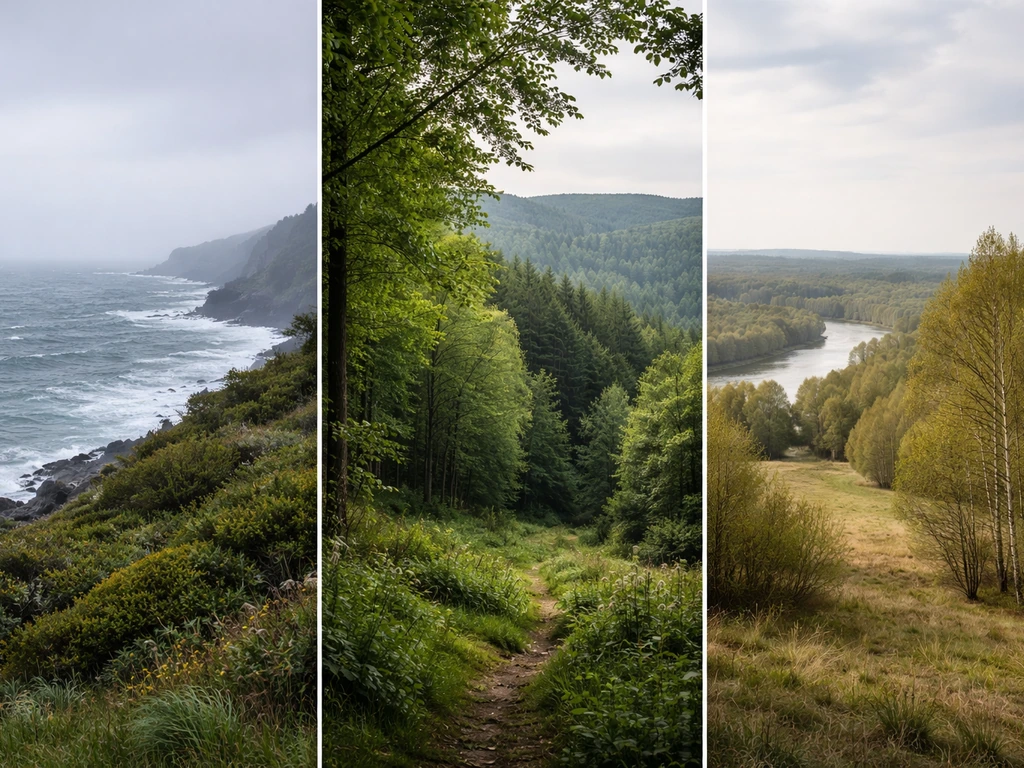
Atlantic coastal Europe, from Portugal and northwestern Spain up through France, the UK, Ireland, Belgium, and the Netherlands, is hazel country in the truest sense. The mild, humid conditions here suit C. avellana extremely well. Winters are cool enough to meet its chilling requirement (more on that shortly), spring frosts are relatively moderate, and rainfall is reliable. This is where you see the densest wild populations and, in some areas, productive small-scale orchards.
Central Europe, including Germany, Austria, Switzerland, the Czech Republic, and Poland, supports healthy wild hazel populations too, though conditions become more continental as you move east. Summers get hotter and drier, winters get colder, and spring frost risk rises. Hazel can handle this, but the window for commercial viability narrows because late spring frosts can catch the early-blooming female flowers (which appear before the leaves, typically from January to March depending on latitude). Poland does have commercial hazelnut production, but it's modest compared to Italy.
Moving further east into Eastern Europe and toward the Balkans, conditions become increasingly challenging for consistent commercial yields. Wild hazel still grows there, but the combination of harsh winters and unpredictable spring frost timing makes orchard management more demanding. The Balkans are somewhat of an exception because of Mediterranean influence in coastal and southern areas, and Turkey (though technically outside Europe proper) is by far the world's largest hazelnut producer, which tells you something about just how productive the Black Sea coastal climate is for the crop.
Mediterranean Europe, particularly southern Italy, parts of Spain, and Greece, forms the core of European commercial production. The climate here is warm and dry in summer with mild, wet winters. Hazel needs careful site selection in these areas, particularly for water and sun exposure, but the right sites produce consistently high yields with high-quality nuts.
Commercial production vs. wild growth: who grows hazelnuts seriously in Europe
Italy is the clear leader in European hazelnut production. The country's output is concentrated in four regions: Campania accounts for roughly half of national production (with around 22,000 hectares of orchard area), followed by Lazio (approximately a third of production), Piedmont (around 20%), and Sicily (roughly 10%). Those four regions alone represent the overwhelming majority of Italian commercial hazelnut cultivation, and Italy is easily the largest producer in the EU.
Beyond Italy, Spain has commercial hazelnut orchards, particularly in Catalonia and the Ebro valley. France produces hazelnuts commercially, mainly in the southwest (Lot-et-Garonne and the Landes area). Poland shows up in European production statistics and was recognized among EU top-7 producers in recent years, though its scale is much smaller than Italy's. Portugal, Greece, and a few other EU countries contribute minor volumes.
| Country | Production status | Key regions / notes |
|---|---|---|
| Italy | Major commercial producer | Campania, Lazio, Piedmont, Sicily; PDO/IGP cultivars |
| Spain | Moderate commercial production | Catalonia, Ebro valley |
| France | Moderate commercial production | Southwest France (Lot-et-Garonne, Landes) |
| Poland | Minor-moderate commercial | Scattered orchards; continental climate challenges |
| Portugal | Minor commercial | Northern and central regions |
| Greece | Minor commercial | Northern mainland and some islands |
| UK, Germany, Belgium, Netherlands | Mainly wild / small-scale | Common hazel widespread as wild/hedgerow shrub |
| Scandinavia, Eastern Europe | Primarily wild | C. avellana in understory; limited commercial interest |
The contrast between wild presence and commercial presence is stark. You can find common hazel growing wild in almost every European country, but that doesn't mean every country can profitably grow hazelnuts as a crop. The difference comes down to the specific climate conditions that determine whether trees set reliable crops versus just existing. In practice, that means factors like winter chilling, spring frost risk, and summer rainfall determine whether hazelnuts thrive specific climate conditions.
What actually determines whether hazelnuts thrive in a given spot
Chilling hours: the requirement most people overlook
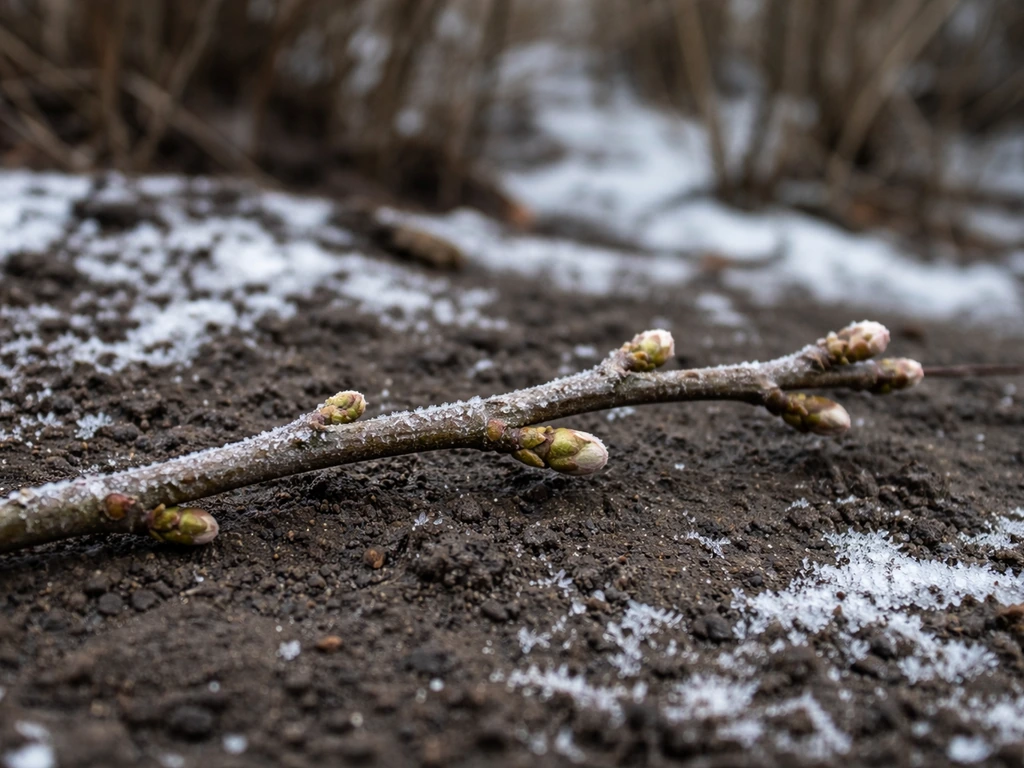
Common hazel is a temperate tree, and like most temperate trees, it needs a period of winter cold (called chilling) to break dormancy properly and bloom reliably in spring. Different cultivars have different chilling requirements, but research on hazelnut varieties using the Utah Model approach has found requirements in the range of roughly 800 to 1,200 chilling units for most commercial European cultivars, though some specialized research has recorded lower values for dormancy break of female flower buds specifically. The practical point: if your winters are too mild, trees may break dormancy erratically, bloom poorly, and produce inconsistent yields. This is increasingly relevant as European winters warm, and it's one reason Mediterranean-edge locations need careful cultivar selection.
Spring frost risk at bud break
This is the other big one. Common hazel blooms early, often in January and February at lower elevations in mild climates, and the tiny red female flowers are vulnerable to hard frost. If temperatures drop below freezing after the catkins have extended and female flowers are receptive, you can lose most of the year's crop in a single night. As winters warm, earlier bud break actually increases frost exposure risk rather than reducing it, because the trees advance faster than the last frost date retreats. Sites with cold air drainage, valley frost pockets, or exposed north-facing slopes are genuinely higher risk for this problem.
Hardiness and winter cold
At the other end, common hazel handles cold reasonably well but is not bulletproof. Extreme cold snaps can damage flower buds and shoots. For commercial cultivation, you generally want to avoid sites where temperatures regularly drop below about -20°C (-4°F) for extended periods, and even shorter cold snaps at -15°C can cause bud damage in poorly-hardened trees. Wild hazel manages in colder zones by virtue of the microclimate protection afforded by surrounding woodland, which commercial orchards don't have.
Rainfall and water
Hazelnuts want around 700 to 800 mm of annual rainfall for productive growth, reasonably well-distributed through the growing season. Most of Atlantic and central Europe comfortably exceeds this without irrigation. Mediterranean production regions like Campania can get by on lower rainfall thanks to winter rains and occasional summer irrigation, but trees under water stress in summer will show it in nut size and fill. Waterlogged soils, on the other hand, are a real problem. C. avellana naturally grows on well-drained soils; standing water around the root zone promotes root disease and reduces vigor quickly.
Soil requirements
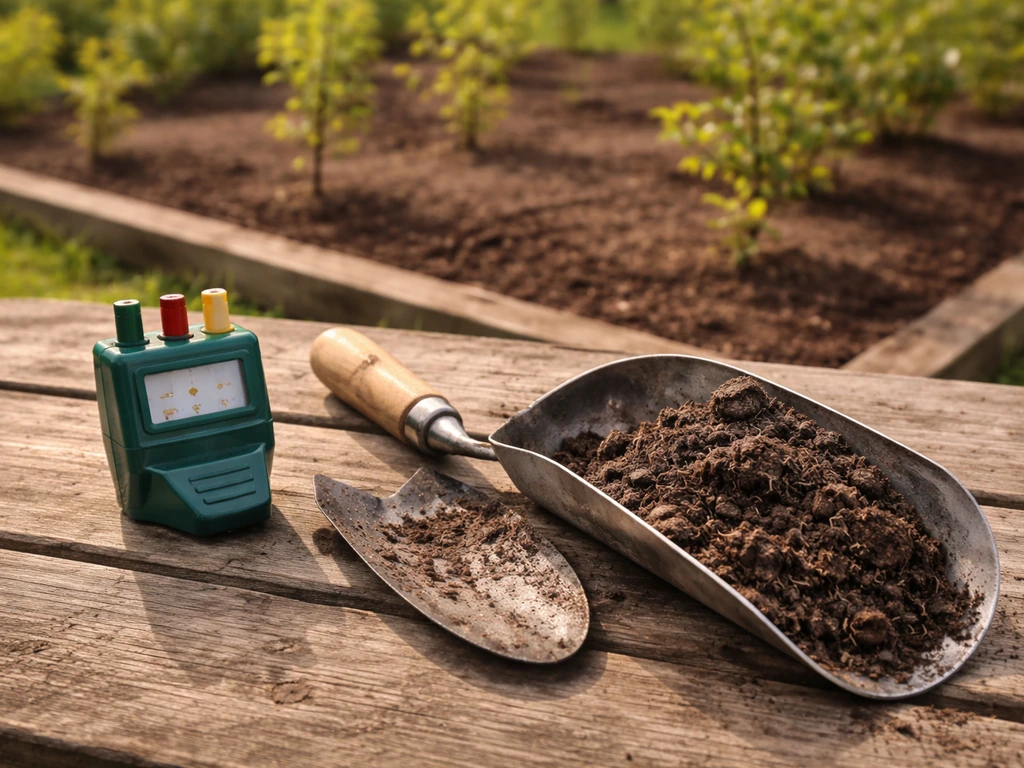
Hazel is adaptable to a wide range of soils but performs best in deep, loamy, well-drained ground. The preferred pH range is roughly 5.5 to 7.8, with soil around 6.0 to 7.0 being genuinely ideal. If your soil pH is below 5.6, lime application is advisable before planting. Very acid soils (below pH 5.5) produce poor growth even if everything else looks right, which matches the ecological observation that wild hazel avoids highly acidic heathland soils. At the other extreme, very shallow chalk soils also cause problems, limiting root depth and creating drought stress.
How to assess whether your specific location in Europe is suitable
The general range tells you hazelnuts can grow across Europe, but it doesn't tell you whether your particular garden, farm, or hillside is a good bet. Here's how to work through that practically.
- Check your hardiness zone and winter minimum temperatures. Most of Europe falls within zones where wild hazel survives, but for commercial-scale planting, identify whether your site gets hard freezes that could threaten early-season flowers. The EU's agroclimatic classification maps are useful here, as are records from your nearest weather station.
- Count your chilling hours. Look at average winter temperatures for your area: how many hours annually do you spend between about 0°C and 7°C? Atlantic coastal areas accumulate these easily. Mild urban microclimates or very southern Mediterranean locations may accumulate fewer than needed for reliable dormancy break.
- Map frost risk at bud break timing. Find out the average last frost date for your site and compare it to when hazelnuts typically bloom in your region (January to March in mild climates, February to April in colder areas). A site where late frosts regularly occur through February or March is a genuine risk for hazelnut flowers.
- Test or know your soil pH. A basic soil test costs almost nothing and tells you immediately whether you're in the preferred 5.5 to 7.8 range or need amendment. If you're on strongly acid soil (below 5.5) or shallow chalk, factor in the cost and effort of correction before committing to trees.
- Assess drainage. Walk your site after heavy rain. If water stands for more than a few hours, you have a drainage issue that needs addressing. Raised beds or mounded planting rows can help in borderline cases.
- Plan for pollination. Common hazel is wind-pollinated but effectively self-sterile: you need at least two different genotypes flowering simultaneously to get consistent nut set. Single-variety plantings, or even single-tree gardens, produce disappointingly few nuts. Plan for at least two compatible varieties or a mix of wild-type seedlings alongside named cultivars.
- Think about sun exposure vs. understory tolerance. Wild hazel grows happily in partial shade, but commercial orchards want full sun to maximize nut fill and reduce disease pressure. If your site is shaded by buildings or trees for more than a few hours a day, expect reduced yields.
Practical next steps for European gardeners and growers
If you're a home gardener in the UK, France, Germany, the Netherlands, Belgium, or most of Atlantic or Central Europe, common hazel is genuinely one of the easier productive trees to establish. It tolerates light shade, handles most reasonably drained soils, and starts producing nuts within three to five years of planting. Buy two named cultivars from a reputable nursery (Barcelona and Cosford is a classic UK pairing, for example) rather than random seedlings, because cultivars are selected for nut quality and reliable yield in a way that seedlings aren't.
If you're in southern Europe and thinking about a commercial orchard, the soil and water assessment matters more than anything else. Italy's most productive hazelnut zones in Campania and Lazio succeed because of a combination of volcanic soils (well-drained, mineral-rich), sufficient winter chilling from elevation, and careful cultivar-to-site matching. Trying to replicate that on heavy clay or in a frost pocket is a different proposition entirely. Talk to regional agricultural extension services or local growers before committing land to hazelnut trees, because the establishment cost and multi-year payback timeline make site mistakes expensive.
One disease note worth flagging: blank" rel="noopener noreferrer">Eastern Filbert Blight (caused by Anisogramma anomala) is lethal to European hazelnut cultivars and can kill trees within five to ten years of infection. It's primarily a concern in North America, where it's established, rather than in Europe, but it's worth being aware of if you're sourcing plant material from outside Europe or reading guidance from US extension services where resistant cultivars (American-hybrid types) are often recommended for reasons that don't apply the same way on this continent.
The bottom line: hazelnuts are genuinely pan-European in their wild distribution, but productive cultivation concentrates where chilling is adequate, late frosts are manageable, soils are well-drained and near-neutral, and rainfall is reasonably reliable. Get those four factors right, and you're working with a tree that has thousands of years of European cultivation history behind it. Get one of them badly wrong, and even a good climate won't save the crop.
If you're curious about how European hazelnut growing compares to cultivation in other parts of the world, the requirements really do shift significantly once you move outside temperate zones. If you're wondering where do hazelnuts grow in Australia, it helps to compare those same climate and chilling limits to what the Australian regions can actually provide how European hazelnut growing compares to cultivation in other parts of the world.
In the United States, where nuts grow depends on similar factors like winter chilling, spring frost risk, and well-drained soil, so the best regions are typically those with temperate conditions Europe. Hazelnut cultivation is also very different in India because the climate and chilling levels change what varieties can perform does hazelnut grow in india.
In tropical regions, the big question is whether chilling and frost-free season timing ever line up for healthy hazelnut production other parts of the world.
FAQ
If hazelnuts grow wild almost everywhere in Europe, can I assume any European location can produce a hazelnut crop commercially?
No. Wild presence usually reflects survival in understory conditions, while commercial production depends on reliable female flowering plus good nut set. The limiting factors are winter chilling adequacy, late spring frost exposure during early bloom, and well-drained soils, so two nearby regions can differ sharply in yield even if both have wild hazel.
What is the biggest “make or break” risk for hazelnut orchards in Europe?
Late spring frost is often the highest-impact risk because hazel can bloom before leaves and female flowers can be receptive during very cold snaps. Orchard design decisions, such as avoiding frost pockets and choosing air drainage areas, can matter as much as the cultivar.
How do I tell whether my winters are too mild for reliable hazelnut production?
Look for signs of erratic dormancy break, weak or inconsistent catkin development, or highly variable nut set year to year. Mild winters can lead to uneven timing across the tree, so even if trees look healthy, yields may be inconsistent. Matching cultivars with known chilling performance is the practical countermeasure.
Do hazelnuts need full sun to produce well in Europe?
They perform best with strong light, but they can tolerate partial shade. For commercial planting, growers typically prioritize open sites to maximize flowering and nut fill, since dense shade can reduce nut size and lower the consistency of harvest.
What rainfall pattern matters most, not just the yearly total?
Hazel needs enough water during the growing season for nut development, not only enough annual rainfall. Long dry spells in summer can reduce nut fill and size, and you can still have adequate yearly rainfall but poor distribution that causes stress during critical stages.
Is irrigation always required in Mediterranean hazelnut areas?
Not always. Some productive zones rely on winter rainfall and occasional irrigation, but the key is avoiding summer water stress during nut development and early growth. If your farm has reliable winter recharge and you can manage summer deficits, you may irrigate less, but heavy reliance on rainfall is riskier in drier subregions.
My soil test shows low pH, can I still grow hazelnuts?
You may be able to, but if pH is below roughly 5.5, you should plan for liming before planting and confirm the depth-related pH where roots will grow. Very acidic conditions can stunt growth even when climate looks suitable, and liming is not a one-season fix, so timing matters.
Why do waterlogged soils prevent hazelnut orchards from performing even if the climate is right?
Hazel needs oxygen around the root zone. Standing water promotes root disease and reduces vigor quickly, so trees may leaf out but never build strong nut-bearing structure. Good drainage is therefore a core site requirement, not a “nice to have.”
Does planting on a north-facing slope help against spring frost, or does it worsen blooming timing?
North-facing slopes can reduce heat accumulation and slow development, which may help avoid some late frosts, but they also influence flowering timing and can worsen light availability. The safest approach is usually to avoid valley frost pockets and choose sites with both cold-air drainage and adequate exposure for flowering and nut fill.
What spacing or orchard microclimate issues can affect frost and yield in practice?
Tree density affects airflow and the orchard’s cold-air behavior. Too-dense can trap cold and humidity, increasing frost and disease pressure, while very open plantings can expose flowers to wind and temperature swings. Many growers manage microclimate by matching training system and row orientation to local frost patterns.
Should I worry about Eastern Filbert Blight if I’m in Europe and buying plants locally?
If you are sourcing from within Europe, the immediate risk is typically lower than in established North American outbreaks, but the bigger issue is biosecurity. Ask suppliers about plant health status and quarantines for any imported material, because bringing in infected stock can create long-term orchard losses even if the disease is not widespread in your region.
If I am a home gardener, do I need named cultivars or will seedlings work?
Named cultivars are strongly preferred because they are selected for consistent nut quality and more predictable yield. Seedlings can vary widely in timing and production, so even if the tree survives, it may bloom at a problematic time for your local frost pattern or produce inconsistent nuts.
Are there European hazelnut varieties that cope better with late frosts?
Yes, but the solution is not just choosing any “frost tolerant” label. Cultivar timing, female flower receptivity window, and regional chilling fit determine whether the bloom overlaps your frost dates. The best next step is to choose cultivars recommended for your specific area and to confirm their bloom timing under local conditions.