Chestnuts do grow in the US, but the answer splits depending on which species you mean. The American chestnut (Castanea dentata) once dominated eastern forests but was functionally wiped out as a canopy tree by blight by around 1950. Today, Chinese chestnuts (Castanea mollissima), European chestnuts (Castanea sativa), and Chinese-American hybrids are the chestnuts most people actually encounter or grow across the country. If you want to know where to find chestnuts in the wild, plant them on your land, or identify a tree you stumbled across, here is what you need to know.
Where Do Chestnuts Grow in the US: Regions and Species
Marcus Hendricks
8 Apr 2026
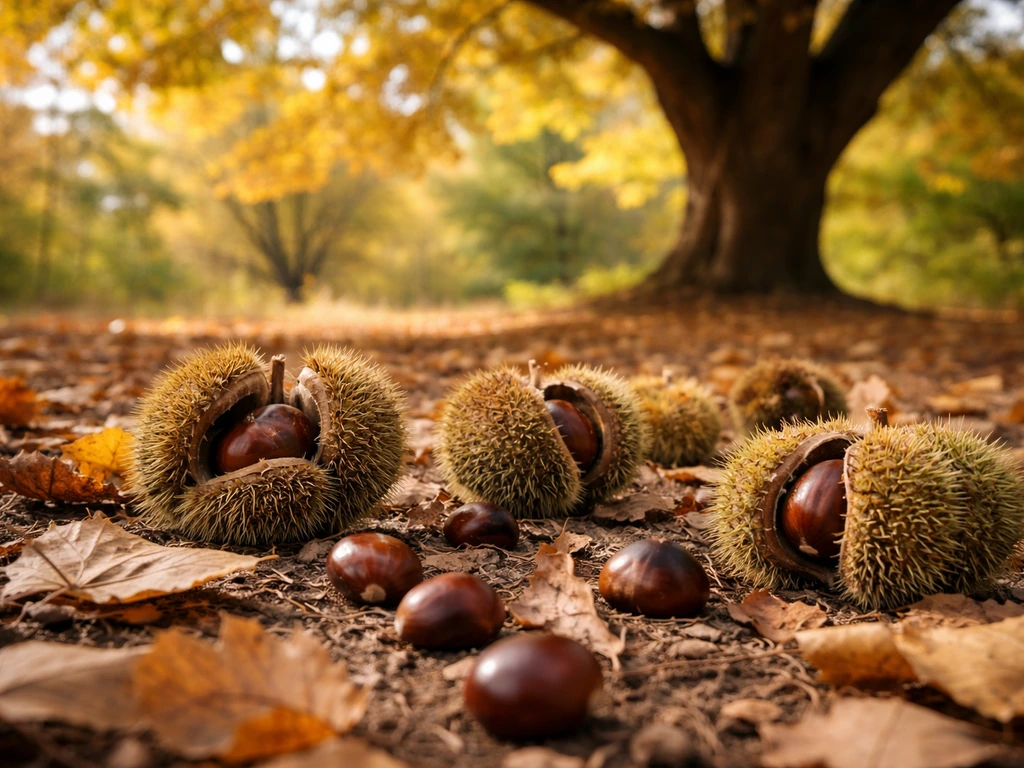
US native vs introduced chestnut species
There are four chestnut species relevant to the US: American chestnut (Castanea dentata), Chinese chestnut (Castanea mollissima), European chestnut (Castanea sativa), and the Japanese chestnut (Castanea crenata). The American chestnut is the only one native to eastern North America. Chinese chestnut was introduced to the United States in 1853 and is now by far the most widely planted and naturalized non-native species. European chestnuts appear in smaller pockets, mostly in the Pacific Northwest and parts of California. Japanese chestnuts are much rarer and mostly confined to experimental or collector plantings.
The tricky part is that pure American chestnuts are increasingly rare. According to the American Chestnut Foundation, over 80% of leaves people send in for identification turn out to be Chinese chestnuts or Chinese-American hybrids, not pure American chestnut. That means if you found a chestnut tree growing somewhere in the eastern US and assumed it was native, there is a very good chance it is not. Knowing how to tell them apart matters, and how chestnuts grow differs in meaningful ways between these species, especially in terms of blight resistance and nut production.
How to tell them apart in the field
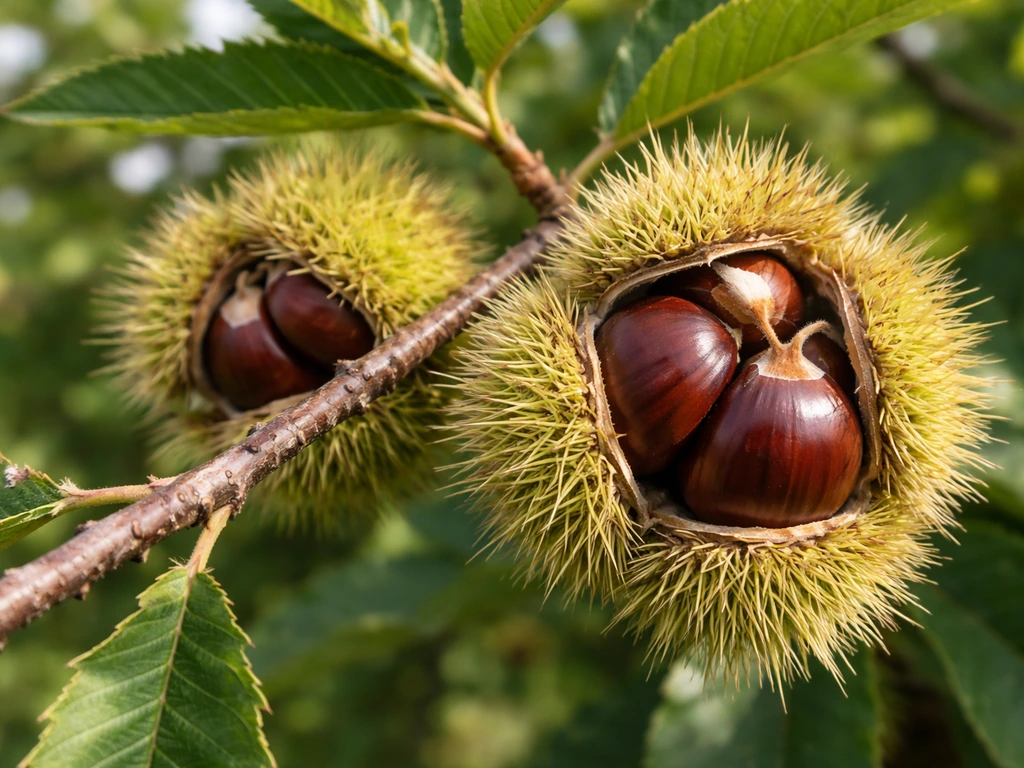
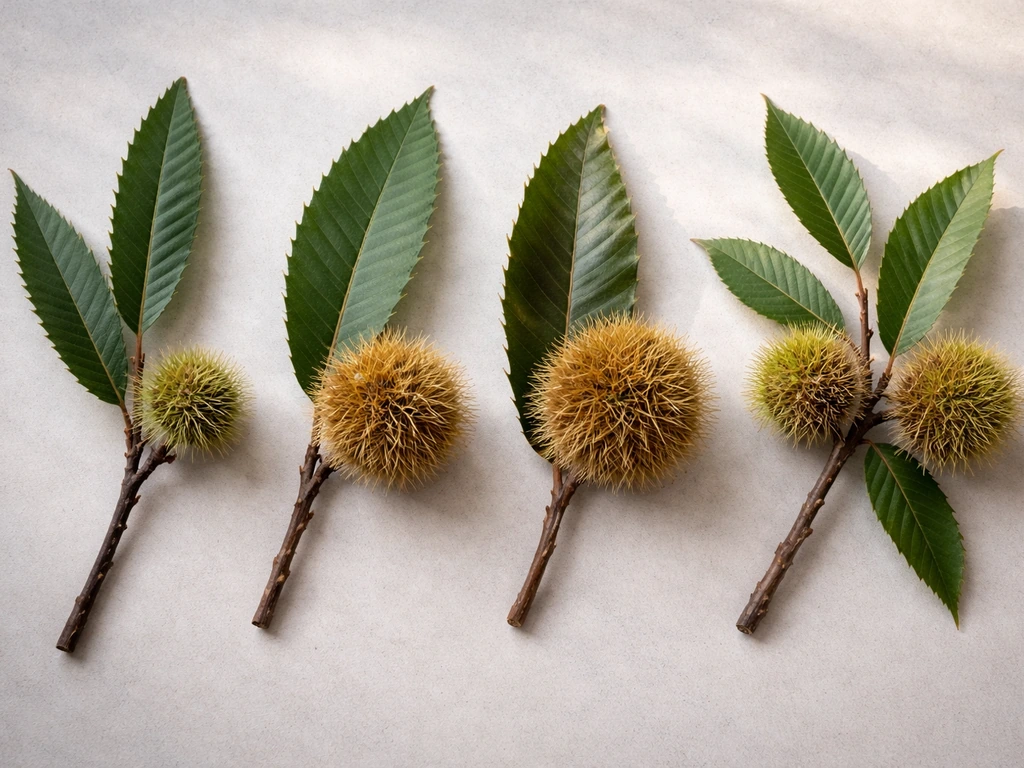
American chestnut leaves are long relative to their width, with teeth along the edges that curve inward toward the leaf tip. The stems are typically reddish. The burs show a dense mass of long, slender spines. Chinese chestnut leaves are broader and rounder, with teeth that tend to curve outward. Chinese chestnut burs are stubbier and the spines less densely packed. If you are standing in front of a chestnut tree and trying to make a call, leaf shape and spine character on the bur are your two fastest clues. And to be clear: if you are in a suburban yard or at a forest edge rather than deep in Appalachian woods, you are almost certainly looking at a Chinese chestnut or a hybrid.
Where American chestnut once grew vs where it survives today
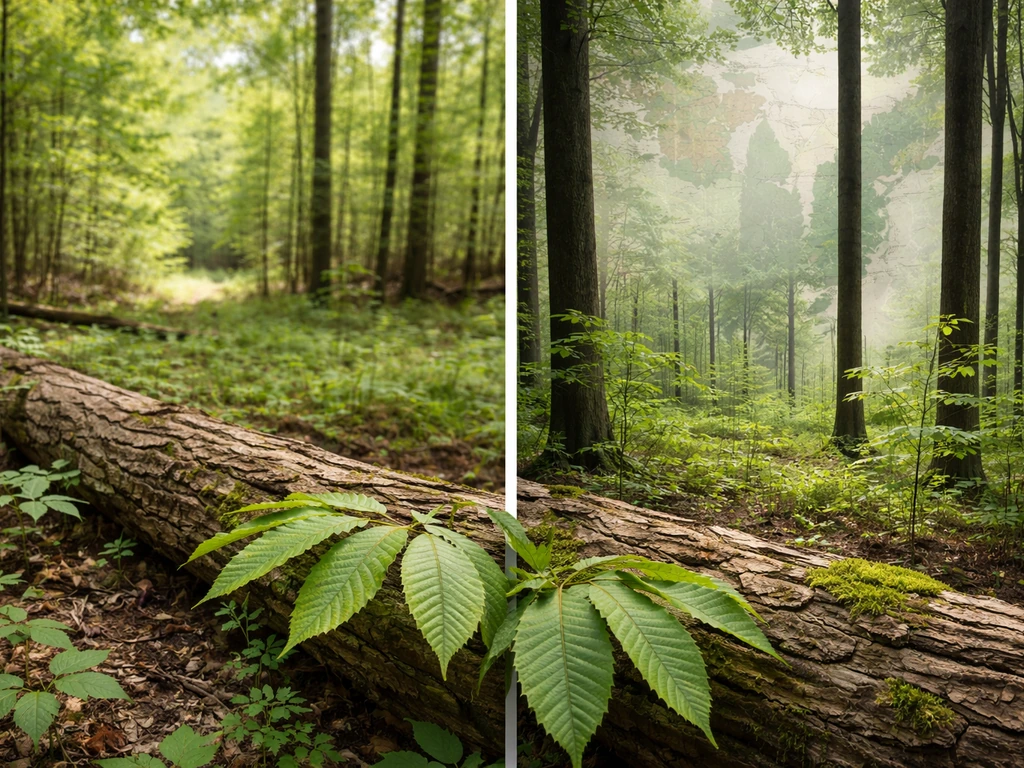
Before the chestnut blight arrived in the early 1900s, American chestnut was arguably the dominant hardwood in the eastern United States. Its historical native range stretched from Georgia and Alabama in the south up through the Appalachian Mountains and into Michigan in the north. It was estimated that one in every four hardwood trees in some eastern forests was an American chestnut. Then Cryphonectria parasitica, the blight fungus introduced from Asian chestnut species, tore through the population. By 1950 it had spread throughout the entire native range and functionally removed the species as a canopy tree.
What survived is important to understand. The blight kills everything above the infection point on the stem, but the root systems of American chestnuts are largely blight-resistant. So across the original range, you can still find American chestnut root sprouts pushing up from old stumps, growing a few feet tall before the blight finds them again and kills them back. They are alive, but they are stuck in a cycle of sprouting and dying. They rarely produce nuts or mature timber. They are ghost trees in a sense, present but ecologically absent. Whether chestnuts grow on trees in the traditional sense is complicated when you factor in this blight dynamic, since many surviving individuals never reach the canopy.
Current geographic range for American chestnut
Pure American chestnut trees that actually produce nuts and reach meaningful size today are rare enough to be noteworthy. Virginia's Lesesne State Forest, for example, maintains several small stands of pure American chestnut on research plots, and they are considered significant enough that the Virginia Department of Forestry tracks them closely. The National Park Service inventoried American chestnuts across eleven national parks in the Capital Region in 2014, recording blight symptoms and reproductive structures just to document that living trees were even present. That kind of effort tells you how rare genuine American chestnut has become.
Restoration plantings are expanding the footprint somewhat. Sites like Lesesne State Forest have received hundreds of bareroot seedlings through restoration programs. Land Between the Lakes National Recreation Area in Kentucky and Tennessee has active restoration work involving mapped existing chestnuts, cuttings, and grafting. The US Forest Service is involved in multiple restoration projects that incorporate blight-resistant genetics from Chinese chestnut into American chestnut lines. So the current range for healthy, reproducing American chestnut is essentially a patchwork of restoration sites and research plots scattered across the original Appalachian and mid-Atlantic footprint, not a continuous natural population. If you encounter what looks like a mature American chestnut in the wild and it is producing nuts, it is worth reporting to the American Chestnut Foundation.
Where Chinese chestnuts, European chestnuts, and hybrids grow in the US
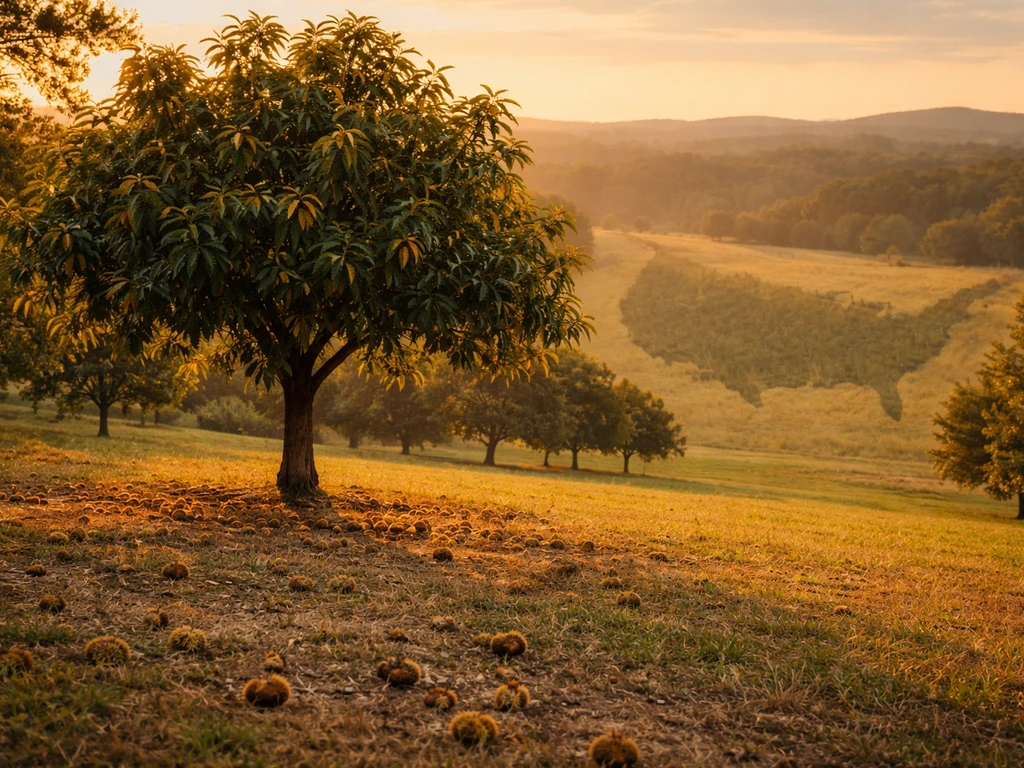
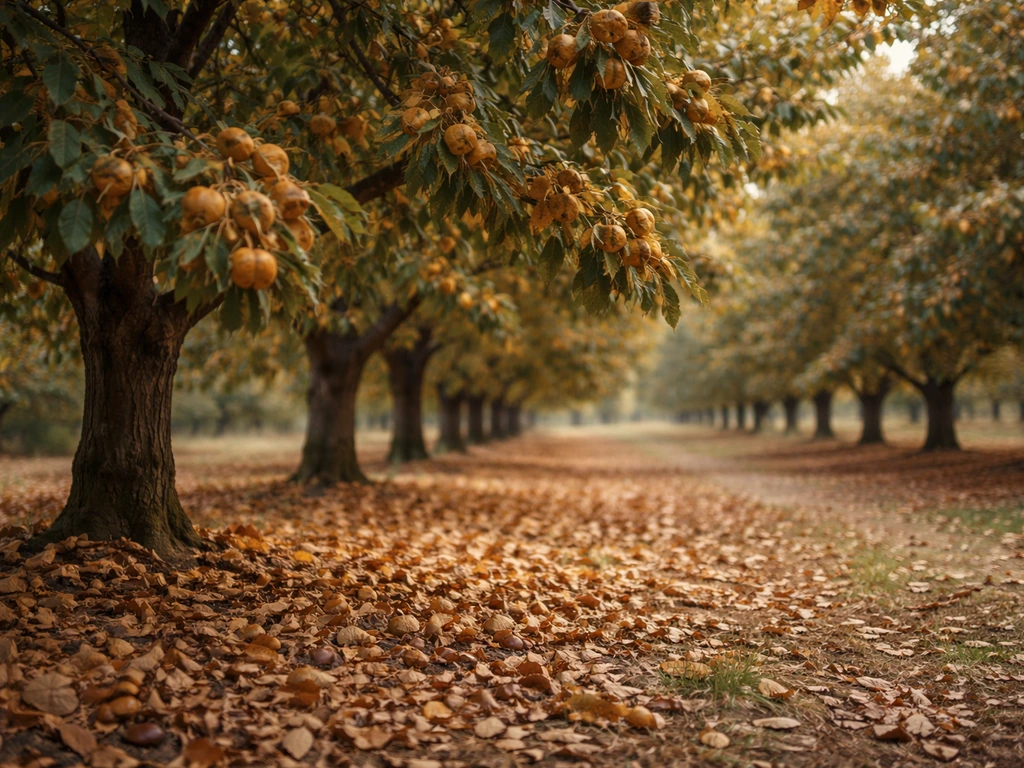
Chinese chestnut is where the action is for most growers and foragers in the US right now. Most US Chinese chestnut production is concentrated in Missouri, Ohio, Michigan, Maryland, and Kentucky, though the tree is grown successfully across a much wider band. Because Chinese chestnut carries natural resistance to chestnut blight, it thrives in the same eastern climate zones where American chestnut once grew without the constant die-back problem. It also tolerates a somewhat broader range of site conditions, which has made it the default choice for commercial chestnut orchards and agroforestry plantings. If you are researching whether chestnuts grow in California, the answer involves Chinese chestnut and European chestnut more than American chestnut, since California's climate profile is quite different from the East.
European chestnuts are grown in the Pacific Northwest, parts of northern California, and occasionally in the mid-Atlantic states. They generally need milder winters than Chinese chestnuts and tend to struggle with cold extremes, making them less suitable for the Midwest and northern states. They are more common in specialty orchards or as landscape trees rather than widespread naturalized populations.
Chinese-American hybrids are increasingly common in both restoration and commercial planting. The Center for Agroforestry has cataloged named Chinese-American hybrid cultivars specifically developed for nut production, combining the blight resistance of Chinese chestnut with the nut quality traits of American chestnut. These hybrids can be found in restoration plantings, university trial plots, and private orchards from the mid-Atlantic states through the Midwest. Horse chestnut (Aesculus hippocastanum) is sometimes confused with true chestnuts but is a completely different genus and not edible. If you want to understand how that species propagates, growing horse chestnut trees from conkers follows entirely different rules than growing Castanea species.
How climate, soil, and elevation shape where chestnuts thrive
Chestnuts are not especially forgiving about site conditions. Get the fundamentals wrong and you will know it within a few seasons. Here is what drives success or failure across US regions.
Temperature and hardiness zones
Chinese chestnut performs reliably in USDA hardiness zones 4 through 8, which covers a huge swath of the eastern and central US. American chestnut historically occupied a similar band, roughly zones 4 through 7 within the Appalachian corridor. European chestnut is more comfortable in zones 5 through 8 but prefers the milder end of that range. If you are in zone 3 or colder (much of Minnesota, the Dakotas, northern Michigan), chestnut growing is challenging regardless of species. If you are in zone 9 or warmer (deep South, coastal California, Arizona), chestnut trees struggle with insufficient winter chill hours and excessive summer heat, which limits both nut set and general vigor.
Soil requirements
Soil is where a lot of would-be chestnut growers run into trouble. Chestnuts demand well-drained, deep soil. A site with any kind of hardpan, clay layer, or seasonally saturated ground will cause problems because waterlogged roots create low-oxygen conditions that directly damage the tree. The target soil pH is 5.5 to 6.5 according to Michigan State University Extension, though the American Chestnut Foundation puts the acceptable range slightly wider at 4.5 to 6.5. If your soil pH climbs above 7.0, you will likely see leaf chlorosis and stunted growth. This is not just cosmetic; it reflects real nutrient uptake failure tied to soil chemistry. Sandy loam soils in hilly or rolling terrain tend to tick all the right boxes: good drainage, appropriate acidity, and enough depth for root development.
Rainfall, humidity, and elevation
The eastern US gets enough rainfall to support chestnuts without irrigation in most years, which is one reason the mid-Atlantic and Appalachian regions historically supported such dense native populations. The western US is more complicated. Chestnuts generally need around 30 inches of annual precipitation or reliable supplemental water. Humidity helps with consistent growth but also raises disease pressure beyond blight, including phytophthora root rot in wet, poorly drained sites. Elevation matters too. American chestnut's historical stronghold was the Appalachian uplands, generally between 1,000 and 4,000 feet, where well-drained slopes and slightly acidic soils from sandstone and shale geology created ideal conditions. Lower elevation river bottoms and coastal plains were historically much less productive chestnut habitat.
Comparing the main chestnut options for US growers
| Species | Native Range | Current US Presence | USDA Zones | Blight Resistance | Best US Regions |
|---|---|---|---|---|---|
| American chestnut (Castanea dentata) | Eastern US, Appalachians | Rare sprouts; restoration plantings only | 4–7 | None (highly susceptible) | Mid-Atlantic, Appalachian restoration sites |
| Chinese chestnut (Castanea mollissima) | China | Widespread, naturalized and cultivated | 4–8 | High (naturally resistant) | Midwest, mid-Atlantic, Southeast |
| European chestnut (Castanea sativa) | Southern Europe | Specialty orchards, Pacific Northwest | 5–8 | Moderate | Pacific Northwest, parts of California |
| Chinese-American hybrids | Bred in US | Restoration plots, commercial orchards | 4–8 | High (bred-in) | Eastern and central US broadly |
For most US growers today, Chinese chestnut or a named Chinese-American hybrid cultivar is the practical choice. They produce reliable nut crops, survive blight, and tolerate the range of conditions found across zones 4 through 8. American chestnut remains ecologically important and restoration efforts deserve support, but planting it with the expectation of a normal nut-producing tree is not realistic without blight-resistant genetics. European chestnut is worth considering if you are in a mild, high-rainfall region of the Pacific Northwest and want larger nuts, but it is the least cold-hardy of the three.
How to find the best planting areas near you
Start with the USDA Plant Hardiness Zone Map. It is free online and gives you an immediate reality check on whether chestnut is viable in your location at all. Once you know your zone, the next step is evaluating your specific site rather than just your region, because chestnuts are more site-sensitive than zone-sensitive. A great zone 6 location on a south-facing slope with sandy loam soil will outperform a mediocre zone 6 location on a clay flat every time.
- Check your USDA hardiness zone using the official USDA map and confirm you are in zones 4 through 8 for Chinese chestnut or hybrids.
- Test your soil pH before doing anything else. A basic home test kit works fine. Target 5.5 to 6.5 and amend with sulfur if you are above that range.
- Evaluate drainage by digging a hole about 12 inches deep, filling it with water, and watching how fast it drains. If standing water remains after an hour, that site will cause problems for chestnuts.
- Look for existing habitat clues. Oaks, hickories, and blueberries growing nearby signal the acidic, well-drained soil chestnuts prefer. Willows, sedges, or cattails signal wet soil that chestnuts will not tolerate.
- Contact your state's cooperative extension service. States like Michigan, Missouri, and Virginia have detailed regional guidance on chestnut varieties and planting timelines specific to local conditions.
- Check the American Chestnut Foundation's resources if you are interested in restoration planting or want to identify whether you have American chestnut on your land.
If you are considering starting trees from seed rather than buying transplants, it is worth understanding the mechanics involved. Growing a chestnut tree from a nut is genuinely possible, but there are important considerations around seed viability, stratification, and the fact that seedlings from hybrid trees will not breed true to their parent. For named cultivars with specific blight resistance or nut traits, buying grafted trees is more reliable than growing from seed.
One thing that surprises people is how much regional variation exists even within a single state. Michigan growers in the southern Lower Peninsula can run productive Chinese chestnut orchards with good site selection, while growers in the Upper Peninsula face cold hardiness limits that make chestnut much more marginal. Missouri's Ozark Plateau, with its acidic sandstone soils and good drainage, is genuinely excellent chestnut country. The mid-Atlantic piedmont in Virginia, Maryland, and Pennsylvania has a long history of both native and cultivated chestnuts, and it remains one of the most reliably productive regions for the species today.
For readers curious about chestnut growing outside the US, the dynamics shift considerably. Growing chestnuts in Canada is viable in warmer zones but requires careful cultivar selection, while conditions in Europe are quite different again. And if you want to understand what the broader international picture looks like, where chestnuts grow in the UK gives a useful point of comparison for how the same species behave under a maritime climate rather than the continental conditions most of the US experiences.
The bottom line: chestnuts grow across a wide arc of the eastern and central United States, and Chinese chestnut in particular is well-established in the Midwest and mid-Atlantic states. American chestnut clings to survival in scattered restoration sites and as blight-suppressed sprouts across its old Appalachian range. If you are choosing a site for planting, zones 4 through 8 with well-drained, moderately acidic soil are your target, and your local extension service is your best first resource for region-specific variety recommendations. Michigan State University Extension recommends establishing chestnut orchards on well-drained soils and notes a recommended soil pH range of 5.5, 6.5 blank" rel="noopener noreferrer">zones 4 through 8 with well-drained, moderately acidic soil are your target.
FAQ
If I find chestnuts in the wild in the eastern US, how can I tell whether they are American chestnuts or Chinese chestnuts/hybrids?
Use two quick checks together: leaf shape (American leaves look longer and the teeth curve inward, Chinese leaves look broader with teeth that tend to curve outward) and the bur (American burs usually have a dense mat of slender, long spines, Chinese burs tend to be stubbier with less densely packed spines). If you cannot confidently match both features, treat the tree as likely Chinese or a hybrid, since most “American” sightings turn out not to be pure American.
What if my American chestnut sprouts are growing from an old stump, will they ever produce nuts or full-size trees?
Often they will not. American chestnut root systems can stay alive and resprout after blight, but the shoots typically keep getting killed back above the infection point, which greatly reduces the chance of reaching mature canopy size and producing reliable nuts. If you see vigorous growth but no nuts over several seasons, that pattern usually fits the sprout-and-die-back cycle.
I want to plant for nut harvest, not just restoration. Which species should I choose for the most reliable production in most US regions?
For most home growers, Chinese chestnut or a named Chinese-American hybrid cultivar is the most dependable path to consistent nut crops because they carry blight resistance and generally have more reliable nut set in areas where American chestnut struggles. American chestnut can be important ecologically, but planting it expecting orchard-style production usually means you need blight-resistant genetics.
Can chestnuts grow in my state if I’m on the edge of the recommended hardiness zones?
Yes, but you need to compensate with site conditions. In marginal zones, a well-chosen microclimate often matters more than the broad zone map, for example a sheltered slope, good air drainage, and soil that is not waterlogged. If you are in a colder or hotter zone boundary, focus on drainage and protection from winter extremes rather than relying on the regional average.
Why do chestnuts fail even when the hardiness zone looks suitable?
The most common cause is poor soil drainage. Chestnuts need deep, well-drained soil, because waterlogged conditions reduce oxygen to roots and raise disease risk. Clay flats, hardpan layers, or sites that stay saturated after rain often lead to stunted growth or dieback even when the temperature zone is correct.
What soil pH should I aim for when planting chestnuts, and what happens if it is too high?
Aim for moderately acidic soil, roughly in the pH 5.5 to 6.5 range as a practical target. If pH climbs above about 7.0, expect symptoms like leaf chlorosis and slower growth, because nutrient uptake becomes less efficient. Don’t just test once, recheck after major amendments because soil chemistry can shift over time.
How much precipitation do chestnuts need, and do they still need irrigation in dry summers?
Many parts of the eastern US can grow chestnuts without irrigation because annual rainfall is sufficient, but in the western US you typically need either around 30 inches of precipitation or reliable supplemental watering. If rainfall is low or distributed unevenly, consider irrigation scheduling focused on the growing season, especially during establishment.
Are European chestnuts a good choice for colder regions, or should I avoid them?
Avoid them for many colder sites. European chestnut is generally less cold-tolerant than Chinese chestnut, so it tends to struggle with harsh winter extremes, which makes it a better fit for milder, higher-rainfall climates like parts of the Pacific Northwest rather than colder Midwest or northern states.
Is it safe to eat nuts from trees people call “horse chestnut”?
No. Horse chestnut is Aesculus, not Castanea, and it is a different genus with inedible, toxic nuts for people. Misidentification is common, so confirm you have a true chestnut (Castanea) before considering any nuts for consumption.
If I grow chestnuts from seed, will the seedlings match the parent tree’s nut quality and blight resistance?
Not reliably. Seedlings from hybrid trees often do not breed true to the parent, so nut size, flavor, and blight performance can vary widely. For named cultivars with specific traits, grafted nursery trees are usually the safer choice when you want predictable harvest results.
If my chestnut tree is producing little to no nuts, what should I check first?
Check three practical factors: whether you likely planted Chinese chestnut or a productive hybrid, whether your soil drainage is truly good (waterlogged sites reduce vigor and reproductive performance), and whether local temperatures and winter chill are adequate. In heat-stressed or low-chill locations, nut set often drops even if the tree survives.
Where should I report or document a real American chestnut if I think I found one?
If you suspect a pure American chestnut, report it to a chestnut-focused organization such as the American Chestnut Foundation, because verified observations help map where pure trees still exist. Include basic details like location, photos of leaves and burs, and whether the tree is producing nuts, since confirmation usually relies on documentation rather than sight alone.